
Kampung UKM 2026 Talk Show: Students Urged to View Climate Crisis as a Systemic Issue


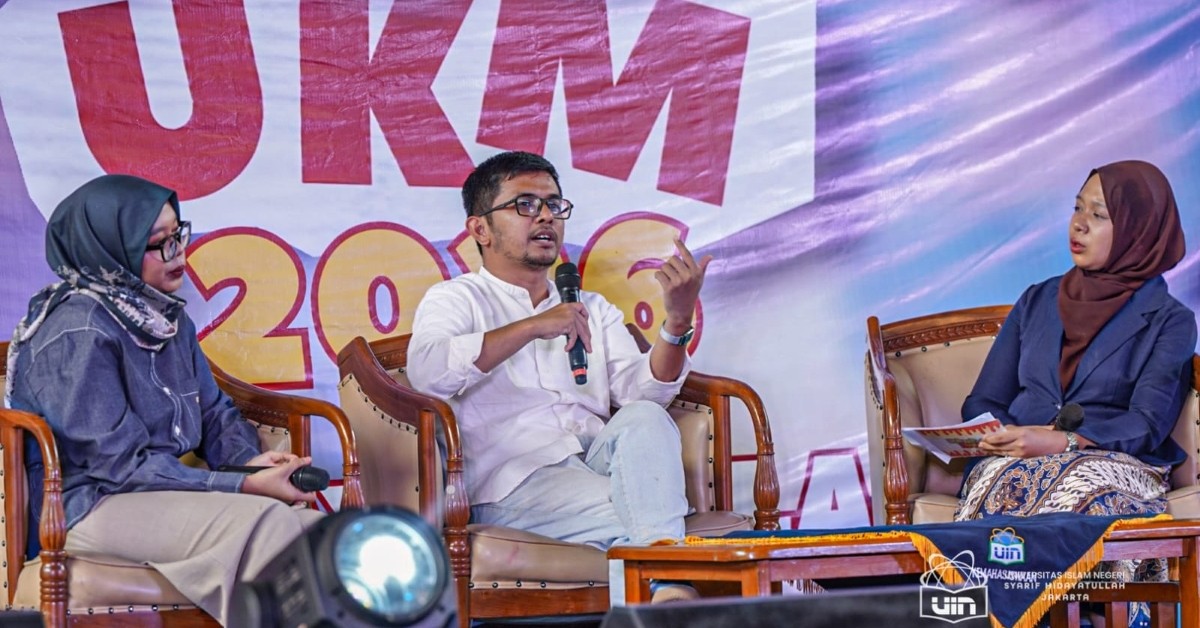
Student Center Field, UIN News Online - UIN Syarif Hidayatullah Jakarta held a talk show titled “The Ecological Crisis Is Not Just News: An In-Depth Discussion on Climate, Environment, and Our Future” as part of the 2026 Student Activity Unit Village (Kampung UKM) series at the UIN Jakarta Student Center Field, Sunday (30/8/2026). The event addressed the importance of critically understanding the climate crisis while encouraging students to get involved in driving environmental change.
The event was attended by Rector of UIN Jakarta, Prof. Asep Saepudin Jahar, M.A., Ph.D.; Vice Rector I for Academic Affairs, Prof. Dr. Ahmad Tholabi, S.Ag., S.H., M.H., M.A.; Vice Rector III for Student Affairs, Prof. Ali Munhanif, M.A., Ph.D.; Head of the Academic Division and Acting Head of the AAKK Bureau, Rahmawati, S.Psi., M.M.; Person in Charge of Kampung UKM, Dr. Fatihunnada, Lc., M.A.; and Chairman of the UKM Forum, Roihan Azkia.
The talk show featured Greenpeace Indonesia Climate and Energy Campaign Manager, Iqbal Damanik, S.I.Kom., M.Si., and Climate Rangers Community Member, Novia Safira Azzahra, S.Hum., moderated by Nabila Filfaberi from UKM FLAT.
In his presentation, Iqbal Damanik emphasized that addressing the climate crisis cannot rely solely on individual behavioral changes. According to him, the public needs to push the government to adopt policies capable of tackling the crisis more broadly and rapidly.
“No matter how much action we take as a society, our actions are actually no larger than what the government can accomplish,” he explained.
He added that simple steps such as reducing excessive consumption and minimizing plastic waste remain essential for the public to take. However, these steps must go hand in hand with urging the government to produce policies that bring real change and overcome dependence on fossil fuels.
Furthermore, Iqbal noted that students hold a strategic position in voicing environmental concerns due to their intellectual legitimacy. According to him, students' voices can inspire the broader public to engage in discussions and monitor climate crisis policies.
“When students speak out, they possess the legitimacy to inspire the wider public to join the conversation,” he stated.
Meanwhile, Novia Safira Azzahra invited students to view the climate crisis and various ecological disasters not merely as individual issues, but as challenges with systemic and structural dimensions. She noted that society needs to be more critical in identifying those who hold significant control and influence over environmental policies.
“We must start questioning and viewing the disasters happening around us as structural problems rather than individual issues,” she remarked.
According to Novia, young people play a crucial role because they are the ones who will live in the future and directly experience the impact of decisions made today. Therefore, students need to build awareness of environmental issues in their surroundings before engaging in broader movements.
She also urged students to shift their perspective on the climate crisis—from merely following news reports to truly understanding the underlying issues. This awareness can then be translated into monitoring policies, holding both the government and extractive industries accountable, and building collective movements.
The talk show was part of the 2026 Kampung UKM series, which introduced various Student Activity Units (UKM) and Autonomous Bodies (LO) within UIN Jakarta, such as LPM Institut, Kalacitra, FLAT, HIQMA, LDK, KMM Riak, Forsa, Scouts (Pramuka), Menwa, Teater Syahid, Marching Band, PSM, FRESH, KPA-ARKADIA, Kopma, KSR-PMI, KMPLHK-RANITA, AIESEC, Formabi-KIP, and others.
Through this event, incoming students were not only introduced to spaces for pursuing their interests and talents, but were also encouraged to critically comprehend environmental issues and play an active role in building a more sustainable future.