Jusuf Kalla Challenges AIUA Rectors to Replace Political Surveys with Advanced Tech Research
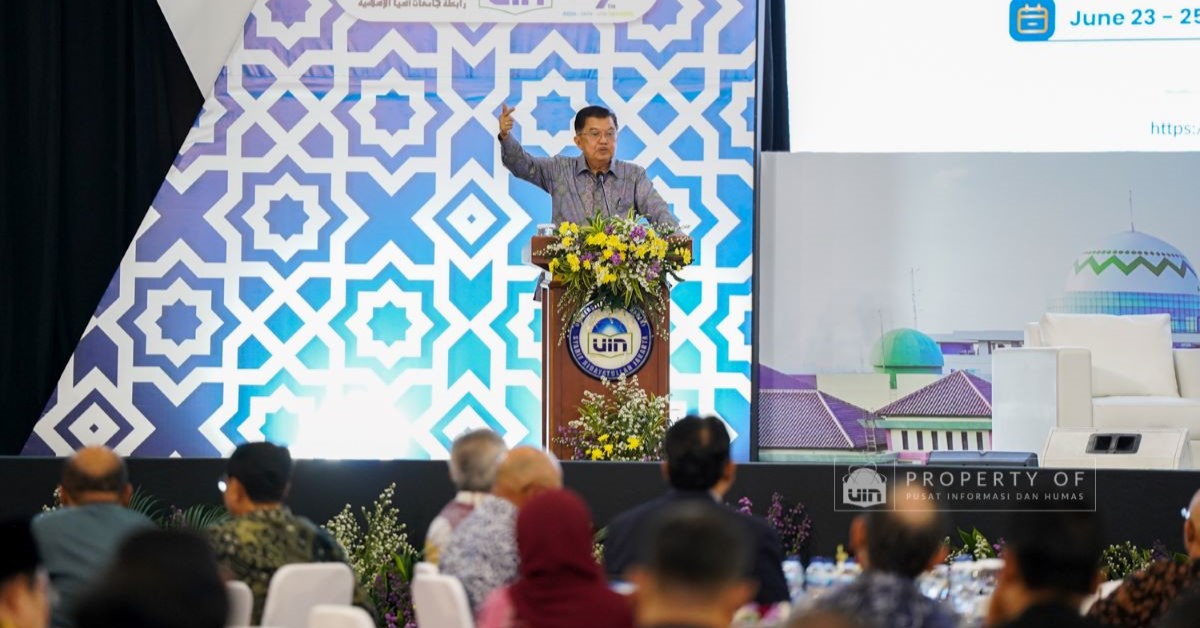
JAKARTA, UIN Online News – In a highly disruptive keynote address at the 15th Asian Islamic Universities Association (AIUA) International Summit, the 10th and 12th Vice President of the Republic of Indonesia, Dr. (H.C.) H. Muhammad Jusuf Kalla, issued a radical critique of modern Islamic academia. Addressing dozens of rectors and policymakers across Asia, Kalla argued that global Islamic resilience can no longer be sustained by theological sentiment alone, but must be anchored by applied technological supremacy and industrial market economics.
The strategic three-day regional consortium ran concurrently from June 23 through June 25, 2026, centering its high-level debates at the Harun Nasution Auditorium in Jakarta. The high-level academic consortium gathered prominent transnational figures, including Thailand’s educational strategist Dr. Shukree Langputeh, the Rector of UIN Sunan Kalijaga Professor Noorhaidi, and the Director General of Islamic Education for the Indonesian Ministry of Religious Affairs, Professor Muhammad Amin Suyitno. The central objective focused on transforming higher education institutions into active hubs for academic diplomacy and conflict resolution.
Delivering his policy paper titled “Islamic Leadership and Peacebuilding in a Fragmented Global Order,” Kalla launched a sharp critique against the current trajectory of State Islamic Universities (UIN) in Indonesia. He openly challenged university presidents, noting that contemporary Islamic campuses have become overly prominent in domestic political commentary and polling metrics while lagging behind in global scientific breakthroughs.
To contextualize his critique, Kalla introduced a powerful geopolitical comparison, highlighting the state resilience of Iran. He argued that Iran’s capability to withstand intense, synchronized pressure from global superpowers like the United States and Israel is not a product of abstract ideological narratives, but a direct result of their deep, autonomous mastery over advanced engineering and defensive military technologies.
Kalla urged modern Islamic institutions to reclaim the empirical scientific culture of historical polymaths like Ibn Sina a.k.a the Avicenna of Persia, emphasizing that modern societal advancement is strictly impossible without prioritizing applied sciences and tech innovation.
During an exclusive doorstop interview with UIN Online News, Kalla was questioned on whether the AIUA consortium must completely restructure its institutional funding, shifting massive capital away from traditional pure theology faculties toward applied science and artificial intelligence laboratories. Kalla asserted that this pivot is a non-negotiable imperative for survival in the modern era.
"This is an absolute necessity, and it applies not just to the AIUA," Kalla stated. "Virtually every Islamic university worldwide must immediately transition to an integrated educational model where theological sciences and applied technology hold equal weight."
Kalla utilized a pragmatic socioeconomic analogy to back his thesis. "Religious institutions only command societal strength when the community is economically advanced," he explained. "If we fail to build robust economic structures through innovation, the operational execution of faith collapses. For example, the paying of zakat (obligatory alms) requires capable, wealthy citizens. If your academic systems do not build successful, wealthy professionals, how can your religious financial systems even function?"
Drawing from his extensive international track record in negotiating peace across regional conflict zones, Kalla challenged the traditional Western-centric media labels applied to post-war nations. He cited groups like the Taliban, arguing that from a localized historical perspective, they were guerrilla fighters defending their sovereign territory against foreign interventions.
For nations recovering from catastrophic warfare, Kalla insisted that the rebuilding of state infrastructure cannot rely on foreign aid, but must be engineered by higher education frameworks.
"Universities must work in tandem with governments and civil societies to focus entirely on two fundamental goals: entrepreneurship and applied technology," Kalla summarized. "That is the only proven matrix for a fractured nation to achieve global advancement."
Concluding his address, Kalla brilliantly reframed his scientific mandate through the lens of classical Islamic eschatology, referencing the famous Rabbana Atina prayer for balanced prosperity. "Our sacred texts demand happiness both in the material world and the afterlife. True advancement in this world is completely unachievable without technological mastery and aggressive entrepreneurship. Only by conquering these material sciences can we successfully secure long-term civilizational prosperity," Kalla concluded.
(Irfan Mufid/Zaenal/Arifin/Photo: Azka Raysa)