
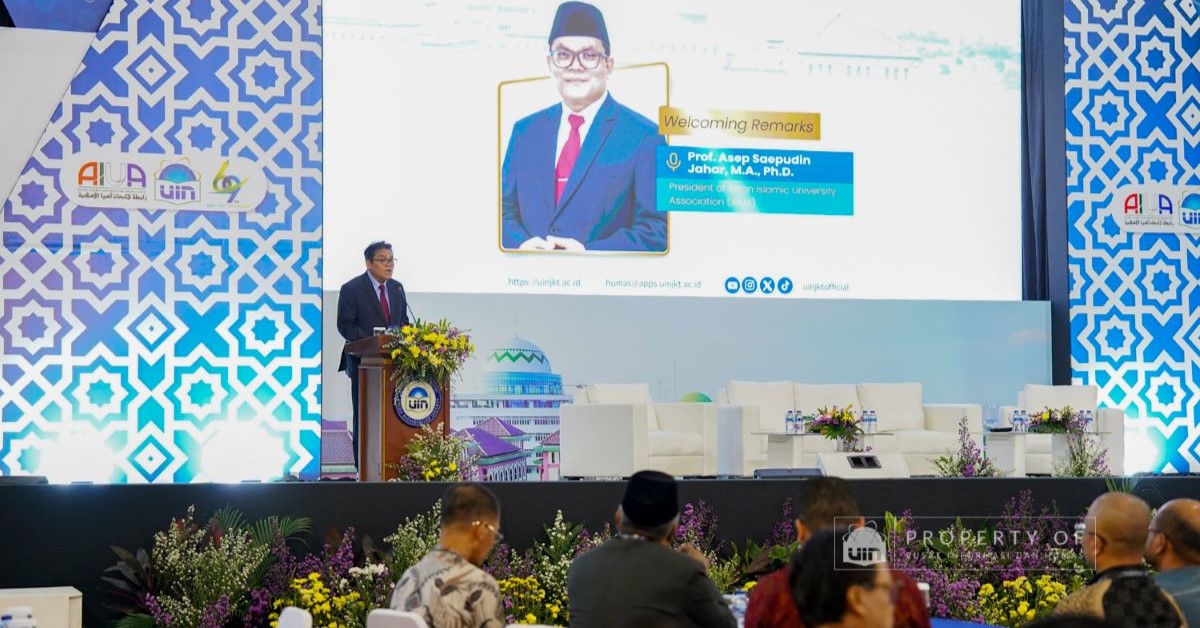
“Islamic Campuses Bear a Deep Moral Accountability for Active Global Justice” says the Rector of UIN Jakarta during AIUA 2026
JAKARTA, UIN Online News – Leading a massive transnational bloc of over 40 Islamic higher education institutions from seven Asian nations, the President of the Asian Islamic Universities Association (AIUA), Professor Asep Saepudin Jahar, Ph.D., officially weaponized academic diplomacy to target active conflict resolution across the ASEAN region. Speaking at the central assembly of the AIUA International Seminar and Annual General Meeting, Jahar mandated that modern universities must step out of traditional isolation and act as direct structural mediators in ongoing geopolitical crises.
Marking a critical evolutionary juncture in mid-June 2026, the three-day (June 23-25 2026) transnational forum took place at the Diorama Room and Harun Nasution Auditorium of UIN Jakarta. These consortium operate under the strategic umbrella “Transforming Islamic Higher Education for Advancing Global Peace, Resilience, and Inclusive Development,” the high-level summit brought together executive delegations from Thailand, the Philippines, Malaysia, Brunei Darussalam, Singapore, and Indonesia.
Rector Jahar, who simultaneously commands the host institution UIN Jakarta, made it explicitly clear that the 15th AIUA assembly completely rejects surface-level academic networking. Instead, the administration is forcing member universities to build synchronized cross-border research pipelines that target highly sensitive territorial disputes.
"We have successfully mobilized the primary network of Islamic higher education boards across ASEAN to lock in collaborative contracts spanning advanced pedagogy, multi-nation research, and grassroots social action," Rector Jahar stated during his executive briefing. "Faced with complex modern warfare and border disputes, this association is actively formulating a unified global declaration. We are outlining exactly how our institutions will deploy intellectual capital to re-engineer regional peace architectures amid terrifying shifting global geopolitics."
The President of AIUA revealed that a core operational goal of the AIUA under his leadership is the institutionalization of a unified, moderate Islamic perspective (Wasathiyah) to act as the legal and ethical foundation for peacebuilding.
"We are building a highly organized, systemic data network allowing researchers and senior faculty to deliver empirical, concrete policy solutions addressing active conflict zones, such as the Pattani region in Southern Thailand and other fractured territories," Jahar explained. "The global scholarship matrix expects Asian higher education to deliver practical blueprints on how to achieve structural, lasting stability."
In a profound philosophical defense of modern university accountability, Rector Jahar drew a sharp line between passive compliance and active intervention. He argued that the moral mandate of an Islamic university is void if it merely documents history instead of shaping it.
“Islamic higher education bears a profound, non-negotiable moral accountability to operate as a hyper-active force for global stability,” Jahar declared. “We strictly reject passive peace, which is defined merely as the temporary absence of active military warfare. True stability is an active framework. It must be aggressively constructed through continuous high-level dialogue, systemic legal justice, absolute societal inclusion, and a deep, unshakeable reverence for cultural diversity.”
Beyond engineering territorial peace frameworks, the 15th general assembly serves as a critical political transition point for the association. The 40 participating university rectors are currently locked in closed-door sessions to draft the corporate leadership roadmap and execute executive structural elections for the AIUA 2026–2028 operational period, permanently securing the association’s competitive global posture.
(Nosa/Zaenal/Arifin/Photo: Azka Raysa)