
Indonesia Islamic Philanthropy Reaches USD 21 Billion as Muslims Shift Toward Sustainable Development Goals
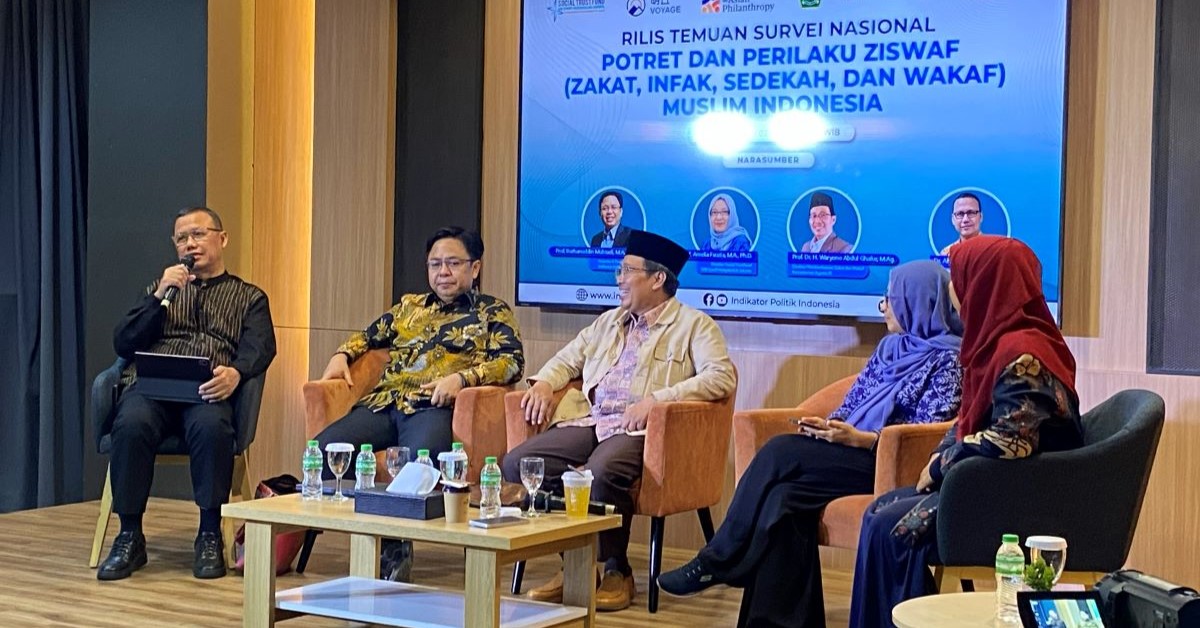
JAKARTA, UIN Online News – Indonesia’s Islamic social finance sector has officially entered a transformative era, pivoting away from traditional short-term charity toward long-term structural development. A comprehensive national survey released by the Social Trust Fund (STF) of UIN Jakarta reveals that the world's largest Muslim-majority population now overwhelmingly views Islamic philanthropy as a strategic vehicle for poverty alleviation, modern healthcare, quality education, and sustainable economic empowerment.
The 2026 National Survey on the Landscape and Behavior of Indonesian Muslim Philanthropy presents one of the most exhaustive data-driven mappings of faith-based giving in over two decades. Surveying 8,360 Muslim respondents across 34 provinces, the study calculation shows that Indonesia’s annual Islamic philanthropic pool—historically encompassing Zakat (alms), Infaq/Sedekah (voluntary charity), Waqf (endowments), and Qurban (ritual sacrifice)—reaches an astounding Rp343 trillion (approximately USD 21.2 billion) per year.
For years, the country’s financial sectors relied heavily on static potential estimates regarding faith-based capital. This new benchmark study provides hard data on how liquid public capital moves in real-time. Voluntary donations (Infaq and Sedekah) make up the largest share at USD 13.7 billion, followed by ritual sacrifice at USD 3.2 billion, permanent social endowments (Waqf) at USD 2 billion, and mandatory asset-alms (Zakat Maal) at USD 1.6 billion.
"For too long, the sector operated under rigid assumptions of potential capital," explained Professor Amelia Fauzia, Ph.D., Director of STF UIN Jakarta and an international expert on Islamic philanthropy. "Our latest empirical findings give us a realistic, modern portrait of the landscape. The core issue in Indonesia is no longer about public participation or a lack of generosity. The urgent challenge lies in institutional governance, data transparency, and structural management to scale these funds for nationwide social impact."
The survey highlighted a powerful public mandates for modernization. An overwhelming 81 percent of respondents explicitly agree that alms capital should be used productively to fund continuous community empowerment programs rather than one-time consumer handouts. The public heavily prioritizes long-term poverty eradication, accessible education, emergency humanitarian aid, and small-business capitalization.
This data is further supported by Professor Burhanuddin Muhtadi, Ph.D., Lead Researcher at Indikator Politik Indonesia, who noted a robust public demand for systematic, data-backed welfare distribution.
However, the path to fully unlocking this multi-billion-dollar ecosystem faces infrastructural roadblocks. The survey revealed that a large majority of transactions are still conducted via cash and traditional offline channels, presenting a massive development opportunity for financial technology (Fintech) developers and global banking systems to spearhead digital transformation and cashless integration.
At the policy level, government regulators see this data as a critical foundation for future legislation. Professor Waryono Abdul Ghafur, Director of Zakat and Waqf Empowerment at the Indonesian Ministry of Religious Affairs, emphasized that the study provides a concrete baseline for creating agile, data-driven public welfare regulations.
As Indonesia marches toward its long-term development targets, this USD 21.2 billion annual asset positions Islamic social finance not merely as a localized religious obligation, but as a sophisticated macro-economic tool capable of independently shielding vulnerable populations from economic shocks, matching the highest benchmarks of international development.
(Press Release of the STF of UIN Jakarta)