
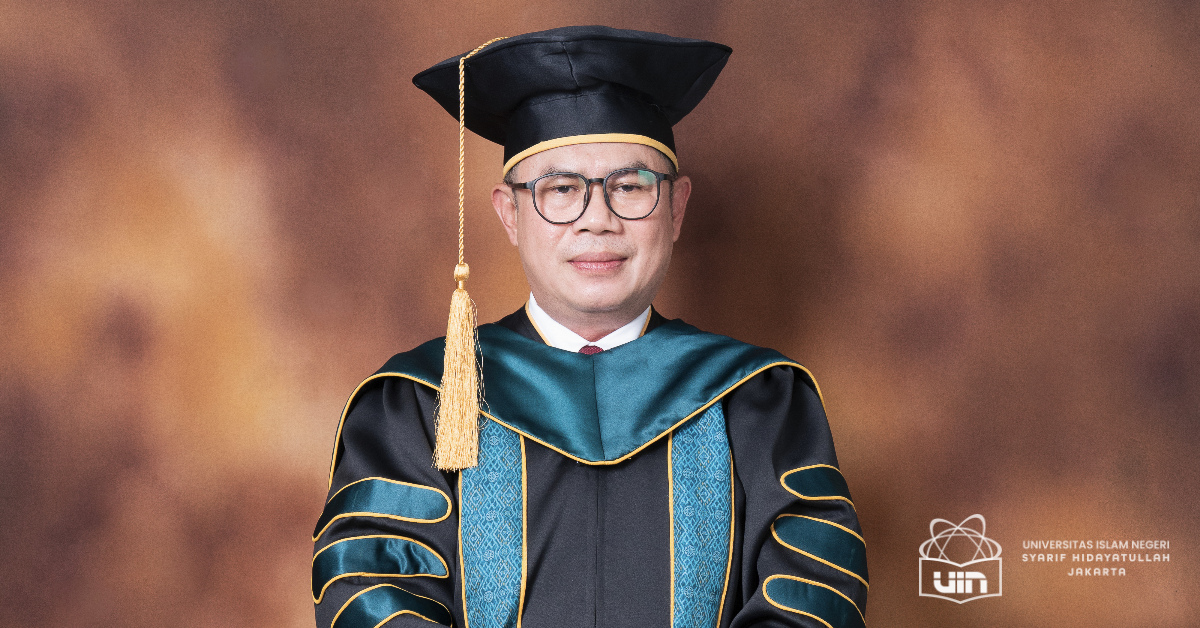
Inauguration of Prof. Dr. Jaenal Aripin: Preserving Substantive Justice and a New Hope for Religious Courts



Harun Nasution Auditorium, UIN News Online – The Open Senate Session of UIN Syarif Hidayatullah Jakarta once again bore witness to the induction of top-tier legal thinkers. In this historic event, thirteen full professors were officially inaugurated. Prominent among them in the field of Islamic Legal Institutions, Prof. Dr. Jaenal Aripin, M.Ag., delivered a professorial address at the Harun Nasution Auditorium on Wednesday (30/09/2026).
For Prof. Dr. Jaenal, every stage of education he completed was not merely a sequence of academic titles. That journey was a space to broaden horizons, shape ways of thinking, and deepen scholarly understanding. From that rigorous process, his intellectual trajectory crystallized, leading him to the pinnacle of academic service. Through this commitment, he dedicated his focus to examining how Islamic law manifests and evolves institutionally within society. Each of his works continuously connects theoretical discourse with the real needs of developing Islamic law in Indonesia.
In his professorial address titled “Reconstructing the Institutional Epistemology of Religious Courts: From the Colonial Regime toward the Unification of Judicial Power,” Prof. Dr. Jaenal delivered his ideas before the academic community and invited guests. This vision did not merely outline a chronological narrative of judicial history; far deeper, it offered a reflection on the intersection between religious authority and state legitimacy.
“Sociologically, religious courts are a living arena where the symbolic capital of religion—namely divine authority and morality—dialectically engages, negotiates, and fuses with the coercive power of the state. It is the most tangible meeting space where law, religion, state, society, and the ideal of justice intertwine,” he stated.
Through his address, Prof. Dr. Jaenal emphasized that religious courts allow the public to observe precisely how Indonesia manages legal plurality without abandoning the framework of a constitutional state governed by the rule of law. He noted that the survival of religious courts in Indonesia is not due to political leniency, but because they are deeply rooted in the legal culture and social needs of Indonesian Muslim society.
“The history of religious courts is a narrative of institutional resilience. It is rooted in the values of Islamic justice alive within society. Having been strongly institutionalized through balcony courts (peradilan serambi) during the sultanate era, subjected to discriminatory treatment and jurisdictional reductions during the colonial era, it eventually rose to achieve affirmation as an equal pillar in the unification of judicial power in Indonesia,” he expressed.
However, behind the milestone of judicial unification under the Supreme Court and modern e-Court digitalization, Prof. Dr. Jaenal offered a poignant note, reminding that courts must not fall into rigid legal formalism. Prof. Dr. Jaenal also stressed the importance of reforming the institution's overarching perspective.
“Institutional epistemology is the method of understanding the source of legitimacy, operation, and orientation of a legal institution. This reconstruction demands that we abandon colonial perspectives that relegated religious courts to marginal institutions. Instead, this body must be affirmed as a constitutional entity fulfilling a vital function in law enforcement, rights protection, and the actualization of justice for the public,” he explained.
As the culmination of his extensive research, Prof. Dr. Jaenal formulated five directions for reconstructing religious courts: affirming constitutional equality within the judicial system, prioritizing substantive justice over formal procedures, focusing on accessibility for justice seekers, expanding transdisciplinary competence into Islamic economics, and transforming the institution from a procedural bureaucracy into a knowledge-based institution.
“First, moving from subordination toward constitutional equality within the judicial system. Second, from formalism toward substantive justice that does not revere procedure as the sole measure of success. Third, from institutional centrality toward centrality for justice seekers through accessible and affordable mechanisms. Fourth, moving from traditional competencies to transdisciplinary competencies alongside the expansion of Islamic economics. Finally, fifth, shifting from a procedural institution into a knowledge-based institution that functions beyond a mere bureaucratic machine,” he elaborated.
Ultimately, his presentation affirmed that these five directions of reconstruction are closely interconnected.
“These five directions do not stand in isolation; rather, they are woven into a grand national project: elevating religious courts from a position systematically diminished by colonialism into a legally equal, substantively just, user-centric, transdisciplinary, and knowledge-grounded judicial body. This is the essence of reconstructing the institutional epistemology of religious courts,” he explained.
The full body of Prof. Jaenal's scholarly work marks his intellectual journey in examining Islamic law and its institutions. This series of works forms an integral part of the academic contributions that led him to the highest rank as Full Professor at UIN Jakarta.
This intellectual journey, forged within academic halls, found tangible application in governance and administrative spheres. That experience brought together deep academic analysis with practical sensitivity to public service. At that intersection, his scholarly work extends beyond theoretical discourse on paper to deliver concrete solutions for justice in Indonesia.