
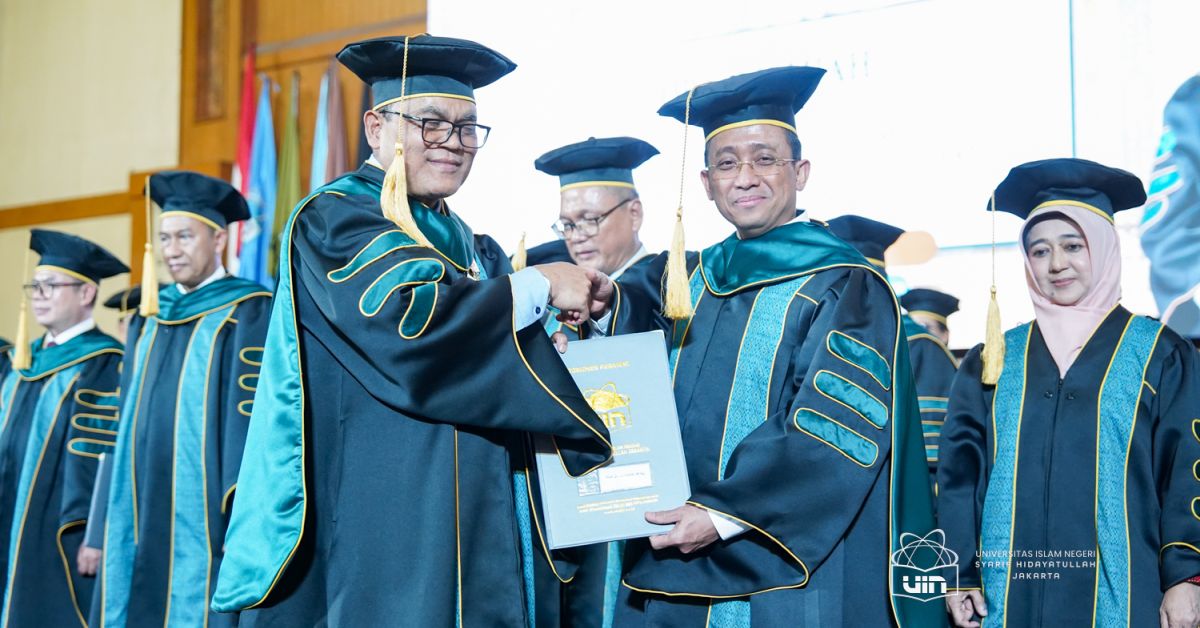
Inaugurated as UIN Jakarta Professor, Prof. Suwendi Advocates Educational Equity for Pesantren



Harun Nasution Auditorium, UIN News Online – Long before the establishment of the national formal education system, Islamic boarding schools (pesantren) had grown into Islamic educational institutions with distinct scholarly traditions, pedagogical models, and social dynamics. However, this long historical journey did not automatically guarantee equal recognition for pesantren within state education policy.
This core issue formed the focal point for Prof. Dr. Suwendi, M.Ag., Full Professor of Islamic Educational Thought at UIN Syarif Hidayatullah Jakarta. In his professorial address titled “From Subculture to State Recognition: The Transformation of Pesantren within the National Education System Architecture,” he stressed that state recognition of pesantren must not stop at legal acknowledgment, but needs to be realized through equitable educational support without eroding the distinct character of pesantren. This vision was presented during the Open Senate Session for the Professorial Inauguration at UIN Jakarta in the Harun Nasution Auditorium on Wednesday (30/09/2026).
Historically, the relationship between pesantren and the state has not always been seamless. In his address, Prof. Suwendi outlined how colonial educational policies actively restricted educational institutions operating outside the government's formal system. Following Indonesia's independence, state recognition of pesantren evolved through a lengthy process. Law Number 20 of 2003 on the National Education System explicitly included pesantren as part of the national education system, paving the way for Law Number 18 of 2019 to emerge as a vital milestone in granting formal recognition to the institution.
Nevertheless, Prof. Suwendi argued, legal recognition within statutory regulations does not automatically resolve underlying issues of equity. Statutory acknowledgment must be accompanied by proportional financial and institutional backing so that pesantren possess equal opportunities to execute their educational function.
“Legal recognition without commensurate support in the financial and institutional domains risks leaving behind misrecognition,” he noted.
To explain the relationship between recognition and equity, Prof. Suwendi drew upon the theory of recognition developed by German philosopher and sociologist Axel Honneth. Within this framework, recognition entails not only the fulfillment of legal rights, but also social esteem for a group's existence and contributions.
“In the context of pesantren, this concept implies that it is insufficient for the state to recognize pesantren solely through regulations. The state must also provide the necessary support that enables pesantren to fulfill their educational function while preserving their institutional identity,” he explained.
Among the key policy proposals offered by Prof. Suwendi to foster educational equity is the principle of “one house, many rooms.” Through this metaphor, he described the national education system as a single house sheltering diverse forms of education. Each form of education maintains its unique characteristics while remaining an integral part of the same unified structure.
This principle rejects the notion that all educational institutions must adopt uniform structures, curricula, and governance models to attain state recognition. Pesantren, with their rich traditions and pedagogical systems, should not be required to conform to standard general school or madrasah curricula simply to be deemed equal.
“No single room is more legitimate than another, just as no form of education is inherently more valid than another,” stated Prof. Suwendi.
This concept translates into several concrete policy approaches. One concerns Gross Enrollment Ratios (GER), which measure population participation across specific educational levels. Prof. Suwendi emphasized the importance of formally factoring pesantren education pathways into overarching national education policies, including targeted financial allocation and institutional strengthening.
He also highlighted the principle of multi-entry multi-exit, which grants students flexibility to transition across different educational tracks in accordance with applicable standards. Under this framework, graduates of formal pesantren education ought to enjoy seamless opportunities to pursue higher educational levels, including across different types of institutions.
Prof. Suwendi's deep commitment to pesantren is an organic reflection of his own educational journey. From 1990 to 1993, he undertook his pesantren education at Raudlatuth Thalibin in Babakan, Cirebon, followed by Pesantren Luhur Sabilussalam in Ciputat from 1994 to 1997, and in 1988 at Pesantren Al-Fatah in Wotbogor, Indramayu. This experience across three distinct pesantren afforded him firsthand familiarity with pesantren scholarly traditions and daily life.
Concurrently, his formal academic trajectory led him to deeply examine Islamic educational thought. After graduating from MAN Babakan Ciwaringin, Cirebon, in 1993, he pursued higher education at UIN Syarif Hidayatullah Jakarta, earning his Bachelor's degree in 1998, Master's degree in 2000, and Doctorate in 2008.
His research focus demonstrates a sustained thematic continuity in Islamic educational thought. His undergraduate thesis analyzed Ibn Jama'ah's concept of Islamic education, while his Master's thesis presented a comparative study between the thought of Ibn Jama'ah and KH. M. Hasyim Asy'ari. At the doctoral level, he investigated the concept and practice of Islamization of knowledge according to Syed Muhammad Naquib al-Attas.
This synthesis of pesantren immersion and rigorous academic research subsequently positioned him as a prominent scholar and policymaker. From 2011 to 2023, Prof. Suwendi served for 13 years at the Ministry of Religious Affairs of the Republic of Indonesia, actively participating in drafting key strategic regulations on Islamic religious education and pesantren, including the formulation of Law Number 18 of 2019 on Pesantren.
This career path naturally informed his advocacy for state recognition of pesantren. For him, pesantren are not merely objects of academic inquiry, but an educational environment he lived through and a policy domain he engaged with directly.
In his view, the transformation of pesantren toward full state recognition should never be interpreted as an assimilation process that dissolves pesantren into a standardized, homogenous education system. Rather, recognition must guarantee that pesantren can flourish as an integral component of national education while safeguarding their cultural autonomy.
“The transformation of pesantren from subculture to state recognition is not intended to erode the essence and core identity of pesantren,” he asserted.
Prof. Suwendi's vision anchors the future of pesantren upon two principles that must advance hand in hand: structural equity within the national education system and the sustained preservation of pesantren identity. These two imperatives need not be in conflict. Pesantren can attain equal support and educational opportunities without relinquishing the scholarly traditions and character that define them.
Watch the complete proceeding of the Open Senate Session for the Professorial Inauguration on UIN Syarif Hidayatullah Jakarta's official YouTube channel: