
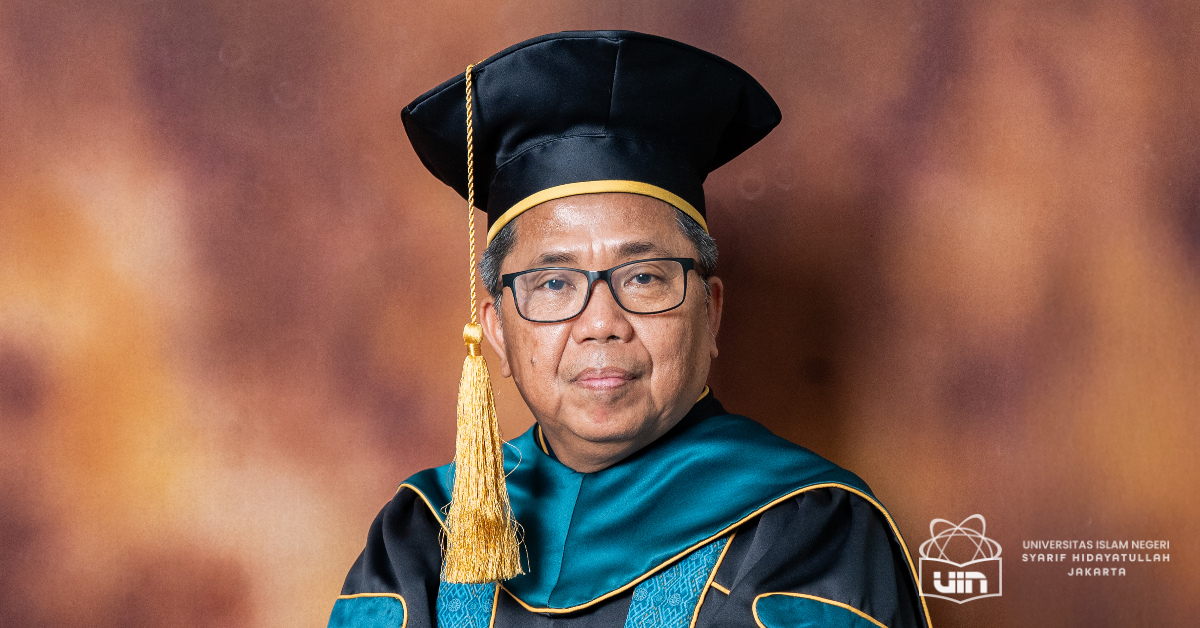
Inaugurated as Professor of Political Science, Prof. Idris Thaha Emphasizes Religion as an Ethical Foundation in Politics



Harun Nasution Auditorium, UIN News Online - When religion enters the political arena, the core issue is not simply whether religion and politics ought to meet, but rather how religious values are translated, who channels them, and for whose interests those values are mobilized. This crucial question formed the centerpiece of Prof. Dr. Idris Thaha, M.Si.'s professorial address titled “Religion in the Arena of Power: Values, Actors, and Accommodation (Political Experiences in Indonesia),” delivered during the Open Senate Session for the Professorial Inauguration at UIN Syarif Hidayatullah Jakarta in the Harun Nasution Auditorium on Wednesday (30/09/2026). On this momentous occasion, Prof. Idris was officially inaugurated as Full Professor of Religion and Politics alongside twelve other newly distinguished professors.
In his address, Prof. Idris positioned religion not merely as a set of doctrines, but as a foundational source of ethics in political life. In his view, religion offers a vocabulary to articulate concepts of justice, public trust (amanah), deliberation, responsibility, public good (maslahah), solidarity, and human dignity.
Consequently, he stressed the necessity of examining the relationship between religion and politics as an empirical reality rather than solely a normative proposition. “A far more essential question is: How does religion function within politics?” he noted. According to him, scholarship must observe how religious values translate into action, how authority converts into legitimacy, and how organizational identities operate as political forces.
This perspective aligns seamlessly with Prof. Idris's academic trajectory, which bridges Islamic education and political science. After undergoing education at Tarbiyatul Mu’allimin Al-Islamiah (TMI) Pondok Pesantren Al-Amien Prenduan in Sumenep, he earned his Bachelor's degree in Islamic Theology and Philosophy at IAIN Syarif Hidayatullah Jakarta in 1993. He subsequently completed his Master's degree in Political Science at Universitas Indonesia in 2004, followed by his Doctorate in Islamic Political Thought at UIN Jakarta in 2018. His doctoral dissertation, titled “PDI Perjuangan and Islam: A Study on the Accommodation of Islam in Politics,” was subsequently published as a book titled Islam and PDI Perjuangan: Accommodating the Political Aspirations of the Ummah in 2018.
Through this research, Prof. Idris demonstrated that religion does not always enter the political arena exclusively under an overt religious identity. In the case of PDI Perjuangan, he identified a nuanced accommodation of Islamic aspirations across organizational structures, formal institutions, party elites, activities, and policy decisions. These findings led him to understand that the dynamic between religion and politics operates through multi-layered institutional channels and inter-actor relationships.
However, the involvement of religion in politics also poses deep ethical challenges when religious values are reduced to mere instruments of power. Prof. Idris warned that religious symbols, clerical authority, and grassroots networks are often co-opted to secure political support, only for the ethical voice of religion to be sidelined when power faces constructive criticism. He illustrated this vulnerability through the metaphor of religion being treated merely as a rubber stamp for political authority.
“My fundamental question is this: why is religion so readily used as a source of political legitimacy, yet so rarely permitted to serve as a source of moral correction?” Prof. Idris posed.
For Prof. Idris, religion must not exist in politics as symbolic ornamentation alone. Its presence must be evaluated by its tangible impact on citizens' lives—including social justice, public service quality, institutional accountability, civil rights protection, and general welfare. Therefore, religion must maintain autonomous space to deliver moral critique, while political power must remain open to scrutiny regarding claims made in the name of faith.
Ultimately, Prof. Idris's intellectual journey—from pesantren roots and Islamic philosophy to political science—converges on the conviction that politics inherently demands an ethical foundation to keep state power oriented toward human dignity. In his formulation, religion is not meant to conquer or replace politics, but to serve as a vital source of moral guidance for political life, democracy, and the exercise of power.
“My ultimate hope for religion, politics, democracy, and academic scholarship is clear: Knowledge must liberate humanity from ignorance; democracy must liberate humanity from domination; and religion must serve as the source of values that elevate human dignity,” he asserted.
Watch the complete proceeding of the Open Senate Session for the Professorial Inauguration on UIN Syarif Hidayatullah Jakarta's official YouTube channel: