
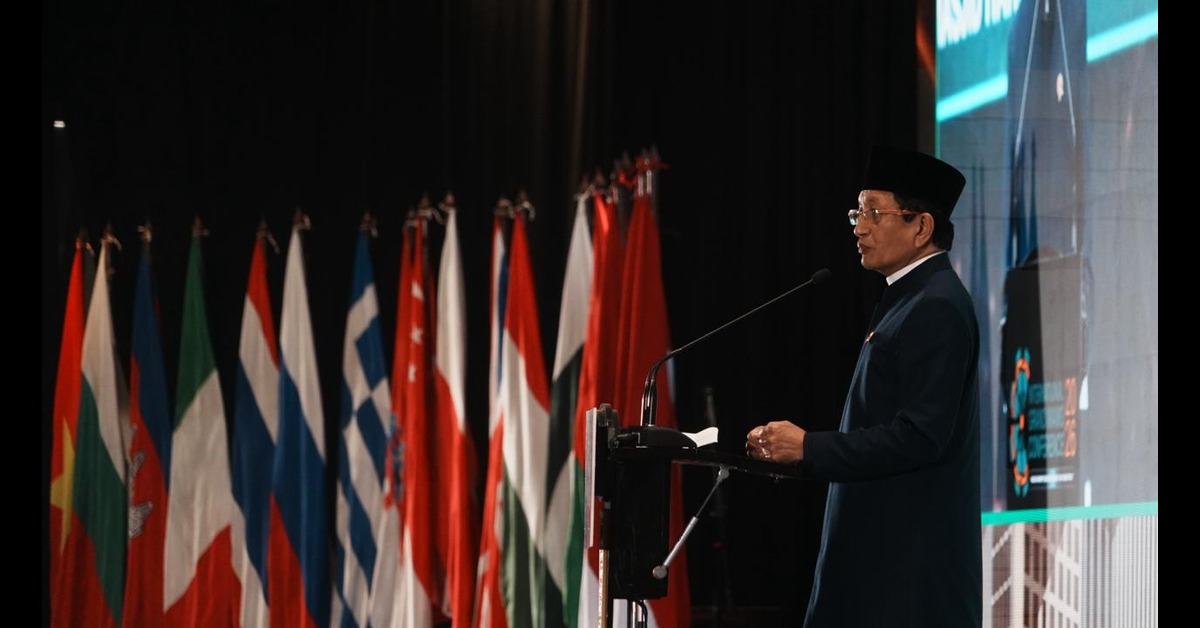
IGIC 2026 Elects Nasaruddin Umar as President of IAMI and Yields the Jakarta Understanding
Jakarta - The 2026 International Grand Imams Conference (IGIC) agreed to establish The International Assembly of Mosque Imams (IAMI). Minister of Religious Affairs, who also serves as the Grand Imam of Istiqlal Mosque, Nasaruddin Umar, was entrusted with the mandate as its first President. IGIC 2026 also yielded a collective agreement titled the “Jakarta Understanding.”
IGIC 2026 took place from September 25 to 27 in Jakarta. The event was attended by participants from various regions worldwide. The grand imam of Europe's largest mosque in Rome, known for his close relationship with the Pope, was in attendance. Latin America was represented by Argentina, followed by Scandinavian nations, France, and the United Kingdom. From Asia came representatives from Uzbekistan, Pakistan, and India, while Malaysia actively represented Southeast Asia. Domestically, the entire leadership of the Mosque Imams Brotherhood Association (IPIM) along with grand imams from every province also participated.
The election of Minister of Religious Affairs Nasaruddin Umar as President of IAMI was warmly welcomed by the grand imams, muftis, and state delegates present at IGIC 2026. The Minister expressed his hopes for support from global grand imams in fulfilling this trust. He affirmed his determination to carry out his duties effectively and expressed readiness to dedicate his service, energy, intellect, and time for the benefit of the ummah.
"I feel unworthy to be chosen as the leader of the grand imams; I fear disappointing the expectations from this assembly. Therefore, if it is indeed His will to choose me as leader, I hope you can understand my shortcomings and assist me in overcoming them," he expressed in Jakarta, Sunday (27/9/2026).
The Minister extended his gratitude for the trust bestowed upon him. He also conveyed his hope that the world's grand imams would support him in executing this mandate.
The Minister emphasized that mosques must return to playing a strategic role in societal life. According to him, mosques should not merely be viewed as places of worship, but must also function as spaces that empower the ummah, bring communities together, and deliver tangible benefits for humanity.
“We must transform the mosque. Up until now, the congregation has been empowering the mosque, but we must reverse this—it is the mosque that must empower the congregation,” stated the Minister.
The Minister explained that the function of the mosque during the era of the Prophet Muhammad (PBUH) was not limited to ritual worship. Mosques also served as centers for education, community empowerment, consultation, assemblies, and spaces to connect diverse social strata.
“A mosque is not just a place, but a center for community empowerment; it served as the state secretariat, the secretariat for imam empowerment, and the Baitul Mal in its era,” he asserted.
Getting to Know IAMI
IAMI was established in response to extensive input from various imams, muftis, and delegates representing 46 countries at the IGIC 2026 forum. IAMI is an international organization that positions mosques not merely as places of worship, but as hubs for education, community development, social solidarity, moral guidance, and peacebuilding.
Imams currently face massive challenges, including religious intolerance, social fragmentation, environmental crises, youth issues, poverty, misinformation, humanitarian crises, and the imperative for constructive interfaith and international dialogue. IAMI, known in Indonesian as Majelis Grand Imam Internasional, serves as a permanent international platform. Through this assembly, recognized imams and religious leaders can exchange knowledge, strengthen cooperation, promote peaceful religious discourse, and contribute to the well-being of humanity.
IAMI's vision is to become the premier global platform uniting imams in promoting harmonious communities, responsible religious leadership, human dignity, and lasting peace. The President will act as the primary representative of IAMI, with responsibilities including: representing IAMI internationally; chairing the Supreme Council; leading international diplomatic and religious engagement; promoting the assembly's mission; and coordinating with major international religious institutions. The President's term of office is three years, renewable once.
IAMI is structured around five strategic pillars and programs: Mosque Harmony, Imam Leadership, Religious Diplomacy, Global Peace and Humanitarian Action, and Sustainable Mosques and Communities. IAMI is headquartered in Jakarta as its permanent secretariat and administrative center. Meanwhile, IAMI regional offices are located in Kuala Lumpur (Asia), Cairo (Middle East), Nairobi (Africa), London (Europe), New York (North America), Rio de Janeiro (South America), and Canberra (Australia and Pacific).
IAMI will host monthly virtual gatherings of global grand imams to collectively address issues facing the ummah. The Minister hopes that in subsequent phases, organizers can invite leaders of other places of worship, such as churches, synagogues, and temples, to discuss humanitarian and environmental challenges.
"We will not engage in practical politics or matters that disrupt mutual comfort, but rather align our perspectives that humanity is one. We follow the example of Prophet Muhammad (PBUH), who during his lifetime was able to bridge all differences so that conflicts vanished," he said.
Jakarta Understanding
In addition to establishing the assembly and electing IAMI's President, IGIC 2026 produced the “Jakarta Understanding.” This declaration outlines several points of consensus positioning imams as key actors in religious diplomacy.
“Through the Jakarta Understanding, the Grand Imams convey the message that peace is a shared responsibility of all humanity, and that mosques can serve as bridges connecting differences,” the Minister stated.
“The Jakarta Understanding also highlights that religious diplomacy can reinforce international diplomacy between nations, while affirming full support for the rights of the Palestinian people,” he added.
Below is the complete text of the Jakarta Understanding delivered at the closing of IGIC 2026:
JAKARTA UNDERSTANDING
On Mosque Harmony, Religious Diplomacy, and Global Peace
International Grand Imams Conference (IGIC) 2026 Jakarta, Indonesia
From Jakarta, Indonesia, we, the Grand Imams, convey a message to the global community that peace is a shared responsibility of humanity; that mosques can serve as bridges connecting differences; that religious diplomacy can strengthen international diplomacy between nations; and that a peaceful global future can only be built through a spirit of humanity and brotherhood that transcends national, cultural, and religious boundaries. Therefore, we, the Grand Imams from around the world, call upon all Mosque Imams:
1. to carry out strategic roles, not only as leaders of worship, but also as conflict mediators, unifiers of diversity, and moral guides for society. Mosque imams must also actively transform religious institutions into open, inclusive community spaces oriented toward humanity and civilization.
2. to act as driving agents of global peace committed to protecting human dignity regardless of ethnic background, religion, nationality, or gender. Mosque imams must also pioneer character education, instilling values of moderation, tolerance, love, compassion, and respect for differences, while strengthening digital literacy.
3. to champion social justice and guarantee the protection of human rights by creating safe, fair, and welcoming environments for children, women, persons with disabilities, minorities, and other vulnerable groups, while supporting family resilience.
4. to mobilize religious diplomacy and interfaith dialogue to prevent conflict, build mutual trust, and strengthen global reconciliation. Mosque imams should also stand on the front lines in rejecting all forms of extremism and violence, misuse of religion, hoaxes, and hate speech.
5. to affirm a shared commitment toward building eco-theological awareness, preserving the balance of nature, halting environmental destruction, and encouraging mosques and religious communities to become pioneers of Earth's sustainability for future generations.
6. to engage in global-scale collaboration with international bodies, governments, and civil society to realize a just, dignified, and peaceful world for all humanity.
7. to affirm full support for the rights of the Palestinian people to self-determination, the protection of civilians, the enforcement of international law, and the realization of independence, justice, peace, and sustainable dignity for Palestine. Jakarta, Indonesia, September 27, 2026. (Bureau of Public Relations and Public Communication of the Ministry of Religious Affairs/PIH UIN Jakarta)