How AIUA 2026 Liberates Asian Universities from Western Accreditation Monopolies with the AICA Framework
JAKARTA, UIN Online News – The second executive session of the 15th Asian Islamic Universities Association (AIUA) International Symposium transitioned into a high-stakes critique of global university governance and curriculum resilience. Bringing together premier institutional architects from Brunei, Malaysia, and Indonesia, the panel interrogated the severe structural tensions between maintaining Islamic theological identity, satisfying neoliberal global ranking metrics, and fighting corrupt administrative architectures.
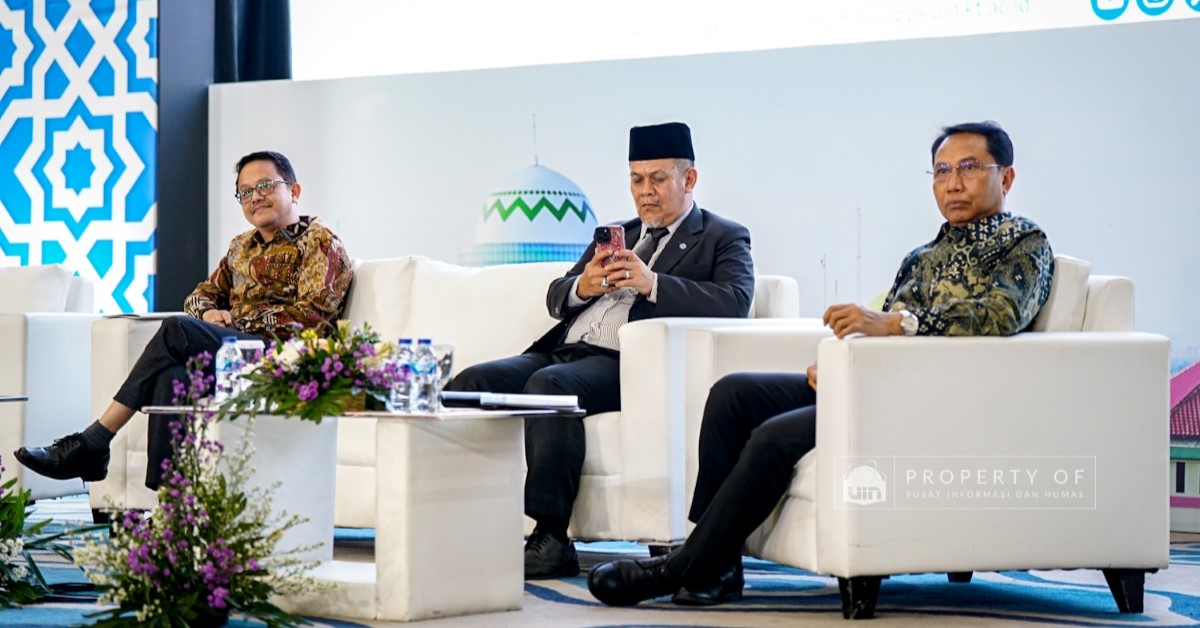
The executive panels and legislative sessions convened simultaneously at the Harun Nasution Auditorium and the Diorama Room of UIN Jakarta between June 23 and June 25, 2026. The panel of experts featured the Director of Research and Internationalization at Universiti Islam Sultan Sharif Ali (UNISSA) Brunei, Dr. Haji Hambali; the Vice Chancellor of Universiti Sultan Azlan Shah (USAS) Malaysia, Professor Dato’ Dr. Wan Sabri Bin Wan Yusof; and the former AIUA President who currently serves as the Director of the Graduate School at UIN Antasari Indonesia, Professor Mujiburrahman.
Delivering a highly critical institutional analysis, the former AIUA President Professor Mujiburrahman forced the assembly of rectors to confront the political economy of modern higher education. He utilized the renowned academic governance framework developed by political scientist Andrew Rosser to map out the three conflicting interest groups battling for control over Indonesian and Asian university ecosystems.
The first is the Neoliberal faction, which aggressively forces universities to focus on corporate economic efficiency, market commodification, and commercial global ranking matrices. The second is the Idealist faction, which fiercely champions pure intellectual development, human rights defense, and treats higher education as an unassailable public good. The third and most dangerous is the Predatory faction, consisting of entrenched bureaucratic actors who manipulate institutional budgets and regulatory controls for corrupt, self-serving interests.
"We must realistically audit our positions within Rosser’s matrix," Professor Mujiburrahman argued passionately. "If we can systematically align our Idealist scholars with robust good governance protocols to directly crush these predatory actors, we will successfully forge the institutional strength to transform ourselves before we even attempt to transform the global order."
Providing an operational counter-strategy, Brunei’s Dr. Haji Hambali outlined a comprehensive transformation roadmap based on bulletproof corporate governance. He argued that modern Islamic campuses must execute a delicate balancing act, absorbing technological innovation and global market relevance without liquidating their theological foundations.
Dr. Hambali detailed the four core values that UNISSA structurally injects into its student body and faculty culture, which are deep knowledge acquisition, ethical leadership, spiritual piety, and visionary foresight.
"Our institutional aspiration completely bypasses the basic manufacturing of work-ready graduates," Dr. Hambali asserted. "We are strictly in the business of engineering visionary leaders who possess the moral and intellectual capacity to direct positive structural changes within global civil society."
Reinforcing the mandate for collective resistance against predatory and isolating educational systems, Malaysian Vice Chancellor Professor Wan Sabri Bin Wan Yusof stated that individual universities are completely defenseless when operating alone in the global market. He demanded the immediate mobilization of the AIUA’s combined network of 90 Asian Islamic universities to act as a unified geopolitical force.
Professor Wan Sabri heavily praised the institutionalization of the AIUA Quality Assurance (AICA) framework, an independent quality assurance system originally initiated in Yogyakarta. The long-term strategic goal is to transform AICA into a premier, self-sustaining international accreditation board that sets its own benchmarks, independent of Western-centric evaluation monopolies.
"If you attempt to navigate these disruptive global tides alone, your institution will be swept away," Professor Wan Sabri warned. "But if you move collectively with 90 universities acting as a single synchronized bloc, we instantly become an unstoppable power to be reckoned with on the international stage."
The executive panel concluded with a unanimous consensus, the future survival of Islamic higher education relies entirely on a university's ability to construct a harmonious loop connecting timeless Islamic ethics, transparent institutional governance, and aggressive technological innovation through permanent regional alliances.
(Khoirillah/Zaenal/Arifin/Photo: Azka Raysa)