
Global Geopolitical Impacts: FISIP UIN Jakarta Seminar Highlights the Urgency of National Maritime Sovereignty


Prof. Bahtiar Effendy Auditorium, UIN News Online – The Faculty of Social and Political Sciences (FISIP) at UIN Syarif Hidayatullah Jakarta hosted a public lecture titled "Building Indonesia's Maritime Security in Facing Contemporary Global Uncertainty." This educational event aimed to examine national maritime defense strategies amidst the dynamics of geopolitical competition among great powers. It was held at the Prof. Bahtiar Effendy Auditorium on Tuesday (22/09/2026).
The event was attended by Vice Rector for Student Affairs of UIN Jakarta, Prof. Ali Munhanif, M.A., Ph.D.; Dean of FISIP UIN Jakarta, Prof. Dr. Dzuriyatun Toyibah, M.Si., M.A.; and Vice Dean I of FISIP UIN Jakarta, Dr. Iding Rasyidin, M.Si. Also present were Head of the International Relations Study Program at FISIP UIN Jakarta, Robi Sugara, M.Sc.; course lecturer and moderator Dr. Rahmi Fitriyanti, S.Sos., M.Si.; faculty members; and active FISIP UIN Jakarta students from the third, fifth, and seventh semesters. The public lecture featured Keynote Speaker Admiral (Ret.) Prof. Dr. Marsetio, M.M., who currently serves as Advisor to the Governor of the Riau Islands.
Opening the discussion, Prof. Ali highlighted the importance of maritime security discourse, which has once again become critical due to the phenomenon of Great Power Rivalry. According to him, the emergence of a new world order following that era has not produced a more orderly global framework, but rather triggered new anxieties driven by sphere-of-influence competition among major powers such as the United States, China, and Russia.
“It is very timely to analyze—even from the American perspective—how the Strait of Hormuz, which was originally international, has turned into a defense zone. We in Indonesia have the Strait of Malacca, which I believe could very likely become our defense zone within the context of national defense if a major conflict breaks out,” Ali expressed.
Extending those strategic perspectives, Prof. Dzuriyatun offered appreciation for the presence of a maritime expert within the faculty. She noted that the presence of the former military leader would provide a broader, valuable, and realistic perspective for the academic community studying political science and international relations.
“I extend a warm welcome to Prof. Dr. Marsetio. Thank you to Admiral (Ret.) Prof. Dr. Marsetio, M.M., for taking the time to attend,” Dzuriyatun welcomed.
Entering the presentation session, Prof. Marsetio raised awareness among participants by emphasizing that students hold a central role in driving future governance. He highlighted Indonesia's geopolitical location between two continents and two oceans, making it a major maritime nation and a global maritime fulcrum.
"Out of nine global chokepoints, four are located in Indonesia," Marsetio explained. He detailed these four vital choke points for global logistics: the Strait of Malacca, ALKI I (Sunda Strait, South China Sea), ALKI II (Lombok Strait, Makassar Strait, Sulawesi Sea), and ALKI III (Ombai Strait, Banda Sea, Maluku Sea).
During his presentation, Marsetio interactively called on several students at random to answer questions regarding the definition of the United Nations Convention on the Law of the Sea (UNCLOS) and the concept of the Indo-Pacific region. Marsetio then reiterated to the audience that Indonesia's maritime standing conforms to UNCLOS regulations, which were officially ratified through Law Number 17 of 1985.
Moving into the Q&A session, enthusiasm peaked as students raised critical questions concerning ALKI security strategies following Middle Eastern crises. Responding to this, Marsetio illustrated vulnerabilities stemming from energy supply route blockades.
“A blockade in the Strait of Hormuz impacts 22% of global oil logistics. As a result, fuel prices in our country, which were pegged in the state budget at US$70 per barrel, have now reached US$106, and even touched US$130 per barrel. Therefore, we must remain vigilant and prevent any blockade from ever occurring in the Strait of Malacca,” he emphasized.
He further asserted that defense relies on the strength of the people, society, and nation in fully understanding their country's strategic position. This line of thought aligns with the fourth Asta Cita priority of the current administration, which emphasizes that Indonesia can only advance when driven by intelligent, high-quality human resources.
“I encourage students not to be shy about asking questions, to keep learning, and to innovate. If you want to advance and become smart, quickly grasp the utilization of AI (Artificial Intelligence). Anything you want to create with AI is possible. Thus it depends on the students—we must not lose the competitive edge to other youth,” Marsetio advised.
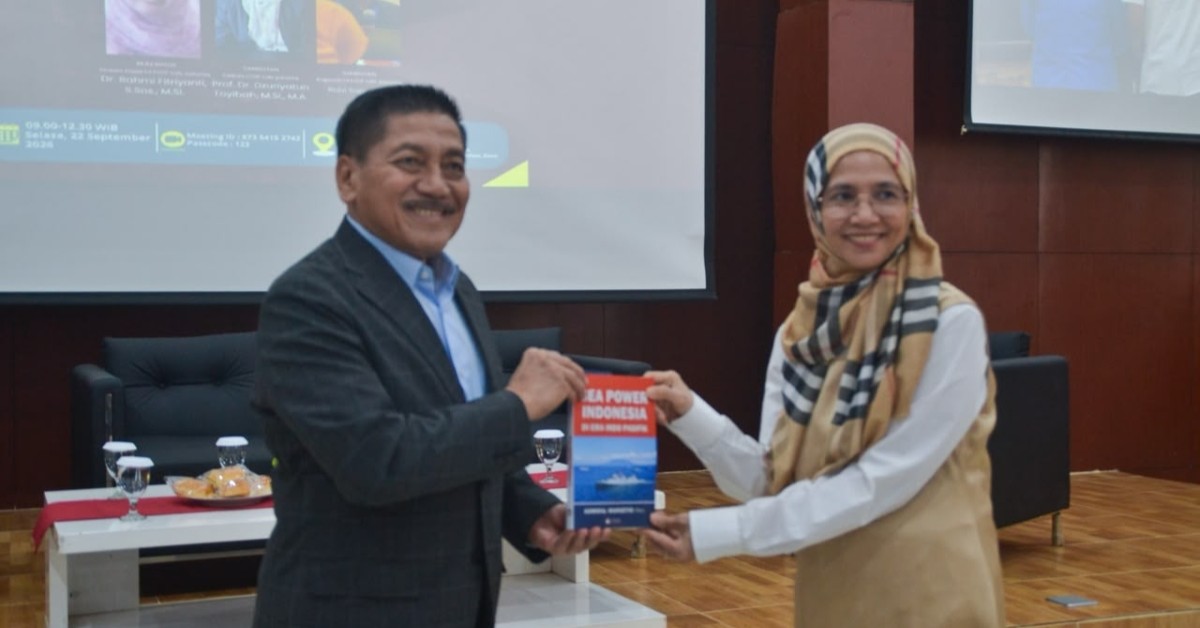
On this special occasion, as a form of support for maritime literacy, Marsetio directly presented copies of his crucial reference books titled "Sea Power Indonesia in the Indo-Pacific Era" and "New Maritime Consciousness" to active students and representatives of FISIP UIN Jakarta.
Through this public lecture, it is evident that securing strategic sea lanes like ALKI and the Strait of Malacca is an urgent imperative to mitigate the adverse impacts of global conflicts, such as those occurring in the Strait of Hormuz. Beyond military readiness, the strongest defense gate relies on maritime awareness, the courage to express opinions, and technological mastery by the younger generation—especially International Relations students at UIN Jakarta—to navigate global turbulence toward the era of Golden Indonesia 2045.