
FSH UIN Jakarta Launches Contemporary Islamic Political Fiqh Book by Prof. Masykuri Abdillah


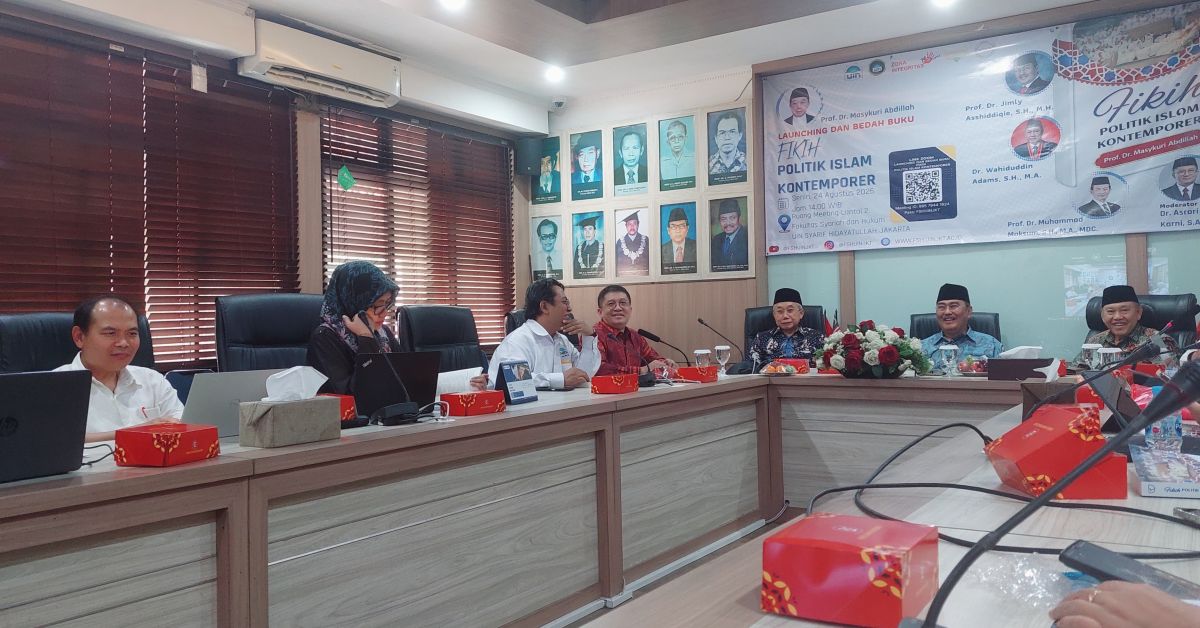
FSH, UIN News Online – The Faculty of Sharia and Law (FSH) UIN Syarif Hidayatullah Jakarta held a Launching and Review of the Book of Contemporary Islamic Political Fiqh by Prof. Dr. Masykuri Abdillah in the Meeting Room on the 2nd Floor of FSH UIN Jakarta, Monday (24/8/2026).
The activity, which took place in a hybrid manner (online and offline), presented the former Chief Justice of the Constitutional Court for the 2003-2008 period, Prof. Jimly Asshiddiqie and the Supreme Court Justice for the 2013-2024 period, Dr. Wahiduddin Adams, S.H., M.A. as the discussant, with Dr. Asrori S. Karni as the moderator.
Offline, the event was attended by the Dean of FSH Prof. Dr. Muhammad Maksum, S.H., M.A., Vice Dean, Prof. Dr. Kamarusdiana, M.H. and Dr. Afwan Faizin, M.A., Head of the FSH Sharia Science S3 Study Program, Prof. Dr. Yayan Sopyan, S.H., M.Ag., and around 30 academics of UIN Jakarta.
Meanwhile, online, Vice Chancellor I for Academic Affairs, Prof. Dr. Ahmad Tholabi, S.Ag., S.H., M.H., M.A. and the Chairman of the Center for Fatwa and Islamic Law Studies (Pusfahim) UIN Jakarta, Prof. Dr. KH. M. Asrorun Ni'am Sholeh, M.A..
In his remarks, the Dean of FSH, Prof. Maksum revealed that Islamic values are more easily accepted by the public when they are able to provide real benefits to society.
"The existence of a draft law with Islamic nuances in the construction of national law is an interesting thing. Our society is plural, so all interests must be able to enter and be considered," he said.
Explaining the content of his book, Prof. Masykuri Abdillah explained one of the main discussions, namely the distinguishing boundary between Islamic countries and Muslim countries. An Islamic state refers to a country that formally places sharia as a positive law or the main source of law. On the other hand, a Muslim country is a country with a majority of Muslim population without having to adopt a label or formal form of Islamic state. This distinction is crucial so that Muslim countries are not considered to have to have a uniform institutional form.
"Islamic countries and Muslim countries must be differentiated. The task of academics is to distinguish something that is indeed different," said Prof. Masykuri.
In response to this, Prof. Jimly Asshiddiqie added that the future of political jurisprudence requires close integration between jurisprudence and modern jurisprudence. Religious values are advised to continue to dialogue with the principles of constitutionalism, democracy, human rights, social sciences, and historical experience.
"There are many aspects of law and jurisprudence that need to be carefully integrated," he said.
Meanwhile, Dr. Wahiduddin Adams assessed that Indonesia's historical experience needs to be an important reference in the development of political jurisprudence. The formulation of the constitution, the establishment of religious courts, and the adoption of sharia principles into laws prove that Islamic values can be transformed harmoniously through the constitutional process.
This 470-page book was written by Prof. Masykuri using a normative and contextual approach, where religious texts are read in tandem with the context of their birth and current social reality.
The Rector of UIN Jakarta, Prof. Asep Saepudin Jahar, M.A., Ph.D. also appreciated the work because it succeeded in bringing together sharia studies with actual legal and political issues. Masykuri added that this study is still wide open to be further developed, especially regarding the relationship between Islam and the Indonesian state, the legal system, and the institutionalization of Islamic values.