From Evidence to Policy: UIN Jakarta Strengthens Government Partnerships for Sustainable Development
Syarif Hidayatullah State Islamic University Jakarta actively contributes academic expertise, research evidence, monitoring frameworks, and strategic recommendations to government institutions and partner organisations in support of sustainable development policy. During 2024–2025, the University strengthened its engagement with national government agencies, environmental authorities, research partners, and civil-society stakeholders through collaborative policy development, evidence-based research, programme monitoring, and strategic planning. These engagements demonstrate that the University's contribution to the Sustainable Development Goals extends beyond implementing activities on campus. Syarif Hidayatullah State Islamic University Jakarta also participates in processes that help government institutions identify development challenges, establish measurable indicators, evaluate interventions, formulate future strategies, and improve public programmes.
This approach directly supports SDG 17: Partnerships for the Goals, particularly through partnerships that connect academic research with public policy and sustainable development decision-making.
1. Developing a National Evidence-Based Policy Measurement Framework with the Ministry of Religious Affairs

One of the strongest examples of Syarif Hidayatullah State Islamic University Jakarta's involvement in government policy development occurred in July 2025, when the Directorate General of Islamic Community Guidance (Ditjen Bimas Islam) of Indonesia's Ministry of Religious Affairs collaborated with a research team from Syarif Hidayatullah State Islamic University Jakarta to develop the Dakwah Service Index (Indeks Layanan Dakwah).
The initiative was developed as part of the broader Religious Development Index and was designed to establish a measurable framework for evaluating the contribution and effectiveness of government religious services. The collaboration responded to an important public-policy challenge: the absence of a specific quantitative instrument capable of measuring the actual impact of government religious outreach services on communities. Syarif Hidayatullah State Islamic University Jakarta contributed its academic and methodological expertise to developing an evidence-based measurement approach.
The research framework was designed around a national quantitative survey assessing five major dimensions:
policy, actors, programmes, communication channels, and the impact of religious outreach services.
The assessment was planned to include government religious services delivered through mosques, Religious Affairs Offices (KUA), religious extension officers, and official digital channels operated by the Ministry of Religious Affairs. The research was designed to collect public perceptions from respondents across different Indonesian provinces, with sampling reaching the district and municipal levels. This approach provides government institutions with a structured mechanism for identifying weaknesses, evaluating service performance, and understanding how communities experience public religious services.
Importantly, the collaboration was intended to generate three concrete outputs:
The Dakwah Service Index, a policy brief for policy formulation, and a data-based report for the Directorate General of Islamic Community Guidance.
The resulting index is also intended to contribute to an annual government Outlook report and provide evidence for future evaluation and policy formulation. Through this collaboration, Syarif Hidayatullah State Islamic University Jakarta directly contributes to government policy measurement, monitoring, reporting, evaluation, and evidence-based future planning.
2. Supporting Government Environmental Strategy and SDG Implementation with Gunung Gede Pangrango National Park

Syarif Hidayatullah State Islamic University Jakarta also contributes to sustainable development policy and environmental governance through collaboration between its Faculty of Science and Technology, SDGs Center, and Gunung Gede Pangrango National Park (TNGGP). On 10 September 2025, representatives of the Faculty of Science and Technology, the University's SDGs Center, and the TNGGP authority conducted a formal follow-up meeting on collaborative implementation of the Sustainable Development Goals.
The meeting addressed strategic issues including:
biodiversity research, ecosystem restoration, wildlife monitoring, conservation management, and community empowerment around the national park.
Government representatives also discussed opportunities associated with environmental financing through the Indonesian Environment Fund (BPDLH) and alignment with the Forest and Other Land Use (FOLU) Net Sink 2030 programme. Syarif Hidayatullah State Islamic University Jakarta's SDGs Center contributed an academic perspective by emphasising that research results should be translated into publications, patents, innovations, and practical solutions that create measurable benefits for communities and environmental management. The partnership is especially significant because it connects university research capabilities with the management of a nationally protected ecosystem.
Monitoring biodiversity and wildlife populations provides scientific information that can support adaptive conservation management, while ecosystem-restoration research contributes to the development of longer-term environmental strategies. The partnership therefore demonstrates the University's participation in identifying environmental challenges, designing collaborative approaches, monitoring ecological conditions, and strengthening sustainable natural-resource governance.
3. PPIM Research Supporting Government Policy Evaluation
Syarif Hidayatullah State Islamic University Jakarta also contributes to policy development through the Center for the Study of Islam and Society (PPIM), which produces evidence-based research intended to inform government and public decision-making. A significant example during the reporting period was PPIM's research on Child-Friendly Islamic Boarding Schools (Pesantren Ramah Anak). The research programme was supported by major Indonesian government institutions, including the National Development Planning Agency (Bappenas), Ministry of Religious Affairs, and Ministry of Women's Empowerment and Child Protection (KemenPPPA).
The research examined how the government's Child-Friendly Islamic Boarding School policy was being implemented in practice. Its empirical foundation was extensive. A national survey conducted in 2023 covered 90 Islamic boarding schools in 34 provinces and involved approximately 1,800 students and teachers.
The investigation continued during 2024 through in-depth interviews involving 170 informants from 17 Islamic boarding schools and 12 related institutions across 13 provinces. The research mapped perceptions, implementation practices, good practices, institutional vulnerabilities, and challenges affecting implementation of the Child-Friendly Islamic Boarding School policy. Rather than merely describing the programme, the research generated evidence that could be used by policymakers to evaluate existing implementation and strengthen future intervention. The resulting publications were publicly presented in July 2025, involving researchers, government representatives, civil-society organisations, Islamic boarding school administrators, academics, and members of the wider community.
PPIM explicitly positioned the research as a reference for stakeholders seeking to strengthen implementation of the Child-Friendly Islamic Boarding School policy in Indonesia. This demonstrates how Syarif Hidayatullah State Islamic University Jakarta contributes to monitoring government policy implementation, identifying implementation challenges, documenting good practices, and providing research-based recommendations for policy improvement.
4. Using Research to Identify Environmental Policy Challenges

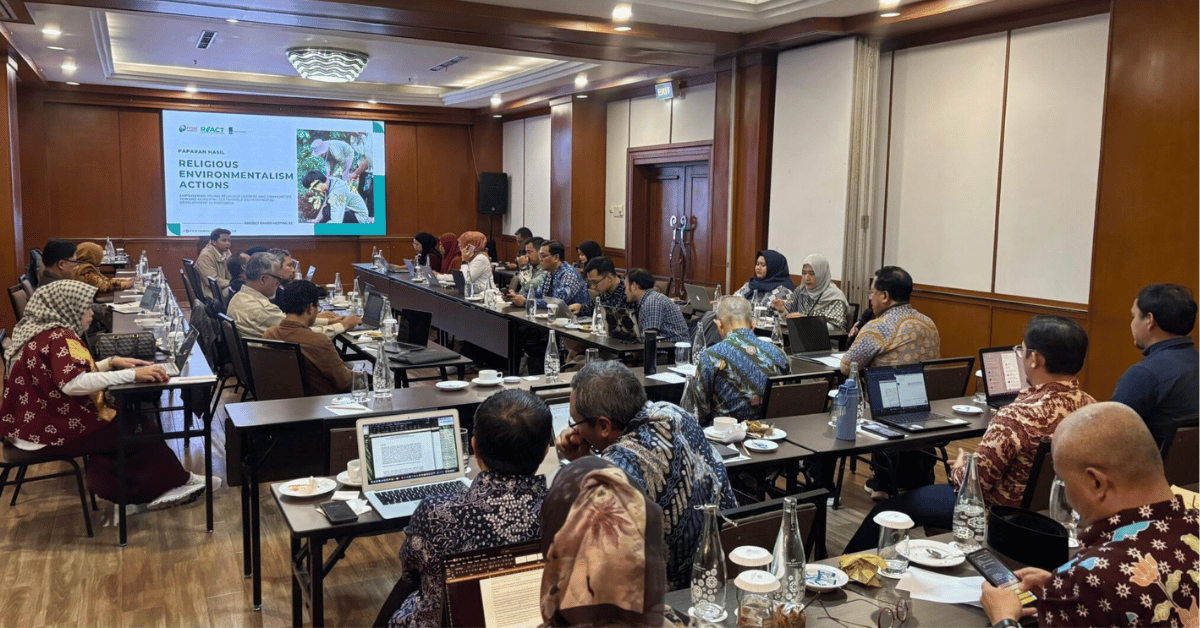
PPIM also strengthened the University's evidence-to-policy contribution through its Religious Environmentalism Actions (REACT) programme. During 2024, PPIM conducted extensive research on environmentally friendly Islamic boarding schools across Indonesia. The study collected information from 361 Islamic boarding schools, followed by focus group discussions and field research across multiple provinces. The research identified several important challenges affecting the sustainability of environmental programmes, including limited internal resources, dependence on institutional leaders, insufficient infrastructure, and dependence on external assistance. It also identified existing sustainability practices involving waste management, biodiversity conservation, sustainable agriculture, alternative energy, water and electricity efficiency, environmental education, and green infrastructure.
Based on the findings, PPIM recommended stronger collaboration among Islamic boarding schools, government institutions, private-sector organisations, and civil society. The research also emphasised the importance of technical assistance, monitoring and evaluation, human-resource development, institutional environmental management, and locally adapted environmental planning. These findings provide policymakers and partner organisations with empirical information about both successful practices and structural barriers affecting environmental programmes in religious educational institutions.
Through this approach, Syarif Hidayatullah State Islamic University Jakarta contributes not only to environmental education but also to the identification of policy challenges and the development of evidence-based recommendations for sustainable environmental governance.
5. Establishing an Institutional Framework for Sustainable Development Partnerships
These external partnerships are supported by the University's institutional commitment to sustainable development. Through Rector's Decree Number 1415 of 2024 concerning the Green Campus Policy, Syarif Hidayatullah State Islamic University Jakarta formally integrated the 17 Sustainable Development Goals into its education, research, and community-service activities. The policy requires University programmes to accommodate the Sustainable Development Goals and strengthens the institutional basis for cooperation involving environmental management, research, community engagement, and external stakeholders.
In April 2025, the University further strengthened implementation by establishing the Green Campus Development Center under the Institute for Research and Community Service. The center coordinates areas including water, energy, waste, infrastructure, transportation, and environmental education. This institutional structure enables UIN Jakarta to connect university-level sustainability strategies with partnerships involving government institutions, communities, academic organisations, and other stakeholders.
6. From Problem Identification to Monitoring and Policy Improvement
The University's partnerships during 2024–2025 demonstrate several stages of policy involvement relevant to sustainable development. Through the development of the Dakwah Service Index, Syarif Hidayatullah State Islamic University Jakarta helped government identify the absence of measurable public-service indicators and develop a national monitoring instrument. Through its collaboration with Gunung Gede Pangrango National Park, the University contributed scientific expertise to biodiversity research, ecosystem restoration, ecological monitoring, and environmental strategy.
Through PPIM research, Syarif Hidayatullah State Islamic University Jakarta generated empirical evidence on the implementation of government programmes, identified structural challenges, documented good practices, and developed recommendations intended to strengthen policy implementation. Together, these activities demonstrate an approach in which academic evidence informs public decision-making. Syarif Hidayatullah State Islamic University Jakarta's contribution therefore encompasses problem identification, policy measurement, strategy development, implementation monitoring, reporting, evaluation, and recommendations for future improvement.
7. Contribution to SDG 17: Partnerships for the Goals
Syarif Hidayatullah State Islamic University Jakarta demonstrates sustained engagement with government and partner institutions in addressing sustainable development challenges. The University's contribution is not limited to signing cooperation agreements. Its researchers and institutional units participate in the design of measurement frameworks, national surveys, environmental planning, programme evaluation, ecological monitoring, and the development of policy recommendations.
The collaboration with the Ministry of Religious Affairs in developing the Dakwah Service Index provides particularly strong evidence of direct academic input into a government policy instrument. Environmental partnerships with Gunung Gede Pangrango National Park demonstrate the integration of university research into conservation planning and monitoring. PPIM's research programmes further demonstrate how university-generated evidence can evaluate government initiatives and inform stakeholders seeking to strengthen public policy.
Through these partnerships, Syarif Hidayatullah State Islamic University Jakarta demonstrates direct involvement in government and stakeholder processes that identify development challenges, develop evidence-based strategies, monitor interventions, report outcomes, and strengthen adaptive policy-making in support of the Sustainable Development Goals.
These activities provide documented evidence of the University's contribution to SDG 17.2.1: Relationships with regional NGOs and government for SDG policy development.
Source :
https://ppimcensis.or.id/2025/08/06/react-expert-meeting-2025-memperkuat-peran-agama-dalam-gerakan-lingkungan-di-indonesia/
https://ppimcensis.or.id/2025/09/26/ppim-dorong-pemanfaatan-zakat-csr-dan-bpdlh-untuk-aksi-iklim/
https://ppimcensis.or.id/2025/12/18/ppim-gelar-project-board-meeting-ke-3-paparkan-capaian-dan-pelajaran-penting-proyek-react/
https://jdih.kemenag.go.id/yzxkthpo/regulation/keputusan-menteri-agama-442-2025_251119.pdf
https://studiaislamika.ppimcensis.or.id/index.php/studia-islamika/article/view/41149
https://ppimcensis.or.id/books/integrasi-green-islam-dalam-arah-kebijakan-kemenag/
https://ppimcensis.or.id/books/memperkuat-kolaborasi-melibatkan-kelompok-green-islam-untuk-mengarusutamakan-isu-lingkungan/