
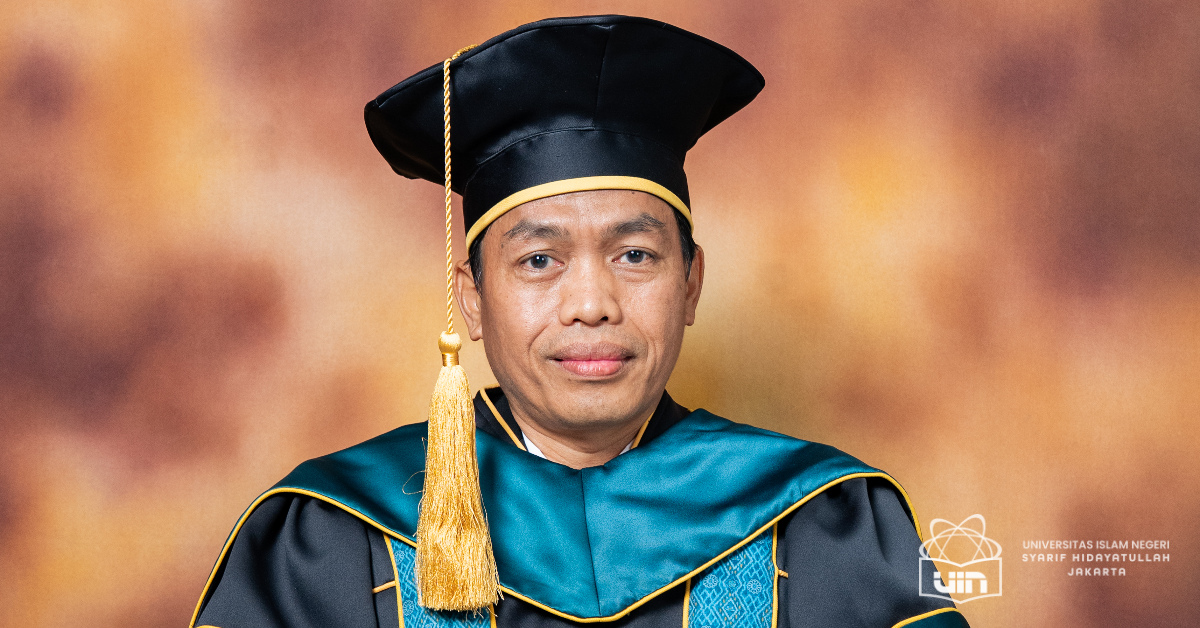
From Campus Journalist to Full Professor, Prof. Bakir Ihsan Examines Pancasila Democracy



Harun Nasution Auditorium, UIN News Online – Amidst the Open Senate Session at UIN Syarif Hidayatullah Jakarta, a solemn and moving atmosphere enveloped thirteen full professors. Among them was Prof. Dr. A. Bakir Ihsan, M.A., whose presence at this historic milestone captured widespread attention through his critical ideas regarding the future trajectory of the nation's democracy, at the Harun Nasution Auditorium, Wednesday (30/09/2026).
Prof. Bakir's journey toward the apex of his academic career began by moving to Jakarta to pursue undergraduate studies in Theology and Philosophy at IAIN Syarif Hidayatullah Jakarta, now known as UIN Syarif Hidayatullah Jakarta. Prof. Bakir did not merely immerse himself in textbooks to survive and sharpen his analytical acumen; he was also actively involved in intra- and extra-campus student organizations, eventually being entrusted as Editor-in-Chief of the Student Press Institute (LPM) Institut. That experience managing campus press served as the primary fuel for his step into professional journalism at Panji Masyarakat Magazine. His intellectual track record and extended dedication to the press eventually led him to serve as Assistant to the Special Staff of the 6th President of the Republic of Indonesia, culminating today at the highest academic rostrum.
This extensive experience in observing social and political dynamics formed the bedrock of his critical thinking when delivering his professorial oration. In his speech titled “A Divided Political Ideology: Institutionalization of Pancasila for Democratic Consolidation in Indonesia,” Prof. Bakir highlighted the democratic paradox following the 1998 Reformasi. Indonesia indeed succeeded in executing the most crucial democratic transformation in Southeast Asia, yet contemporary conditions reveal signs of regression characterized by systemic corruption, weak law enforcement, politicization of state institutions, dynastic politics, oligarchy, the erosion of checks and balances, and a shrinking space for political opposition.
“These issues raise a fundamental question: why does a nation that formally holds Pancasila as state ideology and a democratic constitution still grapple with corruption, transactional politics, oligarchy, and democratic deficits?” he remarked.
The scientific oration analyzed the gap between values formally institutionalized and those that factually govern the behavior of political actors. Through the concept of institutionalized ideology, his scholarly work dissected the paradox between Pancasila institutionalized through the constitution and state bodies versus political practices dominated by transactional pragmatism. He further explained that the root cause of Indonesian democracy's plight is not the absence of Pancasila, but rather the split institutionalization process of ideology. According to him, two parallel yet conflicting institutionalization processes operate simultaneously.
“First, the formal institutionalization of Pancasila that exists constitutionally, symbolically, and ceremonially within state institutions and education. Second, the institutionalization of transactional pragmatism that actively dictates the daily behavior of political actors through patronage politics, money politics, party cartelization, political dynasties, elite compromises, and oligarchy,” he explained.
Prof. Bakir dissected the paradox between Pancasila institutionalized through state organs and the actual political practice on the ground dominated by transactional pragmatism. With immense fervor, he delivered that breaking free from this trap of political ideological division requires rectifying root systemic flaws, rather than merely rotating elites through procedural elections.
“It is imperative to reform campaign finance, which stands as a primary driver of transactional pragmatism, foster formal deliberative arenas that open genuine ideological debates among elites, and establish algorithmic transparency and digital literacy to prevent severe polarization. Furthermore, civil society must be strengthened as a counterbalance to both the state and the market,” he elaborated.
To restore Pancasila as a substantive force in national life, Prof. Bakir reiterated the core imperatives of its five principles.
“The first principle must cultivate public ethics, the second principle must guarantee the protection of human dignity, the third principle must generate a politics of integration, the fourth principle must foster deliberation and true representation, and the fifth principle must yield distributive justice,” he added.
The professorial inauguration of Prof. Ahmad Bakir Ihsan, M.A., marking a major milestone in his academic journey, received warm praise and commendations from various quarters, including First Secretary of the Embassy of Japan in Indonesia Tsutomu Takake, Elshinta Radio Producer Dedy Ramadhan, and Kompas Daily Journalist Nikolas Sarbowo. Through this inauguration, the professorial address delivered is expected to contribute profound academic findings and scholarly insights to both the wider public and the academic community, while reaffirming the crucial role of Pancasila in consolidating Indonesian democracy.