
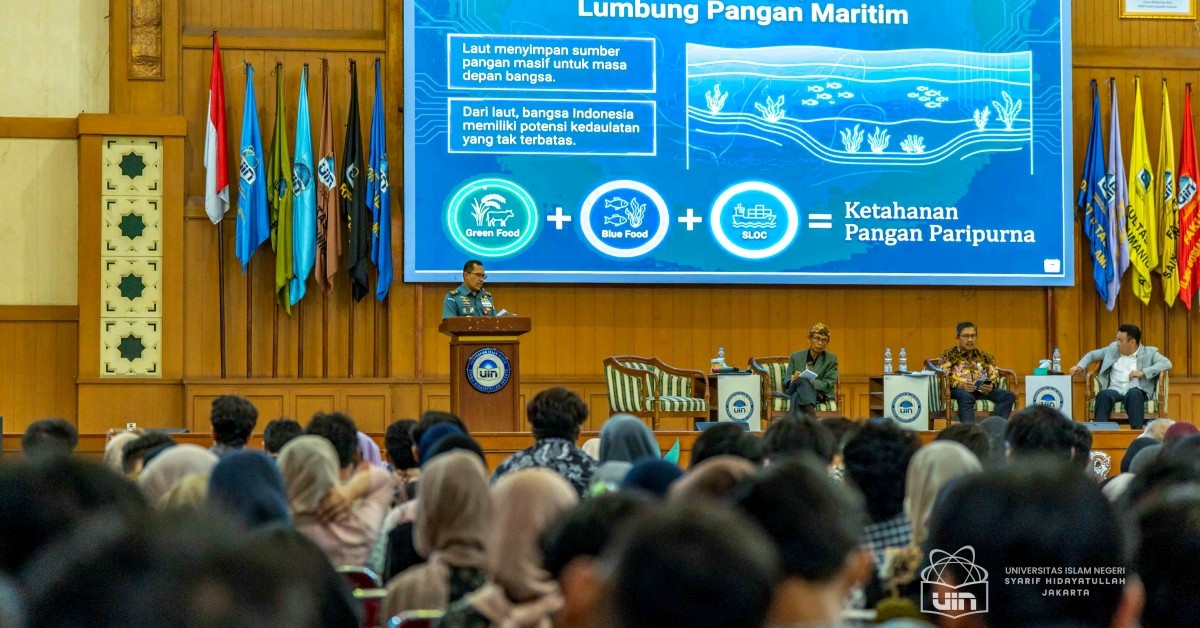
Farmer Regeneration Crisis: Gantari Seminar 2026 Highlights Youth Role in Driving Sustainability


Harun Nasution Auditorium, UIN News Online – In commemoration of National Agrarian and Spatial Planning Day (HANTARU), UIN Syarif Hidayatullah Jakarta hosted the Gantari 2026 National Seminar under the theme “Youth Regeneration as a Driver of Sustainability and Indonesian Food Self-Sufficiency.” The event aimed to serve as an educational platform for UIN Jakarta students to respond to the regeneration crisis in the agricultural sector, held at the Harun Nasution Auditorium, Thursday (24/09/2026).
The event featured prominent national figures across multiple sectors, including Minister of Agriculture of the Republic of Indonesia Dr. Ir. H. Andi Amran Sulaiman, M.P.; Rector of UIN Jakarta Prof. Asep Saepudin Jahar, M.A., Ph.D.; Commander of the Indonesian Navy Fleet Command Vice Admiral Dr. Denih Hendrata, S.E., M.M., CHRM; Procurement Director of the State Logistics Agency (BULOG) Dr. Ir. Prihasto Setyanto, M.Sc.; and Professor of Agribusiness and General Chairman of PISPI Prof. Dr. Achmad Tjachja Nugraha, M.P. Additionally present were Head of the Agriculture and Food Research Organization at BRIN Puji Lestari, S.P., M.Sc., and Young Farmer as well as Founder of Tamara Agro Farm Iqbal Habibie, S.P.
Rector of UIN Jakarta Prof. Asep Saepudin Jahar, M.A., Ph.D., opened the event by emphasizing the vital role universities play in supporting food sovereignty, particularly through research development at the Faculty of Science and Technology (FST). He noted that the campus carries a moral responsibility to safeguard food independence.
“We must continuously strive and develop innovations in other aspects of food. FST, particularly within the Agribusiness cluster being developed, needs to continuously collaborate in innovating and mentoring. We must be involved and take part in this food independence. Indonesia is inherently suited and relevant for agricultural development and food independence,” he stated.
On the other hand, Minister of Agriculture of the Republic of Indonesia Dr. Ir. H. Andi Amran Sulaiman, M.P., offered encouragement to the younger generation while highlighting the national agricultural sector's achievement in accelerating the President's food self-sufficiency target, which earned official appreciation from the Food and Agriculture Organization (FAO).
“The President's target was four years for self-sufficiency; we accelerated and achieved it within a single year, receiving appreciation from the FAO. Our Farmers' Terms of Trade (NTP) reached 129, the highest record in the history of the Republic of Indonesia. Agricultural exports rose by Rp166 trillion, imports were curbed, and rice reserve stocks for El Niño readiness remained secure. We also took firm action against over 100 suspects involved in agricultural infractions for farmers' justice, and dispatched 10,000 tons of humanitarian rice assistance to Palestine,” he elaborated.
Dr. Ir. H. Andi Amran Sulaiman, M.P., added that the sustainability of all these national food sovereignty achievements relies on the strength of character and integrity.
“Success is forged by character. Character is the primary foundation of successful individuals. The four key determinants of your success are honesty, discipline, diligence in learning, and hard work. Those are what matter most,” he added.
Furthermore, to reinforce youth regeneration as a driver of sustainability and Indonesian food self-sufficiency, the Gantari 2026 Seminar presented a panel discussion titled “Building an Agricultural Ecosystem as a Pillar of National Resilience.” Commander of the Indonesian Navy Fleet Command Vice Admiral Dr. Denih Hendrata, S.E., M.M., CHRM, underscored the critical need for regeneration. In his view, the age structure of farmers, which is dominated by older demographics, presents a significant challenge to the sustainability of the agricultural sector. This condition makes the involvement of the younger generation increasingly essential.
“If farmers today are already 60 years old, what will happen in 15 years? That means they will reach 75 years of age. How many years of opportunity do they have left to farm?” he expressed.
In his breakdown, food security cannot be separated from national security. He outlined five strategic roles for students: solution-seeking innovators, technology drivers, value-adding entrepreneurs, supply chain logistics connectors, and leaders with a national vision.
“Innovation without a market will struggle to grow, technology without added value will stall as a mere tool, and entrepreneurship without leadership and national values can lose direction. Therefore, the younger generation must grow as complete food architects,” he said.
Meanwhile, addressing supply and distribution chain perspectives, Procurement Director of Perum BULOG Dr. Ir. Prihasto Setyanto, M.Sc., outlined his institution's role as the national food operator maintaining both availability and affordability.
“Through 1,686 warehouse units alongside price stabilization efforts pursuant to Presidential Instruction Number 4 of 2026, BULOG successfully absorbed 3.989 million tons of rice as of September 2026 toward a 4-million-ton target, bringing total national reserve stocks to 4.52 million tons. This step is balanced with purchase price guarantees at the farmer level of Rp6,500 per kg for Harvested Dry Grain (GKP) and Rp12,000 per kg for rice to break the chain of middleman exploitation,” he explained.
The panel session continued with a presentation from Professor of Agribusiness Prof. Dr. Achmad Tjachja Nugraha, M.P., who highlighted the five pillars of the agricultural ecosystem: agrarian reform, farmer regeneration, local wisdom-based institutions, fair financing, and local supply chain integration.
The second panel discussion, themed “From Research to Impact: Implementing Agricultural Innovation through Multi-Stakeholder Collaboration,” brought together research and field practitioner perspectives. Head of the Agriculture and Food Research Organization at BRIN Puji Lestari, S.P., M.Sc., emphasized that research must not stall in laboratories or remain confined to Intellectual Property Rights (IPR). She explained that BRIN implements strategies to strengthen multidisciplinary human resources, validate crop lines directly with farmers, and execute agricultural technology adoption programs.
“Research must not stop in laboratories or end as mere IPR to avoid falling into the 'valley of death.' Therefore, BRIN implements strategies to strengthen multidisciplinary human resources, validate superior variety lines directly alongside farmers, and run precision agriculture technology adoption programs such as field sensor and drone utilization,” she stated.
In closing, Young Farmer and Founder of Tamara Agro Farm Iqbal Habibie, S.P., asserted that youth involvement in agribusiness is not merely a career choice, but a moral responsibility and leadership duty in safeguarding national food sovereignty.
“As a member of the younger generation and an Agribusiness graduate born into a farming family, it is my duty to return to the region and build Indonesia through agriculture. As Gen Z, we cannot remain mere spectators amidst the threat of a food crisis,” he expressed.
He underscored that the primary key to youth success in penetrating agribusiness industry chains is not the extent of land or financial capital owned, but entrepreneurial mental resilience and the courage to execute modern opportunities.
“Sometimes we fall into the trap of complaining about capital and land, whereas without a resilient entrepreneurial mindset, all those resources will go to waste. Once an entrepreneurial mindset is forged, technology and innovation can be managed to add real value. The future of agriculture lies in the hands of young people who dare to act,” he concluded.