
#FacultyNews: Dean of FSH UIN Jakarta Encourages Political Fiqh to Become a National Legal Solution


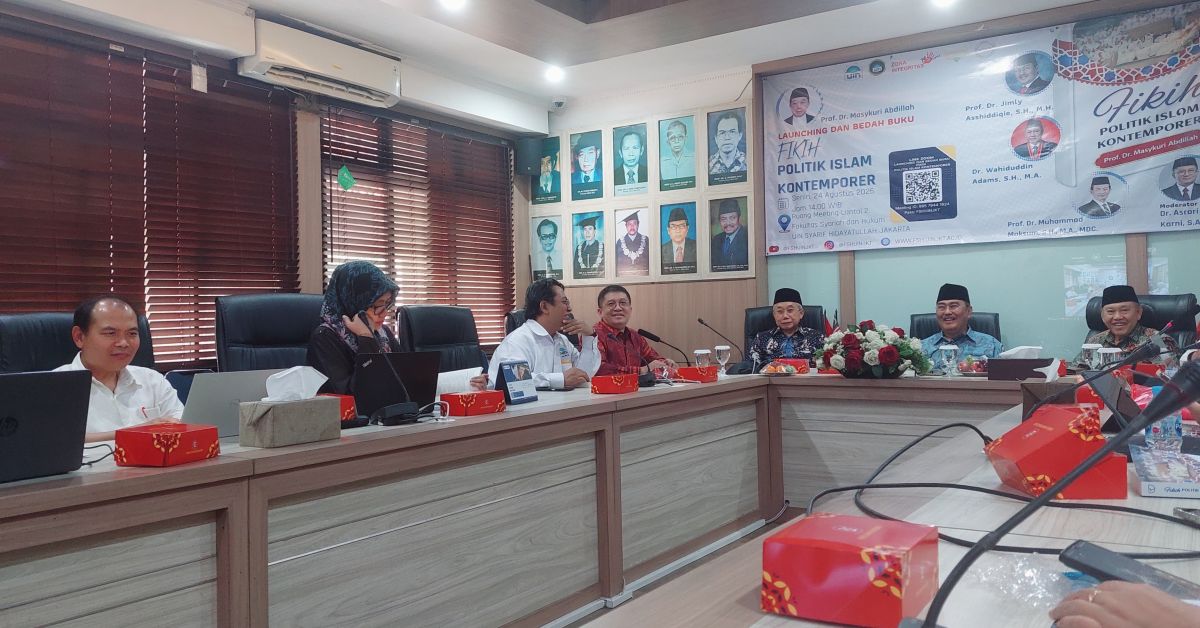
UIN News Online - The Dean of the Faculty of Sharia and Law (FSH) UIN Syarif Hidayatullah Jakarta, Prof. Dr. Muhammad Maksum S.H., M.A., encourages the development of political jurisprudence in order to be able to translate Islamic values into solutions in national law that are contextual, inclusive, and beneficial to society. This was conveyed when closing the launch and review of the book Contemporary Islamic Political Fiqh by Prof. Dr. Masykuri Abdillah in the Meeting Room on the 2nd Floor of FSH UIN Jakarta, Monday (24/8/2026).
Maksum assessed that the debate on the relationship between Islam and the state will continue in Indonesia. According to him, political jurisprudence does not stop at the issue of Islamic identity, symbols, or labels, but needs to produce ideas that can answer concrete problems and be accepted in the life of a pluralistic society.
The activity, which took place offline and online, was also attended by Vice Chancellor I Prof. Dr. Ahmad Tholabi S.Ag., S.H., M.H., M.A. and the Head of the Center for Fatwa and Islamic Law Studies (Pusfahim) UIN Jakarta Prof. Asrorun Ni'am online. Also present were the Dean of FSH Prof. Dr. Muhammad Maksum S.H., M.A., Vice Dean Prof. Dr. Kamarusdiana M.H. and Dr. Afwan Faizin M.A., the Head of the S3 Sharia Science Study Program FSH Prof. Dr. Yayan Sopyan Sopyan S.H., M.Ag., and around 30 academics of UIN Jakarta. The activity presented Prof. Jimly Asshiddiqie and Dr. Wahiduddin Adams S.H., M.A. as the discussants, with Dr. Asrori S. Karni as the moderator.
Maksum explained that Islamic values are more easily accepted when they are able to show real benefits for society. He gave an example of the development of the sharia economy which is not only related to religious identity, but also provides benefits in business activities, financing, investment, and welfare.
"When talking about Islamic economics or sharia economics, what is being talked about is not only identity. There are benefits, there are benefits, and there are interests of the community. Therefore, it is easier to accept," he said.
According to him, the challenge becomes more complex when Islamic values enter the realm of politics and criminal law because they are related to power, citizen freedom, pluralism, and the limits of state authority. Therefore, the idea of Islamic law needs to be formulated by paying attention to the constitution, the needs of the community, and the protection of citizens' rights.
"The existence of a draft law with Islamic nuances in the construction of national law is interesting. Our society is plural. All interests must be able to enter and be considered," he said.
In line with this view, Prof. Dr. Masykuri Abdillah places political jurisprudence as an area of ijtihad that is open to change. Through a 470-page book, he discusses various contemporary Islamic political issues, such as the nation-state and caliphate, constitution, power, citizenship, freedom, pluralism, democracy, and political ethics. According to Masykuri, the understanding of religious texts needs to be adjusted to the historical context and reality of today's society.
"We have to look at the text, the context, and the interpretation: what was the context then, what it is now, and how we should behave," he said.
Prof. Jimly Asshiddiqie added that the development of political jurisprudence requires integration between jurisprudence and law. Religious values need to be in dialogue with constitutionalism, democracy, human rights, social sciences, and Indonesia's historical experience. Meanwhile, Dr. Wahiduddin Adams emphasized that Indonesia's experience shows that religious values can be applied through the constitutional process, including through the establishment of religious courts and the inclusion of a number of sharia principles in laws and regulations.
"There are many aspects of law and jurisprudence that need to be carefully integrated," he said.
The discussion, which lasted almost three hours, showed the importance of bringing together Islamic values with the legal system and the needs of society. Through the development of contextual and benefit-oriented political fiqh, Islamic values are expected not only to be present as a symbol in regulations, but also to be able to contribute to justice, legal certainty, protection of rights, and community welfare.