
Experiential Learning: UIN Jakarta Law Students Visit Constitutional Court to Study Judicial Review and State Governance
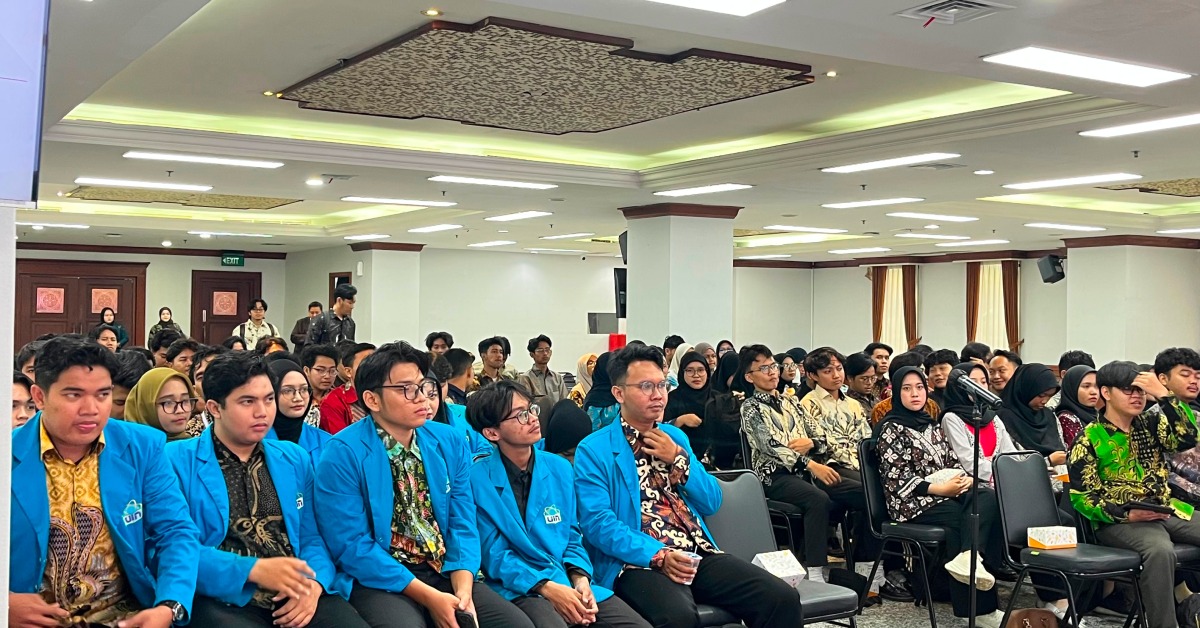
Jakarta, UIN Online News – A delegation of 113 undergraduate students from the Comparative Schools of Law Study Program at the Faculty of Sharia and Law (FSH), UIN Syarif Hidayatullah Jakarta, participated in an advanced academic site visit and guest lecture at the Constitutional Court of the Republic of Indonesia (MK RI) on Thursday, June 11, 2026. The educational excursion was designed to deepen student comprehension regarding constitutional practices and judicial litigation processes through direct interaction within the nation's highest guardian of the constitution.
The student delegation was received by the Expert Legal Analyst of the Constitutional Court, Arinta Sulistiyo Eko Prabowo. In his technical presentation, he outlined the historical genesis of the Constitutional Court as a landmark product of Indonesia's post-1998 democratic reformation, which established a specialized judicial branch dedicated to handling state constitutional disputes.
“That summarizes the baseline socio-political conditions driving the institutional necessity for a judicial body capable of resolving complex constitutional crises. Consequently, the Constitutional Court was established, and since that milestone, Indonesia has operated a dual-judicial system managing judicial power,” he explained.
He detailed the absolute authorities vested in the Constitutional Court, which include conducting judicial reviews of statutes against the 1945 Constitution, resolving jurisdictional disputes between state institutions, deciding on the dissolution of political parties, settling electoral result disputes, and passing judgments regarding parliamentary impeachment motions against the President and/or Vice President.
Furthermore, he distinguished the dual framework of judicial review in Indonesia: the Constitutional Court holds the exclusive mandate to review laws against the 1945 Constitution, whereas the Supreme Court (Mahkamah Agung) evaluates lower-level regulations against higher statutes.
During the interactive dialogue segment, the students examined the legal mechanics behind dissolving political parties. Prabowo clarified that up until this point, the Court has never exercised this specific authority because under current statutory laws, the legal standing to file a dissolution petition rests solely with the President of the Republic.
Regarding the judicial review process, he emphasized that every Indonesian citizen, including active university students, possesses the legal standing (legalis persona) to file a constitutional challenge. To maximize public access, petitions can be submitted either in person or via the secure digital filing networks developed by the Constitutional Court.
The Senior Lecturer of Constitutional Law and official supervisor of the trip, Dr. Mufidah, clarified that this academic excursion is a direct application of the university’s experiential learning methodology, designed to reinforce theoretical classroom lectures with real-world judicial operations.
“This program aims to expand the academic horizons of our students regarding constitutional practices and litigation frameworks in Indonesia by learning directly from a state institution that carries the strategic role of upholding the 1945 Constitution,” she stated.
She added that through this model, students gain a comprehensive understanding of the Court's institutional hierarchy, operational functions, authorities, and administrative mechanics, while simultaneously breaking down contemporary socio-legal issues alongside verified legal practitioners.
“By engaging directly with the Constitutional Court environment and analyzing case files presented by expert speakers, students are equipped to enrich their scientific perspectives, enhance critical thinking skills, and foster a deep constitutional awareness vital for public democracy and the rule of law,” Dr. Mufidah explained.
Ultimately, Dr. Mufidah hopes that this hands-on site exposure provides more than just abstract legal theories, offering a practical preview of constitutional litigation in action. This institutional project is projected to upgrade core professional competencies while shaping the constitutional conscience of the university’s future jurists.