
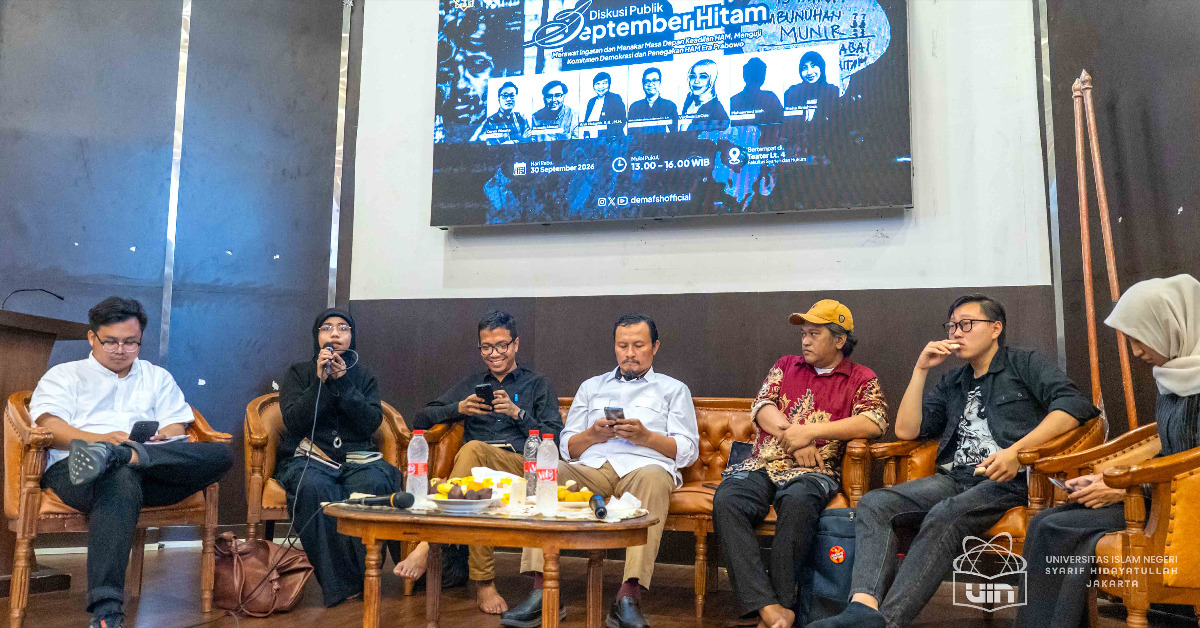
Commemorating 'September Hitam', DEMA FSH UIN Jakarta Highlights Commitment to Human Rights and Civil Liberties


FST Theater Room, UIN News Online – The Student Executive Board (DEMA) of the Faculty of Sharia and Law (FSH) at UIN Syarif Hidayatullah Jakarta hosted a Public Discussion to commemorate Black September (September Hitam). Titled “Preserving Memory and Gauging the Future of Human Rights Justice: Testing Democratic Commitment and Human Rights Enforcement in the Prabowo Era,” the event provided a multi-perspective discussion forum for reflection and student-public contributions in the FST Theater Room, 4th Floor, on Wednesday (30/09/2026).
The event was attended by Vice Dean III for Student Affairs, Alumni, and Cooperation at FSH UIN Jakarta, Prof. Dr. Kamarusdiana, M.H., alongside guest speakers and invitees from various backgrounds, including Senior Policy Analyst of Komnas HAM RI Mimin Dwi Hartono, Deputy Director of Imparsial Hussein Ahmad, Chairman of the Solidarity Action Committee for Munir Nelson Nikodemus Simamora, S.H., Jakarta Legal Aid Institute (LBH Jakarta) Team Representative Daniel Winarta, Centra Initiative Representative Muhammad Islah, KontraS Representative Schwinnndy Lahaude, S.H., President of DEMA FSH UIN Jakarta Dimas Saputra, Event Chair Revita Putri Sadewi, and members of the UIN Jakarta academic community.
In his opening remarks, Vice Dean III for Student Affairs, Alumni, and Cooperation at FSH UIN Jakarta, Prof. Dr. Kamarusdiana, M.H., commended the organization of this scholarly forum as a platform to strengthen students' civic awareness.
“Today's theme is critical for reminding our students that dark historical events once took place in our past. FSH UIN Jakarta consistently opens its doors wide for academic discussions like this, as our focus extends beyond Islamic law to embrace the legal systems operating in Indonesia and globally,” he stated.
Prof. Dr. Kamarusdiana emphasized that academic spaces must be utilized optimally to sharpen the social consciousness and intellectual acumen of the academic community.
“UIN Jakarta students are known for their strong motivation to learn and advocate for the public good. Through this discussion forum, we hope students' legal awareness and scholarly insight will continue to evolve,” he added.
Continuing from a state institution perspective, Senior Policy Analyst at Komnas HAM RI Mimin Dwi Hartono outlined Komnas HAM's institutional framework as an independent body operating under the mandate of the Human Rights Law. This mandate encompasses fostering conducive conditions for human rights execution, strengthening citizen rights protection, and safeguarding academic freedom in scholarly forums.
“Pursuant to Law Number 26 of 2000 on Human Rights Courts, Komnas HAM acts as the official investigator. To date, Komnas HAM has completed investigations into 15 gross human rights violation cases,” he explained.
Mimin revealed technical challenges in the legal enforcement process, noting that investigation dossiers are frequently returned repeatedly by the Attorney General's Office. Although various inter-agency coordination mechanisms have been pursued, securing justice for victims still faces tangible obstacles. Amid these legal hurdles, Mimin also underscored the essential role of students in preserving historical memory so that the pursuit of justice does not stall. According to him, historical literacy on humanitarian issues is vital for the nation's successor generation.
“There is currently a generational gap and historical literacy deficit among youth. Knowledge transmission must occur continuously so society remains resilient against misinformation. Students are the drivers and future defenders of human rights who must constantly champion literacy and critical research. Human rights enforcement demands tight collaboration between state institutions, academia, and civil society to guarantee citizens' fundamental rights,” he asserted.
Offering another perspective, Deputy Director of Imparsial Hussein Ahmad highlighted the necessity of institutional governance within a democratic system.
“In a democratic state order, the division of functions between civilian and military institutions must remain proportional. Good governance is demonstrated by ensuring every institution focuses strictly on its core duties and functions in accordance with statutory mandates,” he explained.
Hussein added that a clear separation of roles serves as the key to preserving the professionalism of security institutions while reinforcing civilian governance.
“Maintaining clear boundaries between military and civilian domains is not only essential for the public sphere, but is paramount for safeguarding military professionalism itself. Civilian institutions, such as ministries and civilian law enforcement, must have their capacities continuously strengthened so public service and national development run optimally,” he noted.
In line with these views, LBH Jakarta Representative Daniel Winarta highlighted the importance of open public space in facilitating active civic participation. During the discussion, he encouraged the academic community to nurture a critical tradition within campus environments to drive national legal reform.
“Information openness and public discussion forums are absolute prerequisites for civic participation in a democracy. Dialogues and educational forums like this are essential for ensuring the public holds a comprehensive understanding of their legal rights. In a democracy, public spaces for dialogue must remain open. It is vital for citizens, particularly students, to express critical and scholarly views toward improving law enforcement in Indonesia,” he stated.
Meanwhile, Chairman of the Solidarity Action Committee for Munir Nelson Nikodemus Simamora, S.H., elaborated on the necessity of maintaining the nation's collective memory regarding the history of human rights struggles.
“Preserving memory surrounding human rights violations is not merely about recalling the past, but is part of safeguarding national historical literacy. Without memory preserved through education, we risk losing the narrative of truth for future generations,” he remarked.
Complementing these viewpoints, Centra Initiative Representative Muhammad Islah presented his perspective on the substantive meaning of Black September. He invited all discussion participants to use this historical moment as a crucial benchmark for evaluating the national legal system. According to him, allowing past atrocities to linger unaddressed only perpetuates social injustice.
“Commemorating Black September serves as a moment to test commitments to legal enforcement and reject all forms of complacency toward impunity in Indonesia. Guaranteeing civil liberties, including freedom of expression and academic freedom, represents a vital pillar that must be guarded together so Indonesia's democratic climate can flourish healthily,” he explained.
Closing the discussion, KontraS Representative Schwinnndy Lahaude, S.H., emphasized the necessity of concrete synergy among human rights institutions, civil society, and students in monitoring humanitarian issues.
“Inter-institutional and civil society synergy is an absolute necessity in driving the human rights agenda. We need a shared political will not only to preserve memory and fight for the resolution of past gross human rights violations, but also to shape the future direction of our legal system. If we fail to preserve public memory, violence risks recurring due to the erosion of collective awareness regarding the vital importance of human rights protection,” he concluded.