Bridging Political Differences Through Inclusive Democratic Forums at Syarif Hidayatullah State Islamic University Jakarta
Syarif Hidayatullah State Islamic University Jakarta is committed to strengthening democratic governance, political literacy, and inclusive public participation by providing academic platforms where political stakeholders with different perspectives can engage in constructive dialogue. The University recognises that meaningful democratic participation requires opportunities for political representatives, policymakers, academics, civil society organisations, and students to discuss public challenges openly and critically. Through academic seminars, public discussions, student-led forums, and political education activities, Syarif Hidayatullah State Islamic University Jakarta facilitates dialogue across political differences and encourages evidence-based evaluation of public policies.
During 2024–2025, the University hosted several forums involving competing electoral candidates, representatives of different political parties, legislators, government officials, and civil society organisations. These activities contribute to Sustainable Development Goal 16: Peace, Justice and Strong Institutions, particularly Indicator 16.3.4 concerning neutral platforms for dialogue among different political stakeholders.
1. Providing Academic Spaces for Constructive Political Dialogue
As a higher education institution, Syarif Hidayatullah State Islamic University Jakarta supports public discussion as an important component of democratic education. Its faculties, academic programmes, and student organisations organise forums that bring together participants with different political backgrounds and institutional responsibilities. These forums provide opportunities to examine public policies, discuss political challenges, and encourage informed participation in democratic processes. Academic discussions are particularly valuable because they allow political claims and policy proposals to be examined through questions, critical analysis, and the exchange of different perspectives. The University's documented activities demonstrate its practical role in facilitating multiparty and multi-stakeholder political dialogue.
2. Bringing Competing Gubernatorial Candidates Together at UNGKAP BANTEN

On 24 September 2024, the University Student Senate organised a political discussion entitled UNGKAP BANTEN: Building the Future of Banten — A Critical Review of Banten's Policies 2025–2029. The event took place at Harun Nasution Auditorium and brought together two competing pairs of candidates in the 2024 Banten gubernatorial election. The participating candidates were Airin Rachmi Diany and Ade Sumardi, alongside Andra Soni and Dimyati Natakusumah. The discussion was attended by University representatives and academic panellists, including Adi Prayitno and Asyari Hasan. Both candidate pairs were invited to present their ideas and respond to questions concerning their programmes, proposed innovations, and public accountability.
One of the central questions concerned how citizens could hold elected leaders accountable for campaign promises. The candidates responded by explaining their respective approaches to public commitments and mechanisms for receiving public complaints. The forum enabled students and academics to critically examine competing political programmes within a shared academic setting. This event provides direct evidence of the University's role in offering a shared discussion platform for political stakeholders with competing electoral interests.
3. Facilitating Multiparty Discussion through Election Fest 2024

On 19 March 2024, the Faculty of Da'wah and Communication Sciences collaborated with the Association for Elections and Democracy (Perludem) and the Centre for Communication and Media Studies (P2KM) to organise the national seminar Election Fest: Evaluating the 2024 Elections — Looking Towards the Future of Democracy.
The seminar brought together political representatives from three different parties:
-
Manik Margana Mahendra, representing Perindo.
-
Farah Savira, representing Golkar.
-
Gustie Arief, representing NasDem.
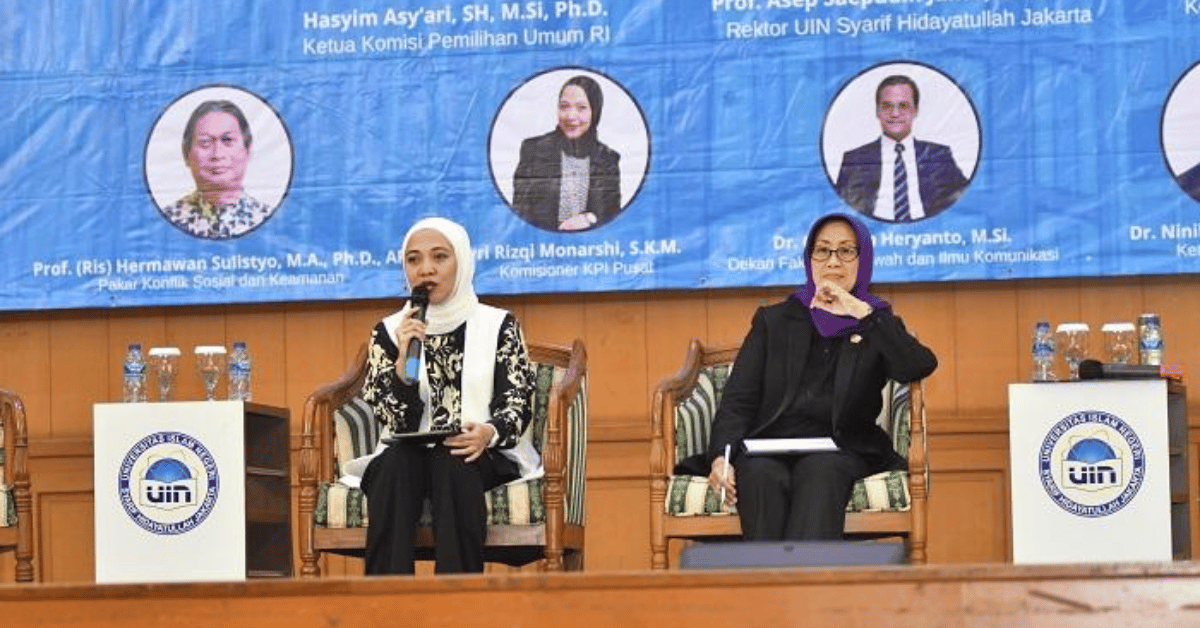
Participants discussed the challenges facing Indonesian democracy following the 2024 general election. Topics included political competition, voter participation, political communication, money politics, and the need for stronger democratic institutions. Representatives of different parties were able to communicate their perspectives within the same academic forum. The discussion also involved academics and civil society representatives who contributed analysis concerning electoral governance and democratic reform. The programme demonstrates how Syarif Hidayatullah State Islamic University Jakarta facilitates dialogue among political stakeholders with different affiliations while encouraging critical evaluation of democratic challenges.
4. Encouraging Dialogue between Legislators from Different Political Parties

On 8 October 2024, the Political Science Study Programme at the Faculty of Social and Political Sciences organised a Studium General entitled The Contribution of Young People to Political Development. The event featured Ahmad Andi Wibowo, a member of the South Tangerang Regional House of Representatives affiliated with the National Awakening Party (PKB), and Elva Farhi Qolbina, a member of the Jakarta Regional House of Representatives affiliated with the Indonesian Solidarity Party (PSI). Both legislators participated in a discussion concerning political development, youth engagement, and opportunities for the younger generation to contribute to democratic governance. By inviting legislators representing different political parties, the University provided an academic setting for the exchange of political experiences and perspectives.
The forum also encouraged students to understand political participation beyond electoral competition, including the responsibilities of public representatives and the importance of civic engagement. This activity reinforces the University's role in creating opportunities for dialogue across party affiliations.
5. Connecting Government Officials, Civil Society, and Students

On 4 August 2025, the Faculty of Social and Political Sciences hosted a public discussion associated with the tenth anniversary of the Indonesian Political Science Student Association (HIMAPOL Indonesia). The event brought together Banten Governor Andra Soni, representatives of civil society organisations, academics, and university students. The programme discussed political awareness, democratic participation, and the importance of strengthening the political capacity of young people. Participants highlighted the role of students as critical partners in democratic development and public governance.
The involvement of government officials, academic communities, and civil society representatives demonstrates the University's continued support for dialogue involving different public stakeholders. The event complemented the University's earlier multiparty forums by expanding opportunities for interaction between public officials and civic stakeholders.
6. Strengthening Democratic Accountability through Academic Questioning
An important feature of the University's political forums is the opportunity for participants to critically examine public statements and policy proposals. During UNGKAP BANTEN, academic panellists questioned competing gubernatorial candidates about their programmes and accountability for campaign commitments. At Election Fest, political representatives and academic speakers examined challenges associated with electoral competition, political communication, and the quality of democratic participation. These discussions encouraged participants to consider the relationship between political promises, public expectations, and institutional responsibility. By facilitating critical questioning, the University contributes to public understanding of democratic accountability and the importance of transparent governance.
7. Promoting Political Literacy and Student Participation
Political dialogue is also an important educational opportunity for university students. Through direct engagement with political candidates, legislators, government officials, and civil society representatives, students can develop a deeper understanding of democratic institutions and public policy. The University's forums encourage students to compare political arguments, recognise competing perspectives, and assess public issues critically. Student organisations also play an active role in organising these activities, demonstrating their contribution to democratic education.
The participation of students as organisers, audiences, and discussion participants strengthens their opportunities to engage with political processes in an academic environment. These activities support the development of informed and responsible civic participation.
8. Maintaining an Inclusive Environment for Political Discussion
The University's documented political forums demonstrate that individuals with different political affiliations can participate in shared academic discussions. The participation of competing candidates and representatives of different parties provides practical evidence of openness to multiple political perspectives. Academic moderation, structured discussion sessions, and opportunities for questioning contribute to a setting where public issues can be examined constructively.
However, the available event reports do not establish that the University has adopted a formal neutrality protocol or specific confidential safe-space procedures for all political discussions. The documented evidence therefore demonstrates the provision of multiparty academic dialogue platforms rather than a separately verified institutional safe-space certification.
9. Strengthening the University's Role in Democratic Governance
The University's political dialogue activities during 2024–2025 demonstrate continuing engagement with democratic governance. The UNGKAP BANTEN forum provided an opportunity for competing electoral candidates to discuss policy proposals. Election Fest brought together representatives of three political parties to evaluate democratic challenges. The Political Science Studium General facilitated discussion between legislators from different political affiliations. The HIMAPOL Indonesia public discussion strengthened interaction among government representatives, civil society, academics, and students. Together, these activities illustrate the University's contribution to democratic participation through the provision of academic discussion platforms.
10. Contribution to SDG 16: Peace, Justice and Strong Institutions
Syarif Hidayatullah State Islamic University Jakarta demonstrates a commitment to inclusive democratic dialogue by providing academic spaces for political stakeholders with different perspectives. During 2024–2025, the University facilitated discussions involving competing electoral candidates, political party representatives, legislators, government officials, civil society organisations, and students. These programmes provided opportunities to examine political challenges, discuss public policies, and strengthen democratic accountability.
The documented participation of different political stakeholders in shared academic forums provides direct evidence that Syarif Hidayatullah State Islamic University Jakarta offers platforms for constructive political dialogue.
Through these activities, the University contributes to Sustainable Development Goal 16, particularly Indicator 16.3.4, by supporting democratic engagement, political education, and dialogue across political differences.
Source :
https://www.uinjkt.ac.id/id/senat-mahasiswa-uin-jakarta-uji-gagasan-cagub-dan-cawagub-banten-2025-2029
https://www.fdikom.uinjkt.ac.id/id/perludem-gandeng-fdikom-uin-syarif-hidayatullah-jakarta-menggelar-seminar-nasional-evaluasi-pemilu-2024-menatap-masa-depan-demokrasi
https://fisip.uinjkt.ac.id/id/studium-general-prodi-ilmu-politik-kontribusi-generasi-muda-dalam-pembangunan-politik
https://www.uinjkt.ac.id/index.php/id/bangkitkan-kesadaran-politik-kaum-muda-gubernur-banten-hadiri-10-tahun-milad-himapol