Beyond Being AI Users: FITK UIN Jakarta Emphasizes Critical Reasoning and Academic Integrity
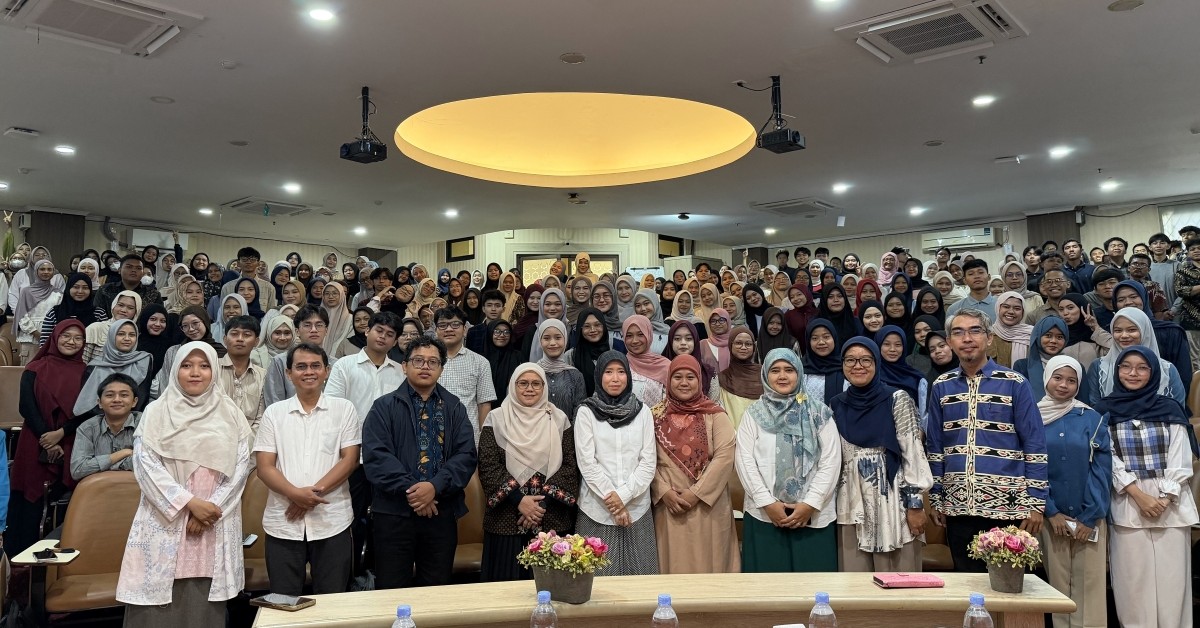
Mahmud Yunus Theater Room, UIN News Online – The Faculty of Educational Sciences (FITK), Mathematics Education Study Program at UIN Syarif Hidayatullah Jakarta successfully held a Studium Generale titled “Utilization of Artificial Intelligence (AI) in Mathematics Learning: Planning, Process, Assessment, and Products.” The event was organized to enable students to utilize AI as critical, creative, ethical, and responsible users, prospective educators, and researchers. The event took place at the Mahmud Yunus Theater Room, 3rd Floor of FITK, on Monday (28/09/2026).
The Studium Generale served as a reminder to UIN Jakarta Mathematics Education students that AI remains a partner for learning in aspects such as developing instructional media, creating Student Worksheets (LKPD), exploring concepts, and supporting research. However, the ability to read, comprehend concepts, think critically, and verify information remains the primary prerequisite. Presenting Vice Dean III of FITK, Salamah Agung, M.A., Ph.D., Junior Researcher at the Research Center for Education under the National Research and Innovation Agency (BRIN) who is also an active academician, Soeharto, M.Pd., Ph.D., and Lecturer in Mathematics Education at UIN Jakarta, Dr. Gusni Satriawati, M.Pd., the speakers enlivened the event moderated by Ikhsan Muttaqin, M.Pd.
Vice Dean III of FITK, Salamah Agung, M.A., Ph.D., in her opening remarks stated that AI can support learning as it develops, but its utilization requires strict adherence to ethics and academic integrity. In particular, Mathematics Education students need to leverage this technology as a space for creative innovation, including through the development of instructional media and learning websites.
Furthermore, Junior Researcher at the Research Center for Education under BRIN and active academician, Soeharto, M.Pd., Ph.D., elaborated on opportunities for AI utilization in learning across lesson planning, teaching materials, LKPD, assessments, educational comics, and learning media. AI platforms such as ChatGPT, Gemini, Claude, Gemini Gems, Scite, Paperpal, and DeepL were highlighted. In his presentation, AI can transform raw materials into interactive and engaging learning products. However, the user's fundamental understanding remains the core foundation.
“It is impossible to effectively use AI if you lack foundational knowledge,” he stated.
Claude and Gemini themselves operate differently when solving mathematical problems. Students are not merely expected to pick the final answer, but must scrutinize the logical consistency of every step and assumption used. For instance, in a problem involving a triangle with side lengths of 4 cm, 7 cm, and 3 cm, AI can indeed calculate its perimeter to be 14 cm. However, before accepting this result as correct, students must verify whether those three side lengths actually satisfy the fundamental condition required to form a valid triangle.
Furthermore, Soeharto, M.Pd., Ph.D., also emphasized the crucial foundation of prior knowledge for students. This foundation is decisive in enabling them to test accuracy and relevance, as well as correct potential AI errors. To him, the human role of students is irreplaceable in reading, comprehending, editing, verifying reference sources, and taking full responsibility for the validity of their final work.
“AI is merely a learning partner or learning collaborator. Do not blindly trust it first; check and verify it first,” he added.
In practice, AI can also be leveraged to support scientific writing, ranging from conducting literature searches, brainstorming, refining language usage, translating, and paraphrasing, to assisting in the literature review process. While AI can be used in preparing scientific papers, its application must remain transparent and responsible. Students were also introduced to Scite to assist in literature discovery and citation analysis, as well as Paperpal to support academic writing. Nevertheless, students must continue to comprehend and ensure the validity of sources referenced in their academic work.
“If you want to produce a good piece of writing, you need quality references. Reading remains essential,” he concluded.
On the other hand, Lecturer in Mathematics Education at UIN Jakarta, Dr. Gusni Satriawati, M.Pd., explained that AI can be utilized in mathematics learning, particularly in geometry topics. AI can assist when students hit a wall in understanding concepts, working through practice exercises, evaluating solution steps, and serving as a mentor in designing lesson plans and teaching materials. Even so, answers provided by AI must still be thoroughly reviewed and re-tested.
In research, the use of AI must also follow prevailing academic regulations, including verifying sources and including an AI disclosure statement in accordance with policy guidelines within the UIN Jakarta academic environment. In discussions surrounding AI detectors, students were also reminded that AI detection scores cannot serve as the sole benchmark for evaluating a piece of writing. What must also be scrutinized is the originality of ideas, validity of sources, authorial understanding, and honesty in AI usage.
In closing, AI can help humans find a path, but humans must remain the ones who understand the direction and destination of that path. Through this activity, students are expected to utilize AI not merely as passive consumers, but as critical, creative, ethical, and responsible users.