
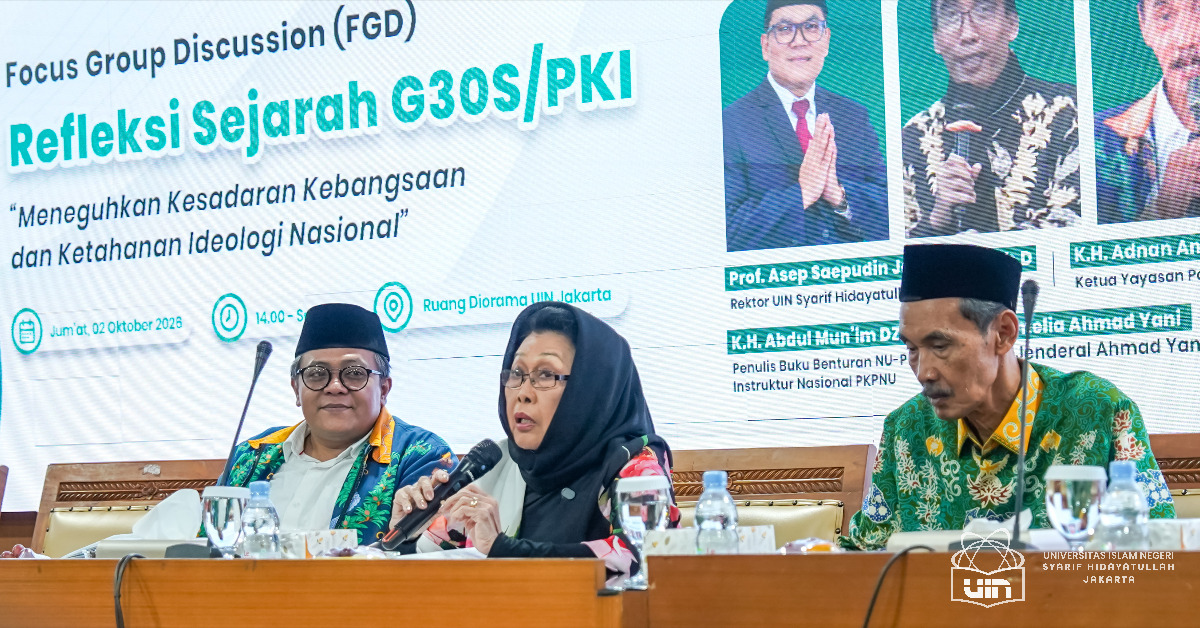
Attending UIN Jakarta, Daughter of General Ahmad Yani Shares Historical Testimony and Literacy Heritage



Diorama Room, UIN News Online – UIN Syarif Hidayatullah Jakarta, in collaboration with the Panata Dipantara Foundation and the Nahdlatul Ulama (NU) community, hosted a Focus Group Discussion (FGD) titled “Reflecting on the History of G30S/PKI: Strengthening Civic Consciousness and National Ideological Resilience” in the Diorama Room on Friday (02/10/2026).
The event was attended by the Rector of UIN Jakarta, Prof. Asep Saepudin Jahar, M.A., Ph.D.; Vice Rector I for Academic Affairs, Prof. Dr. Ahmad Tholabi, M.H., M.A.; and Vice Rector III for Student Affairs, Prof. Ali Munhanif, Ph.D. The forum featured prominent guest speakers, including Chairman of the Panata Dipantara Foundation K.H. Adnan Anwar; Author of the White Paper on the Clashes between NU and PKI K.H. Abdul Mun’im DZ; and the third daughter of the late General Ahmad Yani, Amelia Ahmad Yani.
In his opening remarks, Rector of UIN Jakarta Prof. Asep expressed his appreciation for the collaborative effort between UIN Jakarta, the Panata Dipantara Foundation, and the NU community. According to Rector Asep, a comprehensive understanding of history forms the primary foundation for building students' ideological resilience.
“The key elements of personal fortitude and pride are knowing history, learning from history, and understanding history critically. Without these, we lack any firm anchor,” he noted.
The Rector also reminded students not to forget national hero figures such as Prince Diponegoro, K.H. Ahmad Dahlan, and B.J. Habibie. Historical understanding serves to filter positive values in safeguarding the integrity of the Unitary State of the Republic of Indonesia (NKRI).
“Whatever is good, we adopt as pillars of personal strength, and whatever falls short, we treat as lessons to leave behind. Crucially, we must preserve this nation in all its diversity and unity,” he concluded.
Chairman of the Panata Dipantara Foundation K.H. Adnan Anwar explained that this discourse is routinely initiated by the NU community to address historical dynamics and deliver accurate historical education to the younger generation, particularly Gen Z and Gen Alpha.
He highlighted the emerging tendency toward ahistorical readings of history, which risk distorting the facts surrounding the 1965 events.
“Contemporary phenomena are frequently read in ahistorical ways. Perpetrators are portrayed as victims, while the actual victims are framed as perpetrators,” he noted.
According to K.H. Adnan Anwar, the presence of the families of Heroes of the Revolution in this discussion was vital for conveying the true chronology of events from the victims' perspective, ensuring history is not obscured by propaganda framing.
Author of the “White Paper on the Clashes between NU and PKI 1948–1965,” K.H. Abdul Mun’im DZ, provided an in-depth analysis of the historical dimensions of the PKI movement. According to him, the historical PKI relied heavily on media propaganda strategies and public opinion formation rather than purely physical defense capabilities.
He further emphasized that the resistance mounted by NU and the Indonesian National Armed Forces (TNI) against the communist movement at the time was a self-defense measure to preserve the state ideology.
“The PKI was highly adept at leveraging issues and media propaganda. The younger generation must not be misled by opinion shaping that ignores the background as well as the prologue and epilogue of history,” he stated.
Kiai Mun’im called on the academic community to continuously safeguard the integrity of the nation's historical narrative to prevent confusion at both academic and societal levels. “The victory over that movement represents a victory for Pancasila, which we must continuously preserve and give thanks for together,” he concluded.
A poignant testimony was shared by the third daughter of the late General Ahmad Yani, Amelia Ahmad Yani. She shared her emotional journey through the difficult periods following the tragic 1965 events and her efforts to achieve healing through literacy.
She revealed that the healing process for historical trauma does not originate externally, but stems from inner peace and the courage to document truth through writing.
“I faced many bitter experiences, but what truly heals historical wounds comes from within ourselves. For me, the greatest legacy and asset are these historical records and books,” she noted.
She expressed her hope that the eight historical books she authored will continue to be read and utilized as literary references by the younger generation in understanding the sacrifices of national heroes.
The FGD was also attended by distinguished public figures, scholars, and academics, including the eighth son of the late General Ahmad Yani, Edi; NU Youth Leader Gus Irfan Awaluddin; NU Scholar K.H. Hariri Makmun; Banyuwangi NU Leader K.H. Mansyur; BRIN Nuclear Specialist Prof. Dr. Ir. KH. Atik Bintoro, M.T., APU; Chairman of PCNU South Tangerang K.H. Abdullah Mas'ud; and PTIQ Jakarta Representative K.H. Abdurrosyid. The event concluded with a historical documentary screening and an interactive discussion with UIN Jakarta students.