
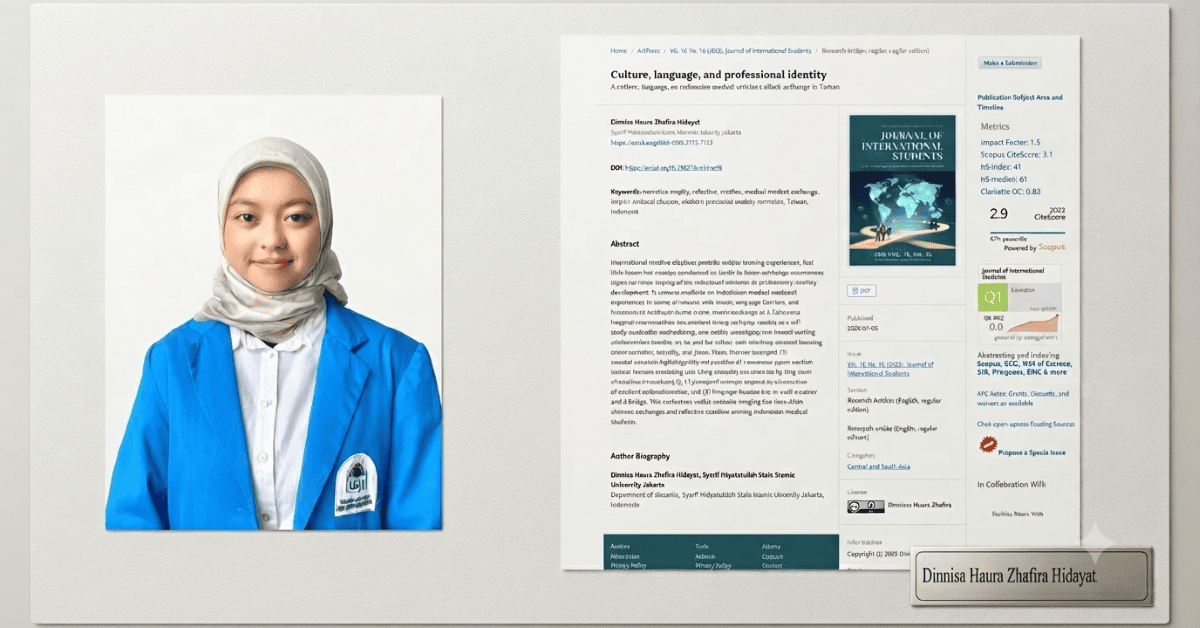
Astounding Achievement: Medical Undergrad of UIN Jakarta Shatters Peer-Review Barriers with a Rare Scopus Q1 Publication
JAKARTA, UIN Online News – In an extraordinary academic feat that routinely eludes veteran global professors, Dinnisa Haura Zhafira Hidayat, an undergraduate student at the Faculty of Medicine (FK) UIN Jakarta, has officially penetrated the upper echelons of international scientific publishing. Confirmed on Monday, July 6, 2026, Haura successfully published her comprehensive qualitative research paper in the prestigious Journal of International Students, a top-tier and Scopus Q1-indexed publication renowned for its hyper-selective peer-review process.
What elevates this milestone into an absolute academic anomaly is consistency. This Q1 paper marks Haura’s third Scopus-indexed publication out of a staggering portfolio of 18 scientific papers she has authored during her undergraduate tenure, solidifying her status as a prolific young force in global medical education research.
Her newly minted study, titled "Culture, Language, and Professional Identity: A Narrative Inquiry of an Indonesian Medical Student's Clinical Exchange in Taiwan," is a direct scholarly output of her one-month clinical mobility deployment at the Far Eastern Memorial Hospital’s Department of Dermatology in Taiwan.
Avoiding standard, high-cost laboratory trials, Haura utilized a highly sophisticated qualitative methodology known as narrative inquiry through a self-study approach. By utilizing rigorous daily logging and real-time reflective practices (reflection on, in, and for action) during her foreign clinical clinical rotation, she managed to map out the psychological and sociological shifts required to build a professional medical identity.
In short, her paper dissects three core geopolitical and human elements:
-
The Cultural Adaptation Paradox: The striking friction between the general warmth of Taiwanese citizens toward temporary visitors versus the sharp social distance felt by foreign medical personnel staying for extended periods.
-
Clinical Identity Formation: How exposure to foreign medical facilities fundamentally accelerates a student's transition from an academic learner to a practicing medical professional.
-
The Linguistic Barrier: The dual nature of language acting simultaneously as a high-stakes barrier to critical medical communication and a cross-cultural professional bridge.
"Alhamdulillah, this field exposure did not merely polish my clinical techniques, but it completely reframed my cultural worldview as a future physician navigating a globalized healthcare sector," Haura noted during an institutional debriefing.
Reacting to the publication, the Dean of the Faculty of Medicine, Dr. Achmad Zaki, M.Epid., Sp.OT., highly commended Haura’s intellectual prowess, framing her success as a case study of how Indonesian medical undergraduates can seamlessly out-compete international peers in core scientific production. "This publication proves that our students possess the advanced cognitive capacity to generate high-impact research relevant to global policy," Dean Zaki stated.
UIN Jakarta's Vice Rector for Academic Affairs, Professor Ahmad Tholabi, echoed this sentiment, calling the feat "highly extraordinary" for a student who has not even earned her full medical doctor (MD) license yet. Through this breakthrough, UIN Jakarta continues to cement its strategic blueprint of embedding a high-intensity research culture early within its undergraduate ecosystem.
(Aida/Zaenal/Arifin)