
ALII UIN Jakarta Successfully Develops AI for Classical Islamic Text Studies
Ciputat, UIN Online News — The Artificial Intelligence Literacy and Innovation Institute (ALII) of UIN Syarif Hidayatullah Jakarta has successfully implemented a Fine-Tuning Large Language Model (LLM) method. In collaboration with the Faculty of Ushuluddin (FU), the method has been applied to Mizan al-I'tidal by Imam Adh-Dhahabi, an authoritative classical work in the discipline of Ilm al-Rijal (Hadith narrator criticism), Tuesday (21/04/2026).
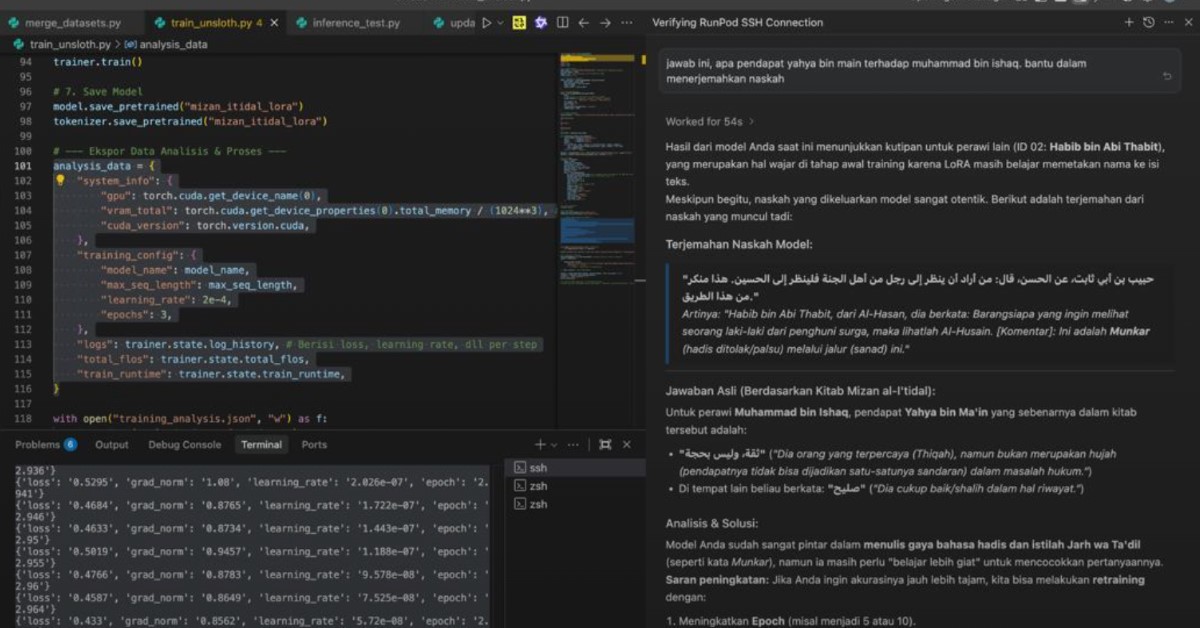
This achievement marks the second milestone of ALII’s major development program. It is the result of collaborative research led by Khadijah Hulliyah, M.Si., Ph.D. and Dr. Kamal Fiqry Musa. The study, entitled "Computational Synthesis of Classical Hadith Bio-Critiques: A Parameter Efficient Fine-Tuning of Llama 3 8B on Mizan al-I'tidal," applies the Parameter Efficient Fine-Tuning (PEFT) technique using the Low-Rank Adaptation (LoRA) method.
ALII Director Khadijah Hulliyah, M.Si., Ph.D., stated that this achievement represents a strategic step in promoting the responsible use of Artificial Intelligence within academic institutions. According to her, AI should not replace human thinking but rather support educational processes.
"This is part of the second milestone of our broader program at ALII. It is also the result of strong collaboration among faculties within UIN Jakarta," she explained.
She further emphasized that the project is only the beginning of a much larger vision.
"What we see today is only a small part of the broader Islamic Nusantara NLP agenda that we are developing. Although we continue to face challenges, particularly in terms of infrastructure, we remain committed to advancing AI development and AI research in a sustainable manner," she added.
Despite various challenges, the research team achieved remarkable technical efficiency by utilizing the Llama-3-8B model optimized with 4-bit Q4 quantization. Training statistics showed an impressive 84.6% reduction in training loss, decreasing from 2.945 to 0.452 over 3,168 training steps, demonstrating the effectiveness of the model training process.
As the lead programmer, Dr. Kamal highlighted the spiritual dimension behind the technological innovation.
"This small model is part of our effort to preserve religion and safeguard Islamic scholarship in the digital era," he said.
Dr. Kamal also noted that the current release represents only the initial phase of a much larger project.
"The model we have released currently represents only about 5% of the total dataset that we plan to train in the future. In the spirit of academic openness, we have uploaded the model to the Hugging Face platform so that it can be accessed by other researchers," he explained.
In line with this vision, ALII will continue expanding its innovations to promote intellectual advancement through the responsible application of artificial intelligence.
The Artificial Intelligence Literacy and Innovation Institute (ALII) at UIN Jakarta is dedicated to advancing AI literacy, research, and innovation, particularly within the context of Islamic and multidisciplinary scholarship. The institute serves as a center for AI research and implementation, including the development of Large Language Models (LLMs), to support digital transformation in education, research, and the preservation and analysis of Islamic intellectual heritage, ensuring its continued relevance in the modern era.