
AIUA Peace Panel 2026: Constructing Inclusivity Through Cross-Border Academic Ecosystems
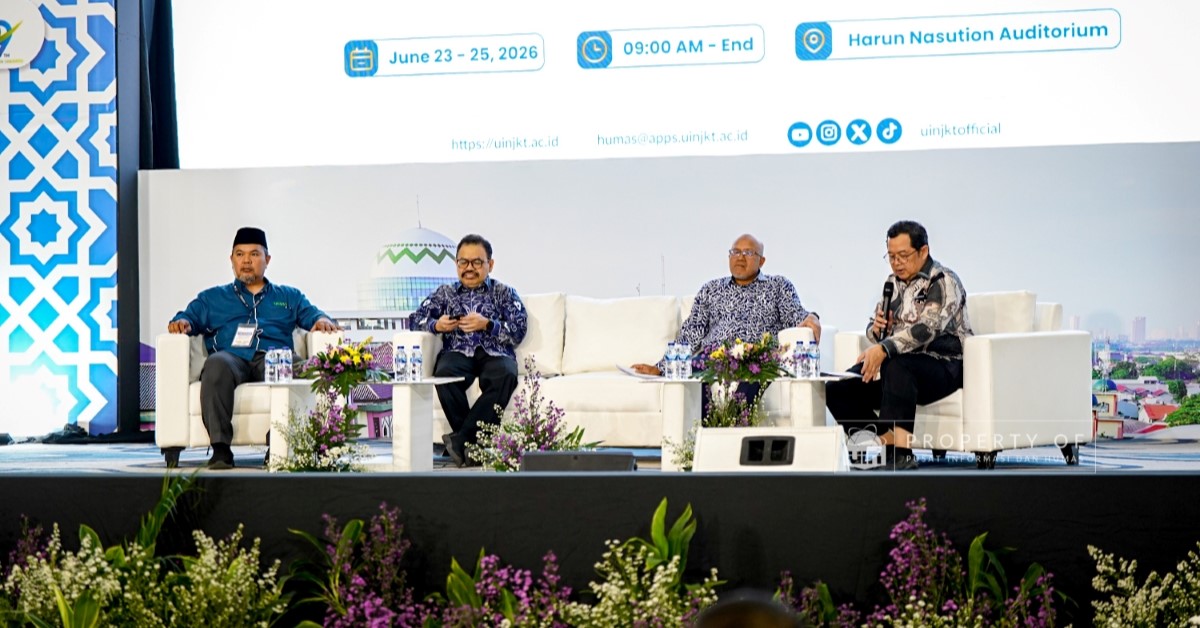
JAKARTA, UIN Online News – The first executive session of the 15th Asian Islamic Universities Association (AIUA) International Symposium focused heavily on utilizing the moral authority and social cohesion of universities to dismantle deep-seated geopolitical crises. The high-stakes international assembly, hosted on the main campus of UIN Syarif Hidayatullah Jakarta from June 23 to June 25, 2026, brought together top-tier Southeast Asian experts to construct highly technical, research-driven peace architectures for fractured regions.
Operating under the strategic umbrella “Transforming Islamic Higher Education for Advancing Global Peace, Resilience, and Inclusive Development,” the executive panel featured two prominent intellectual leaders, namely the Chairman of the Ibn Auf Institute of Technology Thailand, Dr. Shukree Langputeh, and the Rector of UIN Sunan Kalijaga Yogyakarta, Professor Noorhaidi, Ph.D.
Delivering a raw, field-level analysis, Thailand’s Dr. Shukree Langputeh exposed the severe structural challenges suffocating Islamic education in Southern Thailand, a region scarred by prolonged ethno-political warfare and sharp educational achievement disparities. Despite these security threats, Dr. Langputeh revealed that local grassroots communities maintain an unshakeable, deep-seated trust in Islamic academic institutions over state apparatuses.
"As strategic civil actors in conflict zones, we aggressively deploy conflict management models that are entirely rooted in empirical knowledge and rigorous research, not merely based on emotional rhetoric," Dr. Langputeh declared in English.
Dr. Langputeh outlined a bulletproof four-tier peacebuilding framework being deployed in Thailand, which consists of the systemic embedding of Islamic ethical virtues such as absolute justice and consultative dialogue (Shura), the execution of dialogical pedagogy among university faculty, the engineering of conflict-sensitive curricula, and the activation of regional university defense networks through the AIUA. Furthermore, he emphasized the critical need for regional economic resilience by launching Work-Integrated Learning (WIL) frameworks to combat youth unemployment in war-torn provinces.
Reinforcing this operational mandate, Professor Noorhaidi, Ph.D., argued that modern Islamic universities hold a massive, unique philosophical advantage through the integration and interconnection of sciences. He stated that by dismantling the artificial walls between classical theology, modern humanities, advanced social sciences, and hard technology, the academic community becomes naturally insulated against radical, exclusive mindsets.
"Global society is currently trapped in severe social polarizations fueled by hyper-accelerated technological advances and brutal competitions over economic and political resources," Professor Noorhaidi warned. "Therefore, Islamic higher education must scale up its operational role to actively construct a civil society that is structurally committed to global peace."
To prepare the next generation of global peace actors, Professor Noorhaidi outlined three essential character foundations for contemporary university students, which are the aggressive development of logical, critical, and creative thinking matrices; the mastery of advanced international languages alongside cross-cultural communication skills; and the absolute preservation of behavioral integrity, encompassing transparency, honesty, and radical social inclusion.
The international panel concluded by highlighting the host institution, UIN Syarif Hidayatullah Jakarta, as a live, working model of this integrated philosophy. The university has successfully engineered a highly inclusive, pluralistic campus ecosystem by opening its academic faculties to students from diverse non-Muslim religious backgrounds.
By deliberately facilitating a genuine, essential, and unprotected space for interfaith dialogue, UIN Jakarta provides an empirical, real-world blueprint where future Asian leaders can directly experience, practice, and replicate systemic religious harmony and deep mutual respect for diversity.
(Khoirillah/Zaenal/Arifin/Photo: Azka Raysa)