
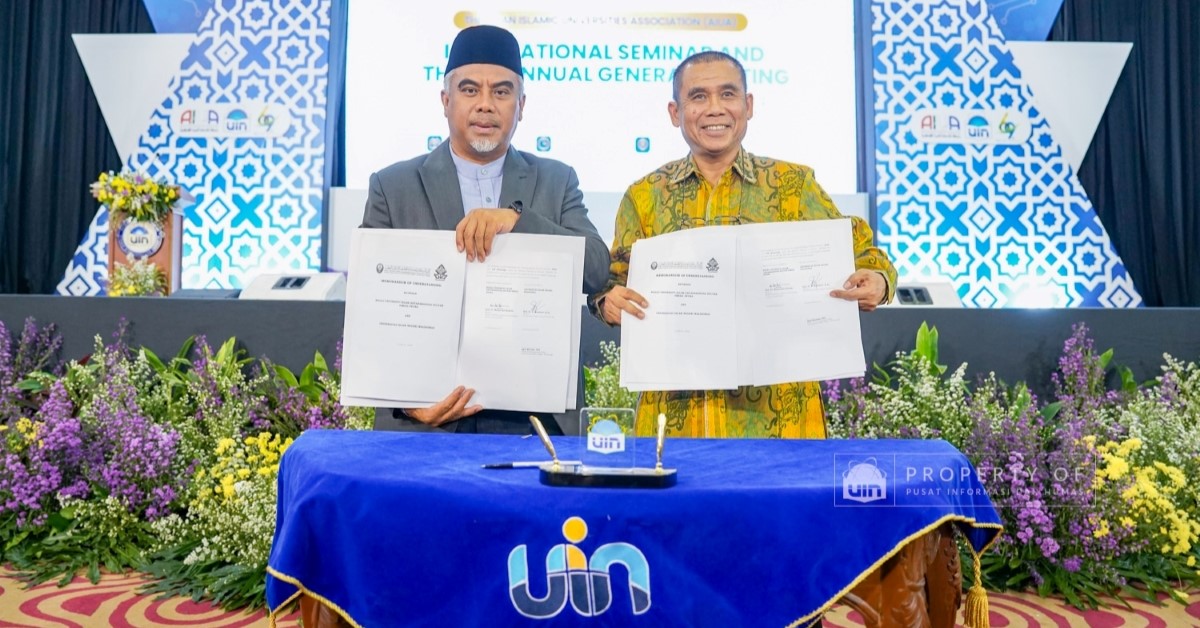
AIUA 2026 Summit Forges High Level Academic Alliance Between Public and Private Asian Universities
JAKARTA, UIN Online News – Directly confronting the complex global intersections of geopolitical friction and technological disruption, UIN Syarif Hidayatullah Jakarta leveraged its presidential tenure within the Asian Islamic Universities Association (AIUA) to launch the central assembly of the AIUA International Seminar and Annual General Meeting. Operating under the strategic banner “Transforming Islamic Higher Education for Advancing Global Peace, Resilience, and Inclusive Development,” the high-stakes summit positions Asian academic institutions as active, influential actors in transnational peace architectures and sustainability policies.
The executive opening, hosted by the Rector of UIN Jakarta, Professor Asep Saepudin Jahar, Ph.D., served as a historic convergence point. The university successfully mobilized top-tier leadership from major Islamic higher education institutions across Asia alongside rectors from 22 premier public and private universities across the Jakarta metropolitan area and Banten province.
The elite list of institutional guests included the rectors of the International Islamic University Indonesia (UIII), University of Indonesia (UI), Jakarta State University (UNJ), IPB University, Universitas Terbuka (UT), alongside executive leaders from prominent private institutions such as Bina Nusantara University (BINUS), Universitas Paramadina, Al Azhar University Indonesia, and Universitas Muhammadiyah Jakarta (UMJ).
The international summit featured high-impact policy addresses from national and global governance architects. Leading the first keynote session, the 10th and 12th Vice President of the Republic of Indonesia, Dr. (H.C.) H. Muhammad Jusuf Kalla, delivered a blunt paper titled “Islamic Leadership and Peacebuilding in a Fragmented Global Order.”
In a sharp intellectual critique, Kalla interrogated the current trajectory of Islamic higher education in Indonesia, arguing that institutions have become overly consumed by political discourse at the expense of empirical scientific advancement. He demanded a radical, immediate curriculum shift to balance classical theological jurisprudence with hard applied technology and market economics.
"Universities must aggressively collaborate with the government and civil society to double down on two non-negotiable pillars, which are entrepreneurship and advanced technology," Kalla stated on the sidelines of the summit. "That is the only bulletproof formula for a nation to achieve real global advancement."
Reinforcing this call for structural transformation, the Governor of the National Resilience Institute of the Republic of Indonesia (Lemhannas RI), Dr. Ace Hasan Syadzily, delivered the second keynote briefing titled “Islamic Higher Education, Democracy, and Global Transformation.” Syadzily focused heavily on building ideological resilience and ethical anchors among the student body to withstand the rapid, unsettling tides of modern digital disruptions.
The academic consortium transitioned into intense field-level analysis during its first executive panel session, moderated by UIN Jakarta's international political expert, Professor Ali Munhanif, Ph.D. The panel featured highly technical presentations on grassroots conflict resolution from Dr. Shukree Langputeh, Chairman of the Ibn Auf Institute of Technology Thailand, and Professor Noorhaidi, Ph.D., the newly appointed Rector of UIN Sunan Kalijaga Yogyakarta.
The operationalization of these academic networks will be supported by state-level frameworks during the diplomatic state dinner. The Director General of Islamic Education at the Indonesian Ministry of Religious Affairs, Professor Muhammad Amin Suyitno, is scheduled to deliver a strategic directive titled “Strengthening PTKIN Global Engagement through Networking, Collaboration, and Institutional Synergy.”
The critical discourses generated throughout the international seminar are engineered to serve as the structural foundation for the historic "Declaration on Islamic Higher Education for Peace, Resilience, and Inclusive Development." This declaration, alongside the drafting of the AIUA Strategic Plan 2026–2028, will be officially ratified during the closed-door Annual General Meeting at the Diorama Room. Through this high-visibility presidency, UIN Jakarta proves its refusal to act as an isolated ivory tower, cementing its role as a strategic engine for global civilization and international peace.
(Irfan Mufid/Zaenal/Arifin/Photo: Azka Raysa)