AICIS+ 2026 to Feature Leading Global Scholars in Dialogue on Islam, Science, and Civilization
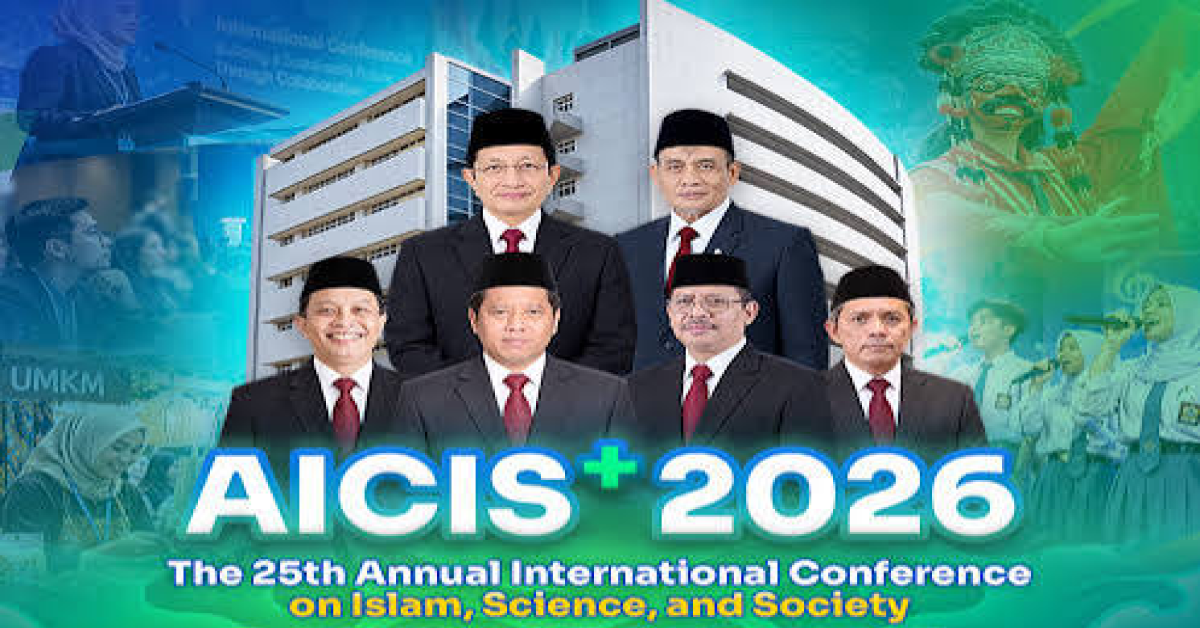
JAKARTA, Berita UIN Online – The 25th Annual International Conference on Islam, Science, and Society (AICIS+) 2026 will bring together prominent scholars, researchers, and experts from leading universities and international institutions worldwide. Scheduled for November 17–20, 2026, at Universitas Islam Negeri Siber Syekh Nurjati Cirebon (UIN SSC) in West Java, Indonesia, the conference will provide an international platform for exploring how Islamic scholarship can contribute to addressing contemporary global challenges.
According to the AICIS+ 2026 conference handbook, the featured speakers represent several countries, including Australia, China, Germany, Iran, Palestine, Japan, Finland, and the Netherlands. Their expertise spans a broad range of disciplines, including Islamic studies, Qur'anic interpretation, interfaith relations, philosophy, the history of civilization, artificial intelligence (AI), technology, anthropology, and sustainable development.
Among the featured international scholars is Prof. Abdullah Saeed of the University of Melbourne, Australia, a leading authority on contemporary Islamic thought. His research focuses on contextual approaches to Qur'anic interpretation, ijtihad, Islamic legal reform, religious freedom, and human rights.
The conference will also feature Prof. Qi Jinjiang of the Confucius Research Institute of China, whose work explores Confucian ethics and intellectual exchanges between Confucianism and Islam. Prof. Dr. Simone Sinn of the University of Münster, Germany, will contribute expertise in religious pluralism, interfaith relations, and intercultural theology.
The intersection of technology and Islamic scholarship will be explored through the participation of Prof. Dr. Behrouz Minaei Bidgoli of Iran University of Science and Technology. His research in computer engineering, machine learning, data mining, and natural language processing offers valuable perspectives on the application of digital technologies to knowledge development, including the computational study of Islamic texts.
Other international speakers include Maho Nakayama of the Sasakawa Peace Foundation, Japan, whose professional work focuses on peacebuilding and conflict resolution, and Prof. Dr. Timo Kaartinen of the University of Helsinki, Finland, whose research in social and cultural anthropology examines ethics, traditions, and social dynamics in Southeast Asia.
Indonesian scholars and practitioners will also play an important role in the conference. They include Dr. Jumana Hazem Elsamna of Universitas Islam Internasional Indonesia (UIII), a Palestinian scholar specializing in Hadith and Sunnah studies; Dr. Abellia Anggi Wardani of Universitas Indonesia, whose research interests include cultural diversity, community resilience, and sustainable development; and Dr. Nur Rofiah, Bil. Uzm., of UIN Syarif Hidayatullah Jakarta and Institut PTIQ Jakarta, whose scholarship focuses on Qur'anic interpretation, women's experiences, and gender justice.
The lineup also includes Wikan Sakarinto, S.T., M.Sc., Ph.D., Director of Politeknik Mitra Industri, whose expertise centers on vocational education, applied technology, and strengthening links between education and industry. Prof. Michael Champion of Australian Catholic University, Australia, and Samia Kotele of the International Institute for Asian Studies, the Netherlands, will bring additional perspectives on history, anthropology, and religious thought.
The diversity of academic backgrounds and international perspectives reflects the central vision of AICIS+ 2026, which carries the theme “Revitalizing Islamic Civilization for Sustainable Life: Local Heritage, Technological Innovation, and Human Flourishing.” The theme highlights the importance of reconnecting Islamic intellectual, spiritual, and cultural heritage with technological innovation to foster a sustainable, inclusive, and humane civilization.
Minister of Religious Affairs: Knowledge Must Advance Human Dignity
Indonesia's Minister of Religious Affairs, Prof. Dr. K.H. Nasaruddin Umar, M.A., described AICIS+ 2026 as a significant milestone in the conference's 25-year journey. He noted that AICIS has evolved from a forum primarily dedicated to Islamic studies into a global platform where theology engages with science, technology, and pressing issues facing humanity.
He emphasized that Islamic knowledge, developed in conjunction with scientific progress, technological innovation, and sound policymaking, should make a meaningful contribution to human dignity and the common good.
According to the Minister, genuine civilizational progress requires more than the generation of knowledge. It must also be grounded in ethics and justice and supported by meaningful collaboration among universities, government institutions, industry, and society.
He also commended UIN Siber Syekh Nurjati Cirebon for hosting the 25th edition of AICIS+. The university's readiness to organize an international hybrid conference, he said, reflects the spirit of innovation, knowledge development, and collaboration promoted by this year's gathering.
Director General Calls for Research with Practical Impact
Meanwhile, the Director General of Islamic Education at the Ministry of Religious Affairs, Prof. Dr. H. Amien Suyitno, called on academics and researchers to move beyond predominantly theoretical scholarship and produce empirical, applicable research that delivers tangible benefits to society and supports national development.
He explained that the theme of AICIS+ 2026 provides a framework for translating Islamic intellectual heritage into innovation and practical solutions. This approach is particularly important in addressing contemporary challenges in education, economic justice, technological transformation, environmental sustainability, culture, diversity, and human resource development.
He further stressed that academic research must engage with the real needs of policymakers, industry, and communities. Islamic scholarship, he argued, should not remain confined to academic journals but should also generate practical solutions to pressing development challenges.
The Director General also praised UIN Siber Syekh Nurjati Cirebon for its readiness to host the international hybrid conference. He welcomed the strong interest shown by public and private Islamic higher education institutions across Indonesia in contributing to the conference's various subthemes.
As AICIS enters its 25th year, the 2026 conference is expected to further strengthen the presence and contribution of Islamic scholarship in global academic discourse. Through interdisciplinary discussions and international collaboration, the gathering aims to generate new knowledge, partnerships, and recommendations that support a more inclusive, just, and sustainable civilization.
About AICIS+ 2026
The Annual International Conference on Islam, Science, and Society (AICIS+) is an international academic forum established in 2001 as the Annual Conference on Islamic Studies (ACIS). It evolved into AICIS in 2012 and adopted its current identity, AICIS+, in 2025 to strengthen the integration of Islamic knowledge, scientific advancement, and societal development.
The 25th AICIS+ 2026 will take place November 17–20, 2026, at UIN Siber Syekh Nurjati Cirebon in West Java, Indonesia. The conference brings together academics, researchers, policymakers, practitioners, and innovators from around the world to advance the contribution of Islamic scholarship to sustainable development, cultural preservation, ethical technological innovation, and human flourishing. (zm)