
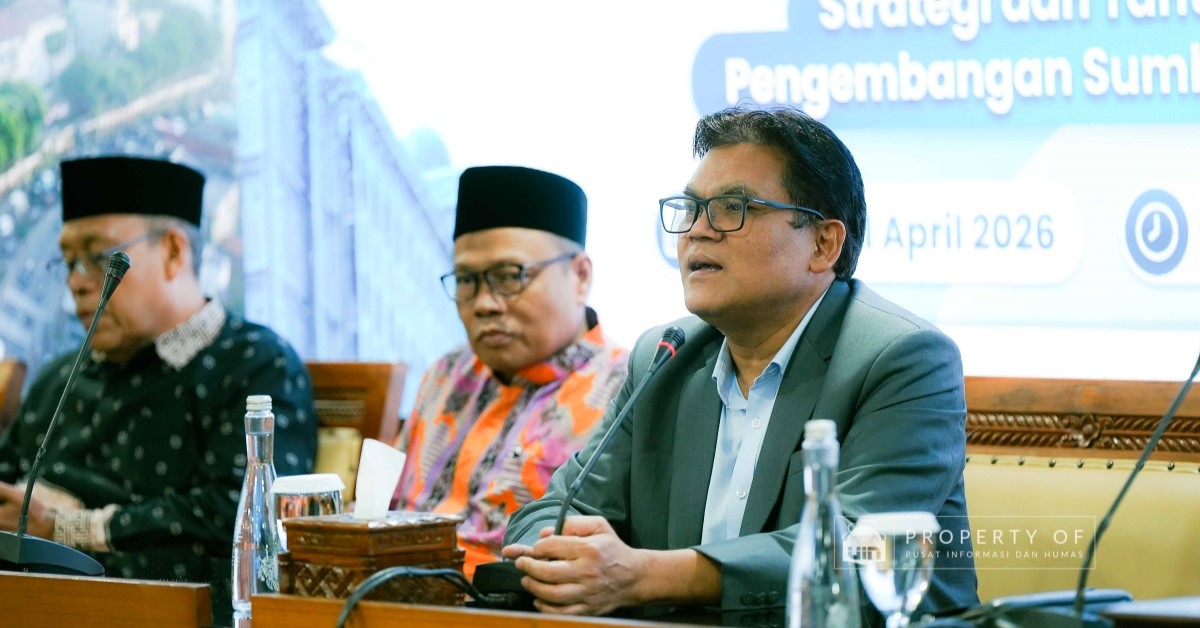
Advancing Its Vision of Excellence, UIN Jakarta Hosts Forum on Strategies for Human Resource Development in Islamic Boarding Schools
Diorama Room, UIN Online News – Amid rapid changes in the education sector, Islamic boarding schools (pesantren) are increasingly challenged to embrace innovation while preserving their long-standing traditions. In response, UIN Syarif Hidayatullah Jakarta collaborated with leaders of Islamic boarding schools across Indonesia to strengthen educational quality and institutional management by organizing a forum discussion and Memorandum of Understanding (MoU) signing ceremony under the theme "Strategies and Challenges in Education and Human Resource Development in Islamic Boarding Schools." The event was held at the Diorama Hall on the ground floor of the Harun Nasution Auditorium on Tuesday (21 April 2026).
The event was attended by the Rector of UIN Jakarta, Asep Saepudin Jahar; Vice Rector for Cooperation and Institutional Development, Din Wahid; President of the Perhimpunan Pengasuh Pesantren Indonesia (P2I), Tata Taufiq; Chair of the Forum Pesantren Alumni Gontor (FPAG), L. Zulkifli Muhadli; as well as leaders of Islamic boarding schools from across Indonesia.
In his opening remarks, Rector Asep Saepudin Jahar emphasized that the entire UIN Jakarta community is committed to working closely with pesantren to nurture students who are intellectually capable, morally grounded, and committed to the values of nationalism and Pancasila.
“The entire UIN Jakarta community will continue working together to help our students become knowledgeable, strong in character, and firmly committed to Indonesian nationalism and the true values of Pancasila. Religious, civic, and national values will continue to serve as guiding principles for Indonesia's younger generation,” he stated.
A lively panel discussion on the Familial Approach to Pesantren Education followed, moderated by Din Wahid. Drawing together the insights of four distinguished speakers—Tata Taufiq, L. Zulkifli Muhadli, Lukman Haris Dimyati, and Maskuri—he concluded that the discussion highlighted the remarkable development of Islamic educational institutions, particularly the rapid growth of Muhammadiyah Islamic boarding schools, which now number 445 institutions, a significant increase compared to previous years.
The discussion extended beyond historical and intellectual perspectives to emphasize the need for pesantren to address contemporary challenges and respond proactively to emerging societal needs.
A major focus of the forum was improving health standards within pesantren through the development of medical personnel. As a concrete initiative, 11 student cadres have been sent to the Faculty of Medicine to help promote healthier lifestyles and strengthen health awareness among Islamic boarding school communities.
“One of our priorities is improving health conditions in Islamic boarding schools. Through P2I, eleven student cadres have already been sent to the Faculty of Medicine. We also need to prepare adequate facilities and infrastructure so they can effectively promote healthy living within pesantren,” Din Wahid explained.
He further emphasized that the newly signed Memoranda of Understanding and institutional partnerships, including collaborations with universities, must be followed by tangible and progressive actions. According to him, pesantren should not only embrace technological advancement but also expand their role in broader human resource development initiatives.
“Following the signing of this agreement, we sincerely appreciate the pesantren leaders who have worked together to address these shared challenges through collaboration. We hope this partnership will continue to produce meaningful and sustainable progress,” he concluded.