LP2M UIN Jakarta Introduces the Thought of Indonesian Women Religious Scholars to the International Community through International Short Course 2026
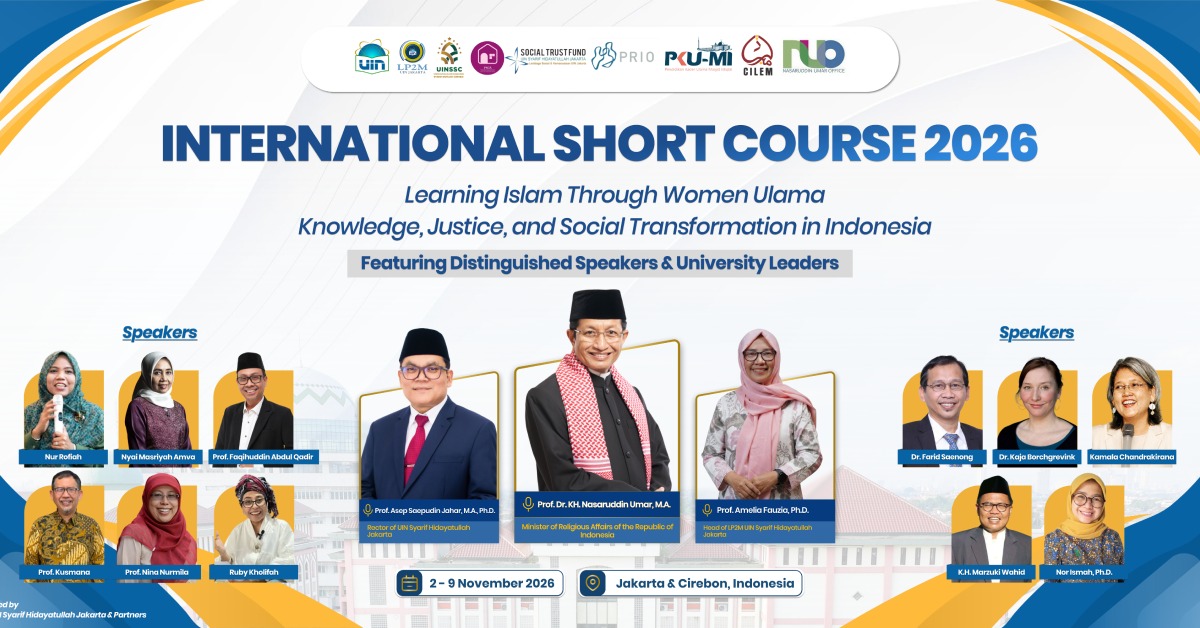
Jakarta — Universitas Islam Negeri (UIN) Syarif Hidayatullah Jakarta continues to strengthen its contribution to introducing Indonesia’s rich Islamic intellectual heritage to the international community through the organisation of the International Short Course 2026. Under the theme “Learning Islam through Women Ulama: Knowledge, Justice, and Social Transformation in Indonesia”, this international academic programme will run for a full week, from 2 to 9 November 2026, in Jakarta and Cirebon. It will highlight the contributions of women religious scholars to the development of Islamic knowledge, justice and social transformation.
The international programme is organised through a collaboration between five institutions: the Institute for Research and Community Engagement (LP2M) of UIN Syarif Hidayatullah Jakarta; the Centre for University Studies and Community Engagement (PKMU) of Istiqlal Mosque and the Nasaruddin Umar Office; LP2M of UIN Siber Syekh Nurjati Cirebon; the Faculty of Social and Political Sciences (STF) of UIN Jakarta; and the Peace Research Institute Oslo (PRIO), Norway. This collaboration provides a platform for learning and cross-border knowledge exchange on the development of Indonesian Islam, particularly the contributions of women religious scholars in fostering intellectual traditions, advocating justice and promoting social transformation.
In her statement, Chair of LP2M UIN Jakarta, Prof. Amelia Fauzia, Ph.D., explained that the programme offers academics, students, researchers and practitioners from diverse backgrounds an opportunity to explore the development of Indonesian Islamic thought firsthand.
“Through meetings with academics, women religious scholars, pesantren leaders and local communities, participants will gain not only conceptual knowledge but also practical insights into how Islamic values are applied in social life,” she said.
The Professor of History and Philanthropy Activist added that the programme also aims to strengthen academic exchange, establish international networks and encourage collaboration between higher education institutions.
“Indonesia’s experience in developing an Islamic tradition that engages in dialogue with issues of justice, humanity and human dignity offers an important perspective to be introduced to the international academic community through this forum,” she explained.
One of the main focuses of the International Short Course 2026 is the development of the Indonesian Women's Ulama Congress (KUPI), an intellectual and religious movement that strengthens the recognition of women as producers of knowledge and holders of religious authority. KUPI offers an approach to the development of Islamic thought that integrates classical intellectual traditions, women's lived experiences, maqāṣid al-sharī‘ah, deliberation and collective ijtihad.
Through this approach, participants will be invited to examine how Islamic knowledge is produced and interpreted, who is involved in the formation of religious authority, and how Islamic ethics can contribute to addressing contemporary challenges. Discussions will cover gender justice, peace, environmental sustainability, social inclusion and societal transformation.
Bringing Together Leading Academics and Religious Figures
To enrich the learning experience, the programme is scheduled to feature a number of distinguished academics, religious scholars and community figures. These include Indonesian Minister of Religious Affairs Prof. Dr KH Nasaruddin Umar, M.A.; Rector of UIN Jakarta Prof. Asep Saepudin Jahar, M.A., Ph.D.; Chair of LP2M UIN Jakarta Prof. Amelia Fauzia, Ph.D.; Prof. Kusmana, Ph.D.; Dr Nur Rofiah, Bil. Uzm.; Prof. Faqihuddin Abdul Kodir; Kamala Chandrakirana; Prof. Nina Nurmila; Nyai Masriyah Amva; Nyai Toah Ja’far; Dr Kaja Borchgrevink; Dr Farid Saenong; KH Marzuki Wahid; and Nor Ismah, Ph.D.
The programme will commence on Monday (2 November 2026) at the VVIP Hall of Istiqlal Mosque, Jakarta. The opening ceremony will be led by Rector of UIN Jakarta Prof. Asep Saepudin Jahar, M.A., Ph.D., and will feature Indonesian Minister of Religious Affairs Prof. Dr KH Nasaruddin Umar, M.A., as the keynote speaker. He will deliver a lecture entitled “Indonesia as a Laboratory of Living Islam”. The session will explore Indonesia as a learning environment for understanding diversity, pluralism and the dynamics of Islamic life. The first day's programme will also include an educational visit to Istiqlal Mosque and an intercultural dialogue among participants.
On the second and third days, learning activities will continue at UIN Jakarta through a series of sessions examining women religious scholars and Islamic knowledge, the history of KUPI, religious authority and gender justice in contemporary society. Participants will also take part in panel discussions and comparative research workshops, enabling them to compare Indonesia's experiences with gender justice issues in their respective countries or regions.
Pesantren as a Space for Direct Learning and Engagement
One of the programme's distinctive features is its community immersion approach, which enables participants to learn through direct engagement with local communities. From 5 to 7 November 2026, participants will take part in activities at Kebon Jambu Islamic Boarding School (Pesantren Kebon Jambu) in Cirebon, which is recognised for its development of women's religious leadership and gender-just practices.
At the pesantren, participants will have the opportunity to engage in dialogue with women religious scholars, join learning activities with students, observe traditional pesantren education and explore practices of leadership and community empowerment. Special sessions will feature Nyai Masriyah Amva, who will discuss women as leaders of Islamic boarding schools, and Nyai Toah Ja’far, who will address waste management and the development of environmentally conscious Islamic boarding schools, known as eco-pesantren.
Living and interacting with the pesantren community will provide participants with firsthand insights into how Islamic educational institutions function not only as centres for the transmission of knowledge but also as spaces for developing leadership, social ethics, environmental awareness and values of justice.
The learning programme will then continue at UIN Siber Syekh Nurjati Cirebon on Friday (6 November 2026). Participants will attend an academic orientation session and discussions on maqāṣid al-sharī‘ah, ethical reasoning, the mubādalah methodology, collective ijtihad and knowledge production. The sessions will include contributions from KH Marzuki Wahid, Prof. Faqihuddin Abdul Kodir, Dr Nur Ismah and Wahid Hasyim.
Through these discussions, participants will explore how social issues are identified, how women's experiences and the expertise of different stakeholders are taken into consideration, and how deliberation and religious reasoning can produce perspectives grounded in justice.
Introducing the Richness of Indonesia's Islamic History and Culture
In addition to academic and pesantren-based learning, the programme will introduce participants to the relationship between Islam, culture and local wisdom. On Sunday (8 November 2026), participants are scheduled to take part in a cultural visit in Cirebon, including an introduction to the historical heritage of the royal palaces and the local batik tradition through a Batik Trusmi workshop featuring the distinctive Megamendung motif.
This activity will provide insights into how Indonesian Islamic traditions have evolved through dialogue with local cultures. Cirebon offers an important setting for exploring the relationship between religious traditions, history, art and the everyday lives of Muslim communities.
The programme will conclude on Monday (9 November 2026) at UIN Jakarta with participants' final presentations, feedback from women religious scholars and academics, learning reflections and programme evaluation. Chair of LP2M UIN Jakarta, Prof. Amelia Fauzia, is scheduled to lead the certificate presentation and closing ceremony.
Throughout the eight-day programme, participants are expected to engage in a variety of learning activities, including academic lectures, seminars, panel discussions, interactive workshops, field visits, reflective journalling and group presentations. Topics will cover Indonesian Islam from a global perspective; women religious scholars and religious authority; gender justice and Islamic ethics; the mubādalah methodology; collective ijtihad; maqāṣid al-sharī‘ah; religion and social transformation; and Islam, culture and local wisdom.
Through the International Short Course 2026, Prof. Amelia emphasised that UIN Jakarta is expected not only to expand its international academic networks and collaborations but also to play an active role in introducing Indonesia's experience as an important centre for the development of contemporary Islamic thought.
“The contributions of women religious scholars, the pesantren tradition and Islamic practices grounded in justice represent Indonesia's intellectual wealth. These are highly relevant to enriching global dialogue on Islam and the future of a civilised society,” she concluded.
Information and Public Relations Centre, LP2M, UIN Syarif Hidayatullah Jakarta