Strengthening Waste Measurement, Recycling, and Landfill Reduction at Syarif Hidayatullah State Islamic University Jakarta
Syarif Hidayatullah State Islamic University Jakarta is committed to responsible waste management through institutional policies, waste segregation, recycling initiatives, and programmes designed to reduce the amount of waste ultimately requiring disposal at landfill sites.
The University recognises that sustainable waste management requires more than collecting and removing waste from campus. It also involves identifying waste streams, separating reusable and recyclable materials, measuring recovered waste, and improving the accountability of final disposal practices.
During 2024–2025, the University strengthened its Green Campus framework through formal waste-management guidelines, faculty-level waste bank activities, expanded waste-segregation infrastructure, environmental education, and collaboration with waste-management partners. These initiatives contribute to Sustainable Development Goal 12: Responsible Consumption and Production, particularly Indicator 12.2.4 concerning policies for measuring waste sent to landfill and waste recovered through recycling.
1. Establishing an Institutional Waste Management Policy
On 21 October 2024, Syarif Hidayatullah State Islamic University Jakarta issued Rector's Circular Letter Number 23 of 2024 concerning Waste Management. The circular implements Rector's Decree Number 1415 of 2024 concerning the Green Campus Policy.
The regulation provides guidance for students, lecturers, administrative staff, faculty leaders, and other University units regarding environmentally responsible waste management. Its provisions encourage the reduction of unnecessary packaging, the use of reusable drinking containers, and appropriate waste disposal practices.
Importantly, the circular also establishes directions for:
-
Separating organic and inorganic waste;
-
Collecting and processing recyclable materials;
-
Limiting the accumulation of waste;
-
Reusing materials through the reduce, reuse, and recycle principles;
-
Educating campus canteen operators about waste segregation and reduction;
-
Supporting education and research related to sustainable waste management.
These institutional provisions establish a formal basis for reducing waste generation and recovering materials that would otherwise require final disposal.
The policy supports landfill reduction, although its published provisions do not explicitly prescribe a separate quantitative reporting procedure for landfill-bound and recycled waste.
2. Implementing Waste Segregation across Campus
On 30 October 2024, the University publicly documented its integrated approach to campus waste management.
The system distinguished between three primary waste categories. Organic waste, including food scraps and leaves, was designated for separate collection and potential composting. Recyclable inorganic waste, including plastic, paper, and cans, was directed toward material recovery. Hazardous and toxic waste, including batteries and chemicals, was assigned to dedicated collection containers. This separation provides an essential operational foundation for preventing recyclable materials from being mixed with general waste. It also supports the identification of different waste streams that may subsequently be measured, recovered, treated, or sent for final disposal.
Through these arrangements, UIN Jakarta has sought to improve the efficiency and environmental responsibility of waste management across its campuses.
3. Measuring Recyclable Materials through FITK Lestari Waste Bank
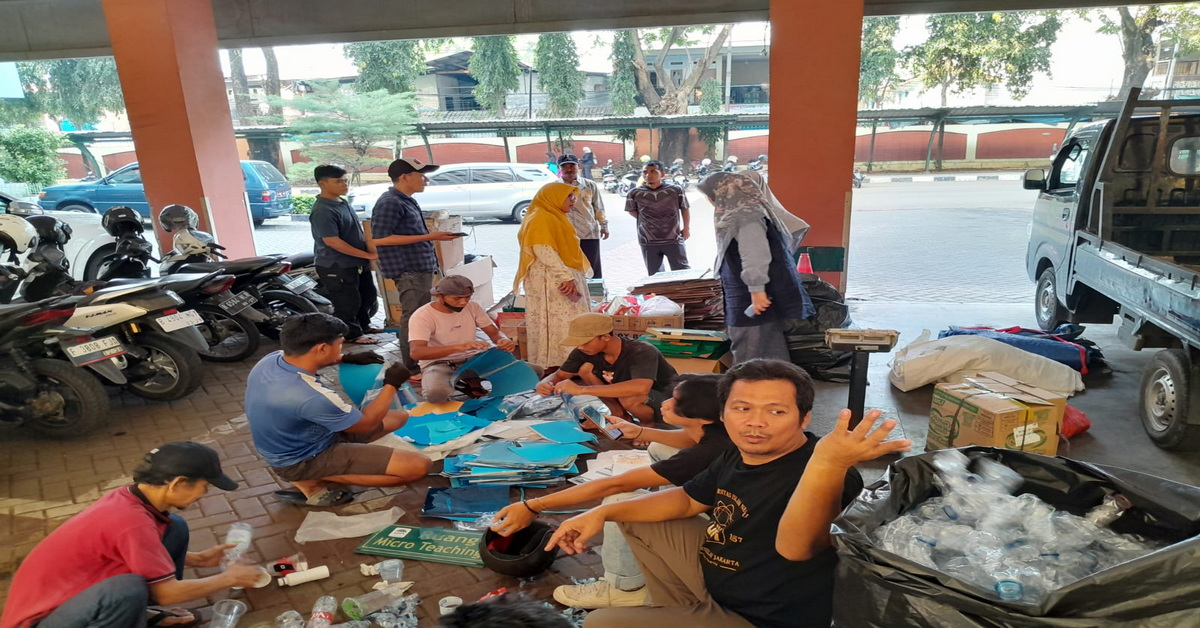
On 26 July 2024, the Faculty of Education and Teacher Training (FITK) launched the FITK Lestari Waste Bank programme as part of the University's Green Campus movement. The inaugural activity took place at the Faculty's parking lobby and involved students, academic personnel, administrative staff, and waste-management participants.
The programme was supported by awareness activities involving the Environmental Agency of South Tangerang City. A significant feature of the initiative was the collection, segregation, and weighing of recyclable materials.
The materials accepted through the waste bank included plastic, paper, metal, and electronic waste. Rather than disposing of these materials directly as residual waste, the programme sought to send them for further processing according to their respective material categories. The Faculty also expressed an intention to organise waste bank activities periodically. The initiative provides practical evidence of waste measurement within a faculty-level recycling programme.
By weighing recyclable materials, the waste bank contributes to a more measurable approach to material recovery and the reduction of waste requiring final disposal.


4. Promoting Organic Waste Recovery and Composting
UIN Jakarta also supports waste reduction through education on the processing of organic materials.
On 14 November 2024, the University's Green Campus team organised training on transforming organic waste into compost. The programme introduced the use of Black Soldier Fly larvae, commonly known as maggots, as a biological method for processing organic materials.
Students, lecturers, and administrative personnel participated in discussions and practical learning activities. The training explained how organic waste could potentially be converted into compost and other useful products rather than being discarded directly.
This educational initiative complements the University's formal waste-management framework by increasing understanding of material recovery.
While the event demonstrates institutional capacity-building, it should not be treated as a verified measurement of the total amount of organic waste diverted from landfill.
5. Expanding Waste Collection Infrastructure in 2025
On 19 July 2025, UIN Jakarta announced the expansion of waste-segregation facilities across its campus environment. The University increased the availability of separate collection bins for organic, inorganic, and hazardous waste.
These facilities were intended for locations experiencing regular campus activity, including academic buildings, canteens, mosques, and student gathering areas. The University's Green Campus leadership explained that expanded waste segregation would help improve recycling opportunities and reduce the burden placed on final disposal sites. This initiative strengthened the physical infrastructure needed to separate different waste categories at their source.
The availability of dedicated collection facilities provides a practical foundation for future waste measurement and monitoring.
6. Strengthening Waste Management Knowledge and Skills
On 2 October 2025, the UIN Jakarta Center for Green Campus Development organised a waste-management training programme. The event discussed methods for managing different categories of waste and the potential use of recycling technologies.
Participants were encouraged to separate organic and inorganic waste before further processing. University representatives highlighted the importance of developing waste-management knowledge and encouraging the academic community to apply responsible practices.
Such training contributes to institutional awareness of recycling, material recovery, and waste-reduction practices.
It also supports the development of human resources capable of participating in a more systematic campus waste-management programme.

7. Developing Integrated Waste Management Partnerships
On 20 October 2025, UIN Jakarta entered into a cooperation agreement with PT Garudha Panglimo Nuswantara to develop integrated campus waste-management arrangements.
The agreement included cooperation on waste segregation, collection, treatment, and reuse of organic and inorganic materials.
It also included technical assistance related to hazardous waste and environmental education for the academic community.
The initiative was preceded by discussions involving University stakeholders and other relevant parties concerning the development of an independent integrated waste-management facility.
The partnership reflects an institutional effort to improve waste recovery and reduce dependence on conventional disposal arrangements.
The October 2025 agreement represents a development milestone; the subsequent operation of the waste-processing facility should be evaluated separately.
8. Strengthening Measurement of Landfill and Recycled Waste
A comprehensive landfill-management policy requires reliable information concerning the destination and treatment of campus-generated waste.
For Indicator 12.2.4, two categories of information are particularly important:
Waste sent to landfill: The quantity of residual waste transferred from University facilities to final disposal sites.
Waste recycled or recovered: The quantity of materials collected for recycling or other recognised recovery processes.
UIN Jakarta's formal waste-management guidelines establish a basis for segregation, waste reduction, and recycling.
The FITK Lestari Waste Bank also provides a documented example of recyclable-material weighing.
However, available public documentation does not yet establish a comprehensive University-wide policy explicitly requiring separate measurement and reporting of both landfill-bound and recycled waste during 2024–2025.
Additional records, including waste collection logs, weighing reports, recycling receipts, and final-disposal documentation, would strengthen the University's ability to demonstrate full implementation of the indicator.
9. Supporting Continuous Improvement in Campus Waste Management
The University's waste-management programmes demonstrate progressive efforts to integrate environmental responsibility into institutional operations.
The 2024 Rector's Circular Letter provides a formal policy foundation.
Faculty-level waste bank activities demonstrate the collection and weighing of recyclable materials.
Campus-wide segregation initiatives support more systematic handling of different waste streams.
Environmental training strengthens the capacity of the academic community to participate in responsible waste management.
The 2025 integrated waste-management partnership provides an additional basis for further institutional development.
Together, these measures create opportunities to improve waste data collection, evaluate recycling performance, and identify practical ways to reduce residual waste.
Future reporting that consistently distinguishes landfill disposal from material recycling would make the University's progress more measurable.
10. Contribution to SDG 12: Responsible Consumption and Production
Syarif Hidayatullah State Islamic University Jakarta demonstrates a commitment to responsible waste management through institutional policies, material segregation, recycling initiatives, and environmental education.
Rector's Circular Letter Number 23 of 2024 establishes a formal basis for waste reduction, organic and inorganic waste processing, and implementation of the reduce, reuse, and recycle principles.
The FITK Lestari Waste Bank, launched in July 2024, provides documented evidence of recyclable-material segregation and weighing.
Additional waste-segregation infrastructure, waste-management training, and institutional collaboration during 2025 further strengthened the University's approach.
Together, these initiatives demonstrate that UIN Jakarta has established waste-management policies and implemented practices intended to increase recycling and reduce the amount of waste requiring landfill disposal.
These measures support Sustainable Development Goal 12, particularly Indicator 12.2.4.
Further formal documentation of the quantities of waste sent to landfill and recycled would strengthen evidence of full compliance with the indicator's waste-measurement requirements.
Evidence Sources
1. Primary Institutional Policy — Waste Management
Syarif Hidayatullah State Islamic University Jakarta. (2024). Rector's Circular Letter Number 23 of 2024 concerning Waste Management.
The policy provides institutional directions for waste reduction, segregation, reuse, recycling, and environmentally responsible waste handling across the University.
https://biroauk.uinjkt.ac.id/id/dokumen
Supporting institutional report:
https://asset.uinjkt.ac.id/uploads/fmXyXwZY/2025/02/Laporan-Kinerja-UIN-JAKARTA-2024-PUBLISH.pdf
2. FITK Lestari Waste Bank — Recycling and Waste Measurement
Faculty of Education and Teacher Training, UIN Jakarta. (26 July 2024). Bank Sampah FITK Lestari Wujudkan Gerakan Green Campus di UIN Jakarta.
The programme documented the segregation, collection, and weighing of recyclable materials including paper, plastic, metals, and electronic waste.
https://fitk.uinjkt.ac.id/id/bank-sampah-fitk-lestari-wujudkan-gerakan-green-campus-di-uin-jakarta
3. University Waste Management Programme
Syarif Hidayatullah State Islamic University Jakarta. (30 October 2024). Waste Management.
The publication describes the University's segregation of organic, inorganic, and hazardous waste and its approach to recycling and responsible waste management.
https://uinjkt.ac.id/id/pengelolaan-limbah
4. Expansion of Segregated Waste Facilities
Syarif Hidayatullah State Islamic University Jakarta. (19 July 2025). Green Campus Initiative: UIN Jakarta Expands Organic, Inorganic, and Hazardous Waste Bins.
The initiative expanded source segregation facilities across University buildings and public activity areas to improve recycling and reduce waste reaching final disposal sites.
5. Waste Management Training
Syarif Hidayatullah State Islamic University Jakarta. (2 October 2025). UIN Jakarta Strengthens Green Campus Initiative through Waste Management Training.
The activity strengthened institutional knowledge of organic processing, recycling, and environmentally responsible waste management.
6. Integrated Waste Management Cooperation
Syarif Hidayatullah State Islamic University Jakarta. (20 October 2025). UIN Jakarta and PT Garudha Panglimo Nuswantara Establish Integrated Waste Management Cooperation.
The cooperation covers waste segregation, collection, processing, reuse, technical assistance, and development of integrated campus waste-management practices.