
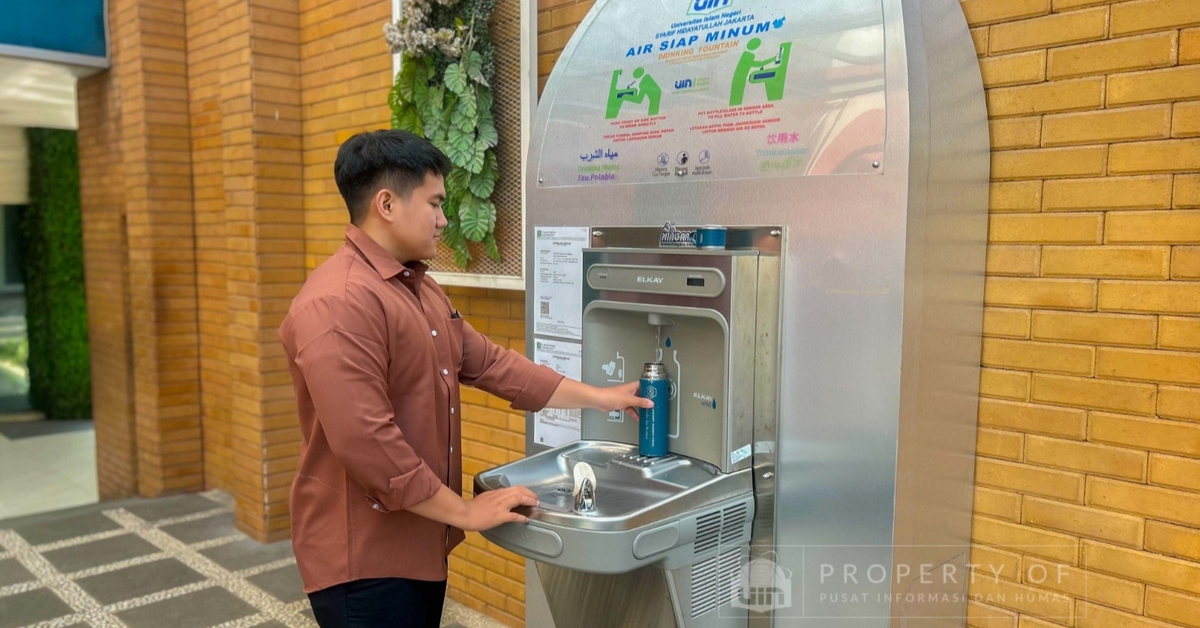
Providing Free and Safe Drinking Water across Syarif Hidayatullah State Islamic University Jakarta
Syarif Hidayatullah State Islamic University Jakarta is committed to providing accessible, safe, and free drinking water for its academic community while reducing dependence on single-use plastic bottles. Access to safe drinking water is essential for health, well-being, and an inclusive campus environment. At the same time, providing refill facilities encourages students and staff to use reusable bottles and reduces the environmental impacts associated with bottled-water consumption.
During 2024–2025, Syarif Hidayatullah State Islamic University Jakarta strengthened its drinking-water provision through institutional plastic-reduction policies, water dispensers, and dedicated Water Drinking Fountain facilities distributed across campus locations. These initiatives contribute to Sustainable Development Goal 6: Clean Water and Sanitation, particularly Indicator 6.3.3 concerning the provision of free drinking water.
1. Providing Free Drinking Water across Campus
Syarif Hidayatullah State Islamic University Jakarta provides Water Drinking Fountain facilities that allow members of the academic community to refill reusable drinking bottles without purchasing bottled water. In July 2025, the University officially documented the availability of these facilities at strategic locations including faculty buildings, the University library, and other supporting facilities.
The Head of the Green Campus Center, Professor Hendrawati, explained that the facilities were provided to enable members of the University community to obtain clean drinking water that is easily accessible and free of charge. This provision supports students, lecturers, and administrative personnel during their daily activities on campus.
The facilities also encourage users to carry reusable bottles and reduce their consumption of disposable plastic drinking-water containers.
2. Expanding Drinking-Water Facilities across Faculties
Free drinking-water provision has been implemented at faculty level. The Faculty of Social and Political Sciences activated its ready-to-drink water facility in early May 2025. Located in the ground-floor lobby, the facility allows members of the faculty community to refill their bottles at no cost.
The Faculty described the service as both an environmental initiative and a practical facility supporting daily drinking-water needs. In June 2025, the Faculty of Psychology also documented the installation of a Water Drinking Fountain.
The Faculty reported that similar facilities had been distributed across Syarif Hidayatullah State Islamic University Jakarta faculties. This distribution demonstrates an institutional effort to make refillable drinking water available beyond a single building or administrative area.
3. Ensuring Drinking-Water Safety through Laboratory Testing
Providing free drinking water requires appropriate attention to water quality and user safety. Syarif Hidayatullah State Islamic University Jakarta 's Water Drinking Fountain facilities use filtration systems designed to provide clean water suitable for consumption. The University documented laboratory testing conducted by PT Unilab Perdana on a Reverse Osmosis drinking-water sample from a facility located in the Academic Services Corridor.
Testing was conducted from 12 to 19 December 2024 under Test Report Number LPUP21680. The results reported that the tested physical, chemical, and microbiological parameters complied with drinking-water quality requirements under Indonesian Ministry of Health Regulation Number 2 of 2023.
Parameters included nitrate, nitrite, heavy metals such as arsenic, lead, cadmium and aluminium, as well as microbiological indicators including Escherichia coli and Total Coliform.
This testing provides evidence that the University's drinking-water provision is supported by water-quality verification.
4. Supporting Refillable Water through Institutional Policy
The University's provision of refillable drinking water is also supported by its plastic-waste reduction policy. Rector's Circular Letter concerning Plastic Waste Reduction, effective from 9 July 2024, directs University units not to routinely provide plastic bottled water during meetings, seminars, workshops, and other campus activities.
Instead, the policy encourages the provision of water dispensers, drinking glasses, and reusable glass bottles in meeting rooms. Members of the University community are also encouraged to carry their own reusable drinking bottles or tumblers. These measures connect access to drinking water with responsible consumption and waste prevention.
By providing refill facilities while reducing bottled-water use, Syarif Hidayatullah State Islamic University Jakarta addresses both health and environmental sustainability.
5. Supporting Student Access to Drinking Water
Students are among the principal users of the University's free drinking-water facilities. The facilities allow students to refill bottles throughout the academic day rather than repeatedly purchasing packaged drinking water. A student interviewed in the University's July 2025 publication described the Water Drinking Fountain as practical and economical, particularly during lunch hours.
The availability of refill facilities may therefore reduce students' routine spending on packaged water while supporting healthy hydration.
Free access also helps ensure that drinking water is available independently of students' ability or willingness to purchase bottled beverages.
6. Reducing Plastic Waste through Refill Stations
The Water Drinking Fountain programme also contributes to the University's efforts to reduce single-use plastics. Disposable plastic water bottles can create substantial waste when used daily across a large university community.
By encouraging users to bring reusable tumblers and bottles, drinking-water stations provide an alternative to packaged water. The University explicitly connects the provision of these facilities with its Green Campus programme and its objective of reducing disposable plastic waste.
The initiative therefore creates a link between SDG 6 on clean water and SDG 12 on responsible consumption and production.
7. Integrating Free Drinking Water into Green Campus Development
Syarif Hidayatullah State Islamic University Jakarta 's drinking-water provision forms part of a broader Green Campus strategy. The University combines drinking-water access with policies concerning water management, plastic reduction, waste management, and environmental awareness.
Refill stations provide a practical environmental service that can be used during normal academic activities. Their placement in faculties, academic service areas, libraries, and other strategic facilities improves accessibility and encourages habitual use.
The programme demonstrates how sustainable infrastructure can simultaneously improve campus services and reduce environmental impacts.
8. Maintaining Drinking-Water Quality
Continued operation of free drinking-water facilities requires regular maintenance and quality assurance. Filtration components must be maintained appropriately, and drinking-water quality should continue to be monitored against applicable health standards. The University's documented laboratory testing provides an important foundation for this process.
Continued testing at different refill locations would further strengthen the University's evidence that free drinking water remains safe and consistently available.
Publicly displaying or publishing testing results can also strengthen user confidence in refill facilities.
9. Contribution to SDG 6: Clean Water and Sanitation

Syarif Hidayatullah State Islamic University Jakarta demonstrates a clear commitment to providing accessible and safe drinking water through its Water Drinking Fountain programme and associated refill facilities. The University provides drinking water free of charge at strategic campus locations, including faculty buildings, library areas, and supporting facilities.
Water-quality testing conducted in December 2024 demonstrated compliance of a tested Reverse Osmosis water sample with applicable Indonesian drinking-water quality requirements. The programme is supported by the University's plastic-reduction policy, which encourages water dispensers and reusable drinking containers instead of disposable plastic bottled water.
Together, these measures demonstrate that Syarif Hidayatullah State Islamic University Jakarta provides free drinking water while promoting healthy hydration, water safety, and environmentally responsible consumption. Through these initiatives, the University contributes to Sustainable Development Goal 6, particularly Indicator 6.3.3 concerning the provision of free drinking water for members of the University community.
1. Main Evidence — University-Wide Water Drinking Fountain Provision
Syarif Hidayatullah State Islamic University Jakarta. (22 July 2025). Perkuat Green Campus, Syarif Hidayatullah State Islamic University Jakarta Hadirkan Fasilitas Water Drinking Fountain.
2. Faculty-Level Evidence — FISIP
Faculty of Social and Political Sciences. (4 June 2025). Water Drinking Fountain: Untuk Menciptakan Green Campus.
https://fisip.uinjkt.ac.id/index.php/id/water-drinking-fountain-untuk-menciptakan-green-campus
3. Faculty-Level Evidence — Faculty of Psychology
Faculty of Psychology. (6 June 2025). Fakultas Psikologi Syarif Hidayatullah State Islamic University Jakarta Kurangi Botol Plastik dengan Water Drinking Fountain.
4. Institutional Policy and 2024 Evidence
Syarif Hidayatullah State Islamic University Jakarta. (2024). Rector's Circular Letter concerning Plastic Waste Reduction.
Available through the University's 2024 Performance Report.