
Leiden University Appoints UIN Jakarta Philologist to Elite Doctoral Examination Board
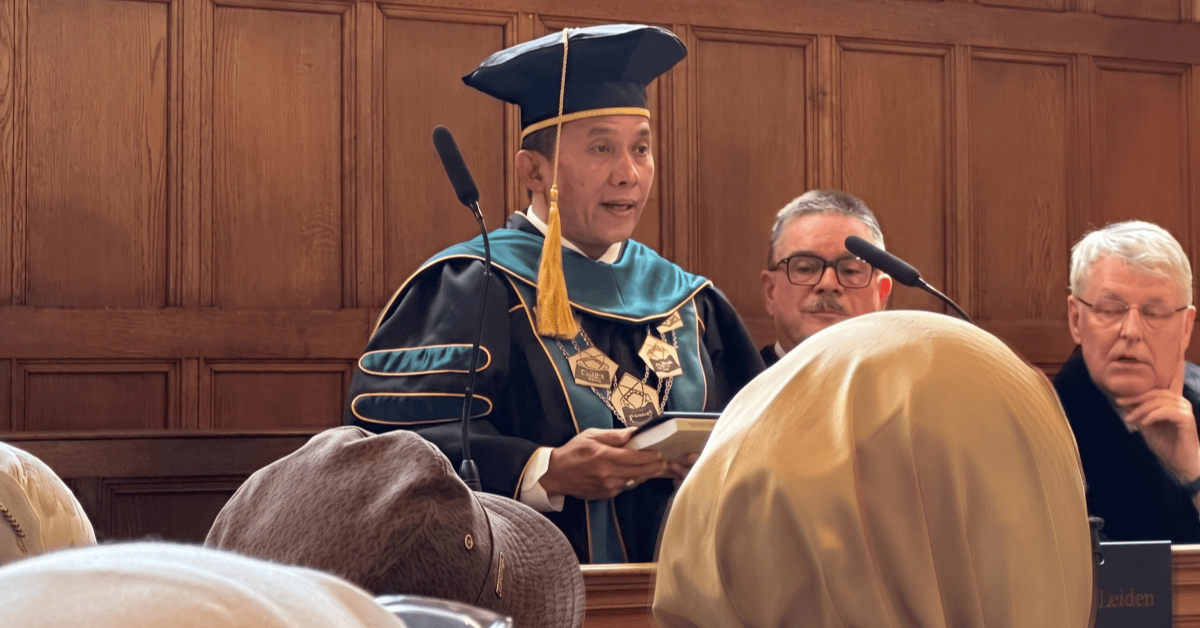
LEIDEN, UIN Online News– Highlighting the expanding global authority of Indonesian scholars in Transnational Islamic Studies, Professor of Philology from UIN Syarif Hidayatullah Jakarta, Professor Oman Fathurahman, Ph.D., was appointed as a distinguished external examiner for a doctoral defense at Leiden University in the Netherlands. His involvement on the doctoral panel underscores global recognition for his academic authority in Southeast Asian codicology and the intellectual history of Islam Nusantara.
The defense, held at the historic Groot Auditorium on Rapenburg, evaluated the doctoral dissertation of Nur Ahmad, an Indonesian scholar completing his Ph.D. at Leiden. His landmark research, titled “Javanese Mystical Qurʾān Interpretation: Kyai Saleh Darat’s (d. 1903) Fayḍ al-Raḥmān and the Javanese Mystical World,” dissects the profound text of Kyai Saleh Darat, a prolific 19th-century polymath who famously educated some of Indonesia’s most defining national figures, including the pioneering feminist R.A. Kartini, as well as the founders of Indonesia's largest Islamic organizations, KH Ahmad Dahlan of Muhammadiyah and KH Hasyim Asy’ari of Nahdlatul Ulama.
Professor Fathurahman served on the elite academic committee alongside world-renowned Western orientalists and Islamic studies experts, including Professor Nico J. Kaptein, Professor Ben Arps, Professor Edwin P. Wieringa, and Professor Johanna Pink.
During the rigorous interrogation phase, Professor Fathurahman challenged the candidate regarding Kyai Saleh Darat’s precise theological positioning toward the highly controversial Wahdatul Wujud (Unity of Existence) or Akbarian Sufi doctrines pioneered by Ibn 'Arabi which dominated the Javanese mystical landscape during the 19th century.
"I was instantly drawn to this defense because it interrogates the exact point where scriptural Islamic exegesis intersects with local Javanese cosmology," Professor Fathurahman remarked. "The intellectual debates between scholars like Kyai Saleh Darat and his contemporaries prove that the Islamization of Southeast Asia was not a passive reception, but a highly dynamic, sophisticated, and pluralistic intellectual dialogue."
This research provides a vital, modern counter-weight to mid-century Western anthropological paradigms—most notably Clifford Geertz's classic categorization in The Religion of Java—by showing how deep orthodox scriptural knowledge and profound Javanese mysticism were seamlessly harmonized by local ulama, rather than existing as fragmented cultural divides.
Leiden University has long been recognized as the world's largest repository for ancient Indonesian and Malay manuscripts. Professor Fathurahman’s presence as an opponent on this doctoral board signals a vital paradigm shift, where Indonesian scholars are no longer just the subjects of Western research, but the ultimate authorities validating it.
He emphasized that this defense proves the absolute necessity of his signature academic methodology known as Philology Plus.
"Classical manuscript text translation is no longer enough," Professor Fathurahman asserted. "To be relevant to global academia, philology must be combined with multidisciplinary tools, such as digital humanities, sociology, and political philosophy. Its goal is to unlock how ancient written heritages actively shape modern socio-religious behavior."
Professor Fathurahman’s global authority in this field is well-established. Beyond his chair at UIN Jakarta, he is the driving force behind DREAMSEA (Digital Repository of Endangered and Affected Manuscripts in Southeast Asia), a massive transnational initiative dedicated to digitizing vulnerable manuscripts across the region. His efforts to democratize ancient texts through digital media earned him the prestigious Habibie Prize for Philosophy, Religion, and Culture.
By anchoring its top faculty members at the core of elite European doctoral boards, UIN Jakarta continues to solidify its reputation as a world-class research university. The event serves as a powerful demonstration of academic diplomacy, proving that Indonesian higher education is leading the global discourse on how local traditions and universal faith coalesce into a vibrant, resilient civilization.
(Zaenal/Arifin)