From Carbon Accounting to Climate Action: Strengthening Emission Reduction at Syarif Hidayatullah State Islamic University Jakarta
Syarif Hidayatullah State Islamic University Jakarta is committed to addressing climate change through systematic carbon management, institutional environmental policies, renewable energy development, and sustainable transportation initiatives.
Recognising the environmental impacts associated with electricity consumption, vehicle operations, and campus infrastructure, the University has developed measures to monitor carbon dioxide emissions and promote reductions in carbon-intensive activities.
Through its Green Campus programme, Syarif Hidayatullah State Islamic University Jakarta combines institutional regulations, energy consumption records, greenhouse gas calculations, renewable energy initiatives, and environmentally responsible campus operations.
These initiatives support Sustainable Development Goal 7: Affordable and Clean Energy, particularly Indicator 7.2.3 concerning carbon management and the reduction of carbon dioxide emissions.
1. Establishing an Institutional Carbon Management Framework
Syarif Hidayatullah State Islamic University Jakarta established its Green Campus Policy through Rector's Decree Number 1415 of 2024. The policy provides an institutional framework for integrating environmental sustainability into campus management, infrastructure development, and academic activities.
This framework is strengthened by Rector's Circular Letter Number 17 of 2024 concerning Global Climate Change Mitigation and Adaptation.
The circular encourages University units to implement measures addressing the sources of greenhouse gas emissions, including electricity efficiency, renewable energy adoption, and the protection and expansion of green spaces.
Rector's Circular Letter Number 21 of 2024 concerning Energy Management provides additional guidance on improving resource efficiency and reducing unnecessary energy consumption.
Together, these documents establish an institutional policy foundation for carbon management and environmental mitigation.
2. Measuring and Monitoring Campus Carbon Emissions
An important component of the University's carbon management process is the identification and calculation of carbon dioxide emissions associated with campus operations.
Through its Green Campus reporting activities, Syarif Hidayatullah State Islamic University Jakarta evaluates emission sources associated with electricity consumption and transportation within the campus environment.
The University's 2026 Green Campus documentation reports a calculated carbon footprint of 5,902.26 metric tons of CO₂.
The reported calculation consists of:
-
Electricity-related emissions: 4,126.60 metric tons of CO₂.
-
Car-related emissions: 353.76 metric tons of CO₂.
-
Motorcycle-related emissions: 1,421.90 metric tons of CO₂.
-
Bus-related emissions under the reporting method: 0 metric tons of CO₂.
The calculation follows an approach documented in the University's UI GreenMetric evidence.
The electricity component uses 4,912,621 kWh recorded from November 2025 to June 2026. Therefore, the 2026 carbon footprint should be understood as a calculation based on the documented reporting inputs rather than a verified full-calendar-year greenhouse gas inventory.
These calculations nevertheless demonstrate that the University has established a process for identifying major emission sources and assessing their contribution to campus carbon impacts.
3. Reducing Electricity Consumption through Energy Management
Electricity consumption is an important contributor to the University's calculated operational carbon emissions.
To address this source, Syarif Hidayatullah State Islamic University Jakarta monitors institutional electricity consumption and implements energy conservation measures.
According to the University's Green Campus electricity records, total electricity consumption was 9,424,866 kWh during the 2024 measurement cycle and 8,809,775 kWh during the 2025 cycle.
Both cycles represent twelve months of electricity usage.
This corresponds to a reduction of approximately 6.53 per cent between the two reporting periods.
The University's energy management initiatives include encouraging efficient electricity use, improving lighting technologies, promoting responsible operation of electrical equipment, and increasing awareness of energy conservation among students and staff.
These actions provide a practical connection between institutional energy policies and efforts to reduce the environmental impacts associated with campus electricity consumption.
4. Expanding Rooftop Solar Energy Infrastructure
Renewable energy development is another component of the University's emission reduction strategy.
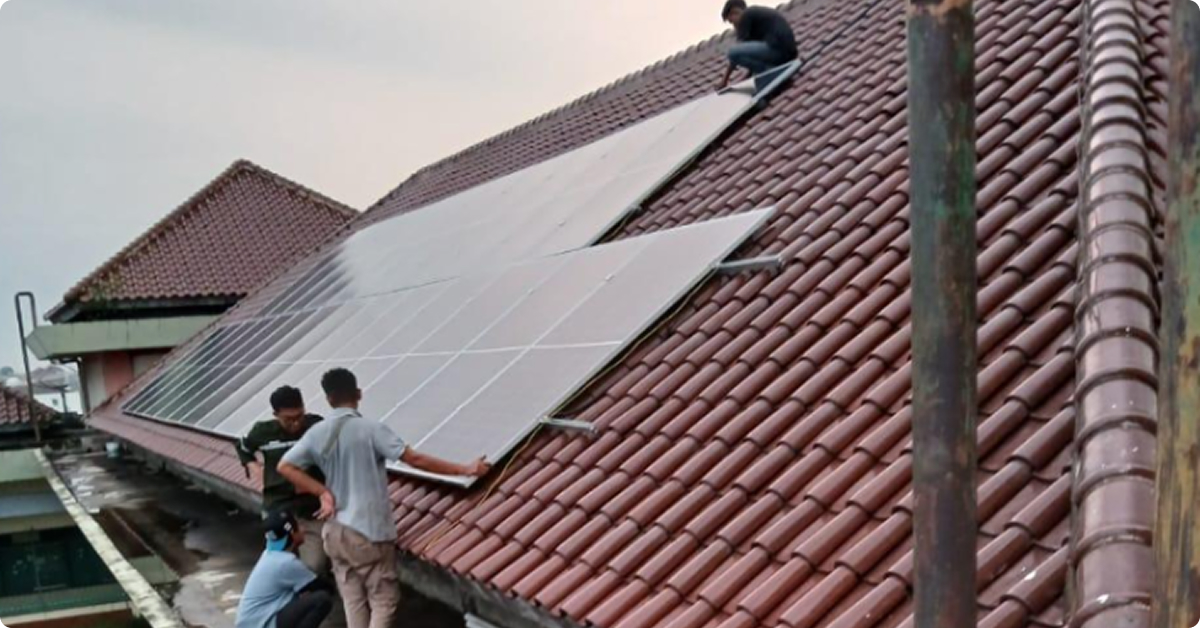
On 5 June 2025, Syarif Hidayatullah State Islamic University Jakarta signed a cooperation agreement with PT Agra Surya Energi concerning the development and leasing of rooftop solar photovoltaic systems.
The agreement covered a planned total capacity of 270.17 kWp across four major campus buildings.
The project was designed to support the University's Green Campus objectives by increasing renewable energy generation and reducing dependence on conventional electricity supply.
Subsequent institutional reporting identifies operational rooftop solar installations at the Faculty of Science and Technology and the Faculty of Education and Teacher Training, while installations at the Rectorate and Harun Nasution Auditorium were undergoing further development.
These measures demonstrate the University's approach to emission reduction through changes in its energy infrastructure.

5. Supporting Sustainable Infrastructure and Solar-Powered Facilities
The University's renewable energy initiatives extend beyond rooftop photovoltaic installations.
Green Campus documentation describes the use of solar-powered street lighting as part of sustainable campus infrastructure.
The University's subsequent institutional reporting identifies 396 solar-powered streetlights distributed across campus roads, open spaces, and parking facilities.
These lighting systems operate independently of the conventional electricity grid, helping reduce electricity demand from the main supply.
The University also promotes energy-efficient lighting, natural daylight utilisation, and improvements in building management.
Together, these measures support more sustainable infrastructure operations and contribute to the University's broader carbon management strategy.
6. Promoting Low-Emission Transportation
Transportation is another important source of emissions identified in the University's carbon calculations.
Syarif Hidayatullah State Islamic University Jakarta promotes environmentally responsible mobility through transport management and the development of electric campus transportation.
Rector's Circular Letter Number 16 of 2024 concerning Transportation Management provides part of the University's institutional framework for managing campus mobility.
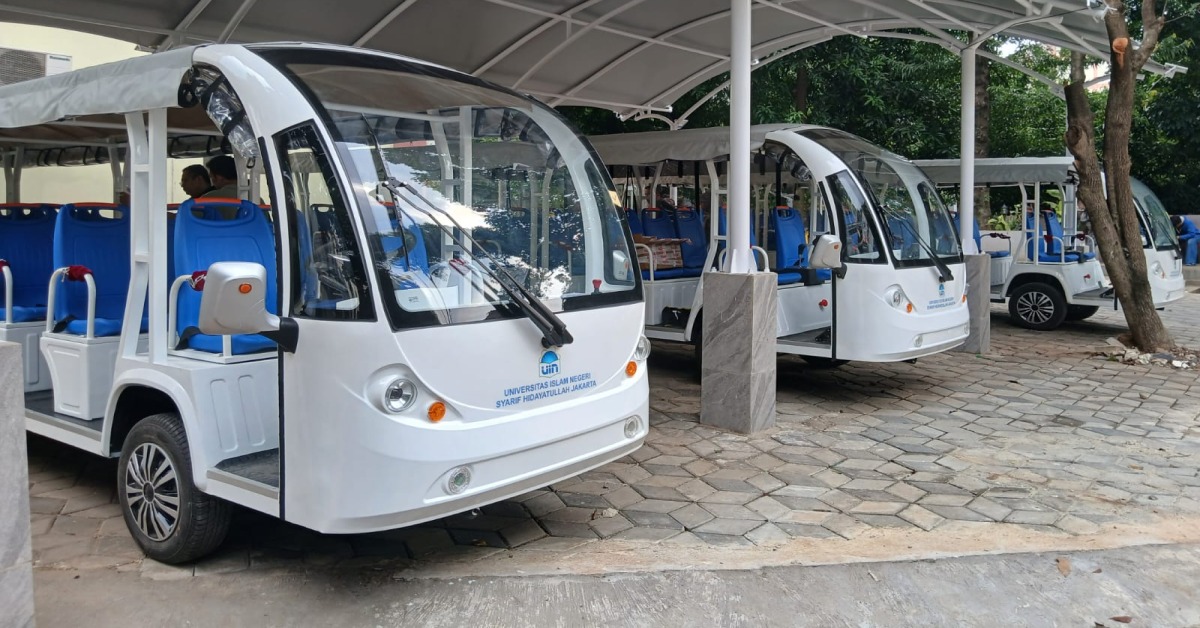
The University also operates electric shuttle buses, locally known as BILIS, to provide transportation services within campus areas.
On 25 December 2025, the University announced the addition of three electric shuttle buses, bringing its reported fleet to six units.
Electric shuttle services provide an alternative to conventional fuel-powered transportation and support efforts to reduce local exhaust emissions within campus operations.
However, the amount of carbon dioxide avoided through these services has not been separately verified in the available documentation.
7. Extending Carbon Reduction Initiatives to Local Communities
The University's environmental commitments also extend beyond its campus boundaries.
On 25 August 2025, the Social Trust Fund of Syarif Hidayatullah State Islamic University Jakarta, in partnership with PT Tokio Marine Life Insurance, inaugurated a solar panel installation at Cercondeso Hall in Cidokom Village, Bogor Regency.
The installation formed part of a Green Village initiative supporting rural environmental sustainability, renewable energy adoption, and community empowerment.
The project's documentation estimates that the installed solar energy system could avoid approximately 4,180 kilograms of CO₂ emissions annually.
This is a projected environmental benefit, rather than a verified measurement of actual annual emission reductions.
The programme also involved tree-planting activities with local children through the Green Rangers initiative and environmental education connected to responsible plastic waste management.
The Green Village project demonstrates how the University's carbon reduction commitments can support environmental improvements and community engagement beyond campus operations.
Because this project is located off campus, its estimated emission savings are reported separately from the University's campus carbon footprint.
8. Strengthening Monitoring and Environmental Accountability
Effective carbon management requires consistent monitoring, reliable reporting boundaries, and periodic evaluation of emission reduction measures.
The University's Green Campus documentation provides information on electricity consumption, transportation-related emissions, and renewable energy initiatives.
These records allow the University to identify emission-intensive activities and develop interventions that support improved environmental performance.
The available documentation establishes a carbon calculation process, although further verification would strengthen reporting consistency.
Important opportunities for improvement include developing comparable twelve-month emission inventories, documenting emission factors and measurement boundaries, monitoring renewable energy generation, and evaluating the verified impacts of individual reduction programmes.
These measures would help distinguish reductions in electricity consumption from reductions in total greenhouse gas emissions.
Strengthened reporting would also support greater transparency and accountability in the University's long-term climate action programmes.
9. Contribution to SDG 7: Affordable and Clean Energy
Syarif Hidayatullah State Islamic University Jakarta demonstrates a documented commitment to carbon management through institutional policies, emission calculations, electricity conservation, renewable energy development, and sustainable transportation.
Rector's Decree Number 1415 of 2024 establishes the Green Campus Policy, supported by further circular letters addressing climate change mitigation, energy management, and transportation.
The University's electricity records demonstrate a reduction in grid electricity consumption between the 2024 and 2025 reporting cycles.
Its renewable energy initiatives include a rooftop solar development partnership signed in June 2025 and the continued implementation of sustainable energy infrastructure.
The University also operates electric campus shuttle services and supports community-based solar energy initiatives. More recent Green Campus reporting provides calculations of emissions associated with electricity consumption and campus transportation.
Together, these institutional policies, monitoring practices, and operational initiatives demonstrate that Syarif Hidayatullah State Islamic University Jakarta has established a process for carbon management and for implementing measures intended to reduce carbon dioxide emissions.
These efforts contribute to Sustainable Development Goal 7, particularly Indicator 7.2.3, while providing a foundation for continued improvements in greenhouse gas monitoring and sustainable campus operations.
Source :
https://uinjkt.ac.id/en/fulfilling-green-campus-commitment-uin-jakarta-signs-rooftop-solar-power-plant-cooperation
https://www.uinjkt.ac.id/index.php/id/energi-dan-perubahan-iklim
https://ppid.uinjkt.ac.id/id/penuhi-layanan-mobilitas-sivitas-uin-jakarta-tambah-tiga-bilis-anyar