Extending Disposable-Waste Reduction Policies to Campus Services and External Partners
Syarif Hidayatullah State Islamic University Jakarta is committed to reducing disposable materials and plastic waste not only through individual behaviour within the academic community but also through the involvement of service operators and external partners supporting University activities.
The University recognises that meaningful waste reduction requires coordinated action across campus operations. Food services, event consumption, waste collection, and other supporting services can generate significant quantities of disposable packaging and materials.
During 2024–2025, the University strengthened its Green Campus framework through formal plastic-reduction and waste-management guidelines, engagement with campus food-service operators, expanded waste-segregation facilities, and collaboration with external waste-management partners.
These initiatives contribute to Sustainable Development Goal 12: Responsible Consumption and Production, particularly Indicator 12.2.7 concerning the extension of disposable-item minimisation policies to outsourced services and the supply chain.
1. Establishing a Formal Plastic-Waste Reduction Policy
On 9 July 2024, Syarif Hidayatullah State Islamic University Jakarta issued Rector's Circular Letter Number 09 of 2024 concerning Plastic Waste Reduction. The policy establishes institutional measures intended to reduce single-use plastics across University activities.
Its provisions include avoiding plastic bottled drinking water during meetings, seminars, workshops, and other campus activities. University units are encouraged to provide water dispensers, drinking glasses, and reusable glass bottles in meeting rooms. Members of the University community are also encouraged to reduce their consumption of food and beverages packaged in plastic and to carry reusable drinking bottles.
These measures establish an institutional approach in which disposable-product reduction is incorporated into the provision of campus activities and services.
2. Extending Waste-Reduction Practices to Campus Food Services
An important provision of Rector's Circular Letter Number 09 of 2024 specifically addresses campus food-service operations.
The policy directs relevant University units to educate canteen operators regarding the segregation of organic and inorganic waste and the reduction of waste generation. This provision is particularly relevant to the extension of environmental practices beyond individual University employees.
Canteens represent service operations in which food packaging, beverage containers, and disposable materials can contribute significantly to campus waste generation. By explicitly including canteen operators within the implementation of waste-management practices, the University extends its environmental expectations to service providers operating within the campus environment.
The provision demonstrates that plastic- and waste-reduction initiatives are not limited exclusively to academic or administrative staff.
3. Reinforcing Service-Level Waste Management through the 2024 Waste Policy
On 21 October 2024, the University strengthened this framework through Rector's Circular Letter Number 23 of 2024 concerning Waste Management. The regulation implements the University's Green Campus Policy and establishes additional directions for sustainable waste handling.
It reiterates the importance of educating canteen operators to segregate organic and inorganic waste and reduce waste generation. The regulation also encourages the collection and processing of organic and inorganic materials, limits unnecessary waste generation, and promotes reuse through the principles of reduce, reuse, and recycle.
Together, Rector's Circular Letters Number 09 and Number 23 of 2024 demonstrate a coordinated institutional effort to incorporate food-service operations into the University's wider waste-minimisation framework.
4. Reducing Disposable Materials in Campus Activities
The University's policy also addresses consumption associated with institutional events.
Plastic bottled water should not be routinely provided during meetings, seminars, workshops, and other University activities. Instead, campus units are encouraged to use water dispensers and reusable drinking containers.
This approach has implications for service arrangements supporting University events. Meeting organisers, consumption providers, and other parties responsible for event-related services are required to operate within an environment in which the University has formally prioritised reducing disposable plastic.
The policy therefore creates an institutional expectation that service arrangements should support reusable alternatives wherever practicable.
5. Communicating Reusable Practices across the Campus Community
In September 2024, the University's Green Campus Team publicly reinforced the implementation of its plastic-reduction policy.
The University encouraged members of the academic community to minimise plastic use by carrying reusable drinking bottles and reusable eating utensils. This public communication was explicitly linked to Rector's Circular Letter Number 09 of 2024. The initiative helped translate the written policy into everyday operational practices.
It also strengthened awareness that waste reduction depends on changes in the way food, beverages, and other services are consumed across campus.

6. Supporting Waste Segregation in Food-Service Areas
In July 2025, UIN Jakarta expanded the availability of segregated waste bins for organic, inorganic, and hazardous waste.
The initiative specifically recognised waste generated from food and beverage activities across campus, including canteens and other areas with high levels of daily activity.
Organic waste, plastic packaging, food residues, and other materials require different treatment and recovery processes.
The expanded facilities provide service operators and campus users with infrastructure to support source separation.
This implementation complements the University's earlier policy requirement to educate canteen operators on waste segregation and reduction.
7. Working with External Waste-Management Partners
The extension of sustainable waste practices beyond direct University operations was further demonstrated in October 2025.
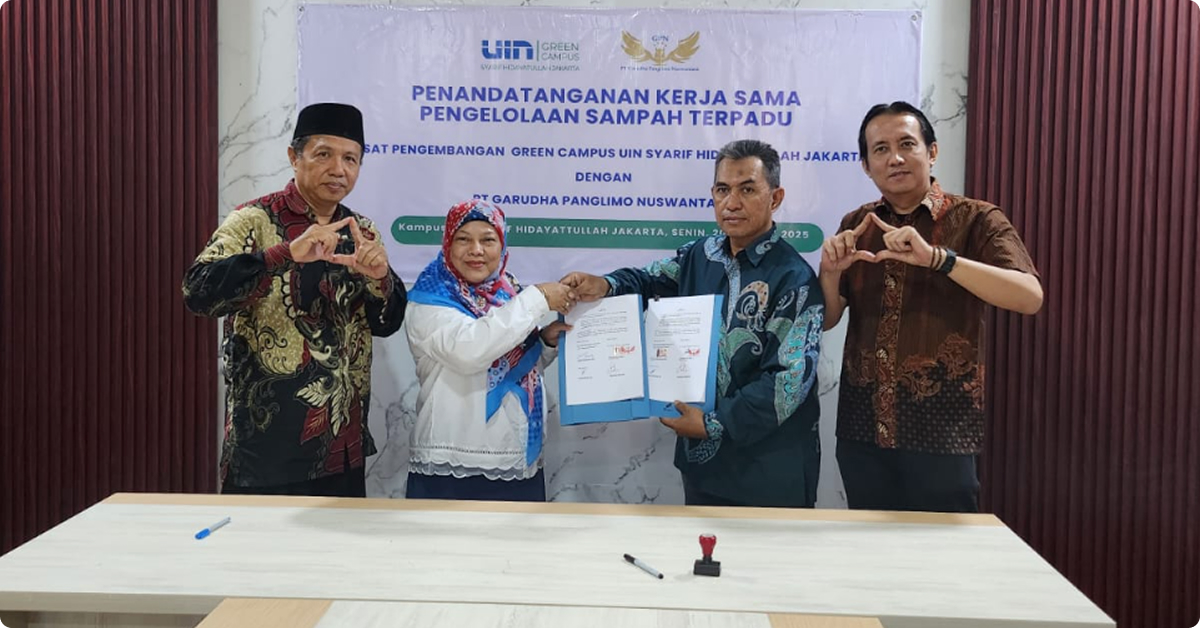
The University's Center for Green Campus Development established cooperation with PT Garudha Panglimo Nuswantara concerning integrated waste management.
The collaboration covers waste segregation, collection, processing, and reuse of organic and inorganic materials.
It also includes technical assistance related to hazardous waste management and environmental education.
This partnership demonstrates that UIN Jakarta is increasingly integrating external service partners into its environmental management activities.
The agreement complements internal waste-reduction policies by involving an external organisation in the implementation of campus waste-management objectives.
8. Strengthening External Service Engagement
The University's existing policies provide a documented basis for extending waste-reduction practices to selected service providers.
The clearest example is the explicit inclusion of campus canteen operators within the University's 2024 plastic-reduction and waste-management guidelines.
External collaboration on integrated waste management during 2025 provides further evidence that environmental responsibilities are not confined exclusively to direct University personnel.
However, available public documentation does not establish that every outsourced service contract contains a mandatory clause requiring compliance with the University's disposable-item minimisation policy.
Future procurement and service agreements could strengthen implementation by explicitly incorporating requirements concerning single-use plastics, reusable materials, waste segregation, and responsible disposal.
Such provisions would make the extension of the policy across outsourced services more systematic and auditable.
9. Supporting Responsible Consumption and Production
Reducing disposable materials requires cooperation between consumers, University units, food-service operators, and external partners.
UIN Jakarta's 2024 policies establish behavioural and operational expectations concerning plastic reduction and responsible waste management.
The inclusion of canteen operators is significant because food-service activities represent an important source of disposable packaging and organic waste.
The University's later engagement with external waste-management partners demonstrates an additional mechanism for extending sustainable practices beyond direct institutional operations.
Together, these measures contribute to a broader institutional approach in which responsible consumption is supported through both internal policy and service-level implementation.
10. Contribution to SDG 12: Responsible Consumption and Production
Syarif Hidayatullah State Islamic University Jakarta demonstrates a commitment to extending waste-reduction and disposable-item minimisation practices beyond individual members of the academic community. Rector's Circular Letter Number 09 of 2024 establishes measures to reduce single-use plastics and explicitly directs the engagement of campus canteen operators in waste segregation and waste-reduction practices.
Rector's Circular Letter Number 23 of 2024 reinforces these measures through a wider institutional waste-management framework. During 2025, the University further strengthened implementation through expanded waste-segregation infrastructure and cooperation with an external integrated waste-management partner.
Together, these measures demonstrate that UIN Jakarta extends disposable-waste reduction practices to campus service operations and engages external partners in supporting sustainable waste management. These initiatives contribute to Sustainable Development Goal 12, particularly Indicator 12.2.7.
Further incorporation of explicit waste-minimisation requirements into all outsourced service contracts would strengthen University-wide implementation and provide clearer evidence of comprehensive supply-chain coverage.
Evidence Sources
1. Primary Policy — Plastic Waste Reduction
Syarif Hidayatullah State Islamic University Jakarta. (9 July 2024). Rector's Circular Letter Number 09 of 2024 concerning Plastic Waste Reduction.
Official institutional document available through the University's Green Campus documentation and 2024 Performance Report.
https://asset.uinjkt.ac.id/uploads/fmXyXwZY/2025/02/Laporan-Kinerja-UIN-JAKARTA-2024-PUBLISH.pdf
2. Waste Management Policy
Syarif Hidayatullah State Islamic University Jakarta. (21 October 2024). Rector's Circular Letter Number 23 of 2024 concerning Waste Management.
https://biroauk.uinjkt.ac.id/id/dokumen
3. Green Campus Policy Implementation
Syarif Hidayatullah State Islamic University Jakarta. (12 September 2024). Creating a Comfortable Campus Environment: Green Campus Team Issues Environmental Guidance.
4. Waste Segregation Infrastructure
Syarif Hidayatullah State Islamic University Jakarta. (19 July 2025). Green Campus Initiative: UIN Jakarta Expands Organic, Inorganic and Hazardous Waste Bins.
5. External Waste-Management Partnership
Syarif Hidayatullah State Islamic University Jakarta. (20 October 2025). UIN Jakarta and PT Garudha Panglimo Nuswantara Establish Integrated Waste Management Cooperation.