
Burhanuddin Muhtadi Receives APSIPOL Distinguished Political Scientist Award 2026
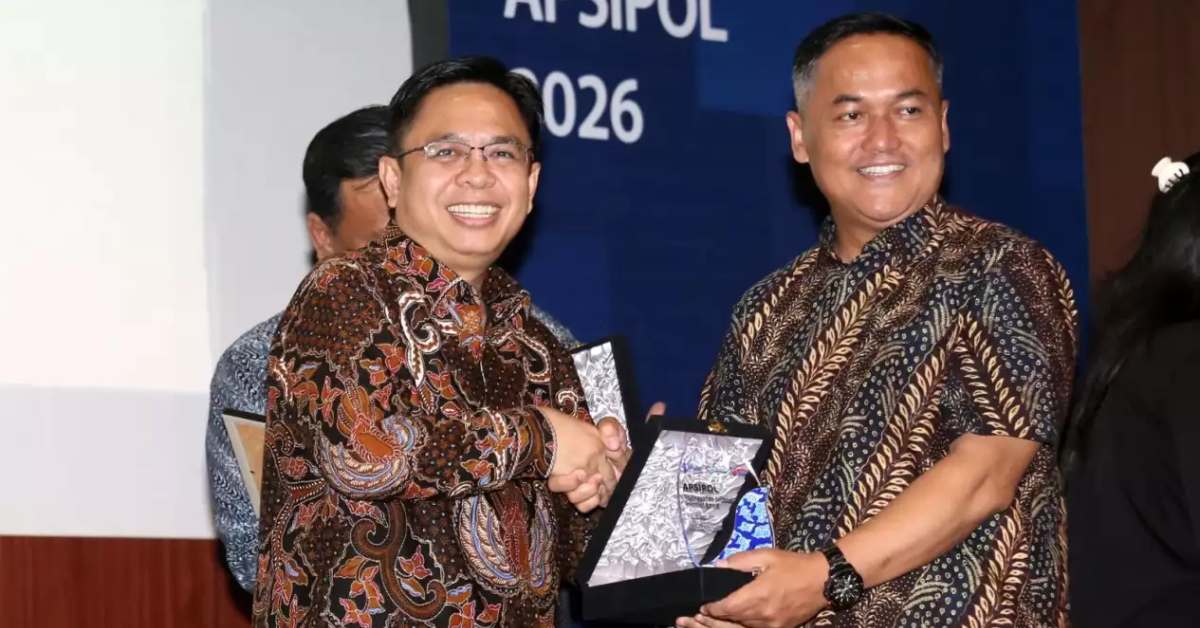
Surabaya, UIN News Online – Prof. Dr. Burhanuddin Muhtadi, Professor of Political Science at the Faculty of Social and Political Sciences (FISIP), UIN Jakarta, has received the APSIPOL Distinguished Political Scientist Award 2026 in recognition of his contributions to the development of political science through academic research and publications.
The award was presented during the National Gathering marking the 10th anniversary of the Indonesian Association of Political Science Study Programs (APSIPOL), held at ASEEC Tower, Universitas Airlangga, Surabaya, on Monday (11/02/2026).
The recognition was granted pursuant to a decree issued by the Chairperson of APSIPOL on October 31, 2026. It recognizes academics whose scholarly contributions have helped advance the discipline of political science through research, publications, and other academic work.
Beyond receiving the award, Burhanuddin delivered an academic address highlighting the importance of methodological diversity in political science research. He warned that the growing dominance of quantitative approaches in international academic journals could narrow opportunities for qualitative and historical research.
He observed that political science scholarship worldwide has increasingly relied on causal inference, experimental methods, and formal models. While these approaches have contributed to the development of the discipline, he argued that they should not come at the expense of other research traditions capable of capturing the complexity of social and political phenomena.
"From a scholarly perspective, political science may appear to be advancing rapidly, but there is a serious problem concerning methodological plurality. Methodological pluralism is increasingly eroding as political scientists become preoccupied with causal inference, experiments, and formal models," he said.
To illustrate his argument, Burhanuddin recalled advice given by University of Washington Professor Joel S. Migdal to academic Ahmet T. during research into the causes of the decline of Islamic civilization. The anecdote highlighted the distinction between generating numerical findings and developing deeper conceptual insights through qualitative inquiry.
"If you want to go for numbers, feel free to do so. If you want to develop ideas, come to me," he quoted Migdal as saying.
Burhanuddin also cautioned against the tendency to focus political research too heavily on short-term developments. He emphasized the importance of examining political dynamics over longer periods while avoiding conceptual stretching, in which concepts are applied so broadly that their analytical meaning becomes blurred.
Drawing on the scholarship of Paul Pierson and Giovanni Sartori, he stressed the need for conceptual precision when examining political phenomena such as populism and money politics. In his view, every analytical concept must have clearly defined boundaries to remain useful in rigorous academic research.
"Political phenomena cannot be examined within an excessively narrow time frame because politics is a moving target, constantly evolving," he emphasized.
In the final part of his address, Burhanuddin discussed practical strategies for making greater use of survey data produced by research organizations to support academic publication. He outlined several approaches, including incorporating academic research variables into commercial survey questionnaires, reusing existing samples through double sampling techniques, and conducting text-based analyses of political speeches.
Through these strategies, he argued, the needs of research institutions and the interests of academic scholarship can complement one another. Making effective use of available data from research organizations can also provide an alternative way to increase scholarly publication output without relying entirely on competitive research grants.
His recognition at the APSIPOL gathering underscores his contribution not only to the advancement of political science research but also to ongoing discussions about the methodological foundations of the discipline. His academic address further highlighted the importance of maintaining diverse research approaches, conceptual rigor, and broader analytical perspectives in understanding an increasingly complex political landscape.